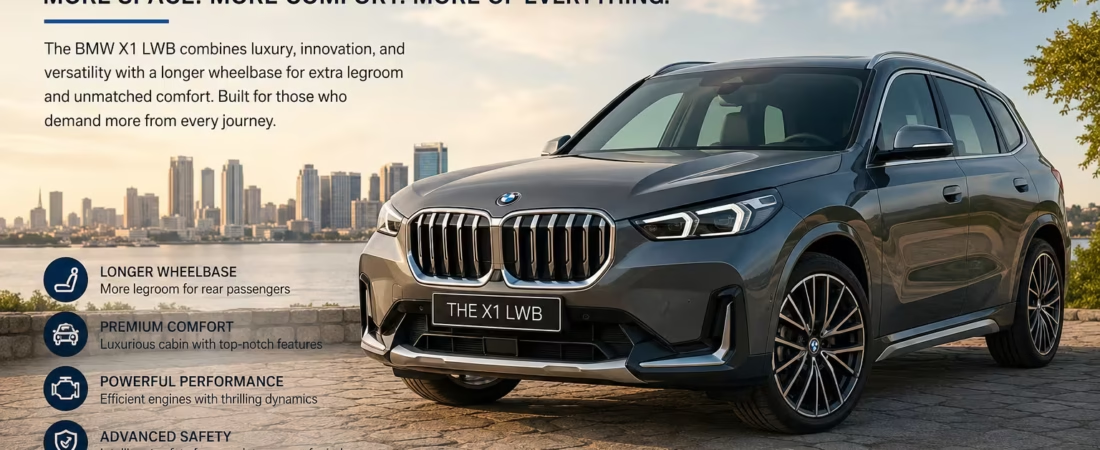
The BMW X1 LWB is set to become one of the most interesting luxury SUV launches in India in 2026. BMW India has confirmed that the new BMW X1 Long Wheelbase will be launched on 21 August 2026, with pre-launch bookings already open through the company’s authorised dealer network. Unlike the regular X1, the LWB version has been designed around a simple but increasingly important idea: give rear-seat passengers substantially more space without moving into a much larger and more expensive SUV segment.
BMW will manufacture the X1 LWB locally at its BMW Group Plant Chennai, an important detail because local production can have a significant effect on pricing and positioning in India’s luxury-car market. BMW has already used the long-wheelbase X1 formula for the electric BMW iX1 LWB, which was introduced in India in 2025. The upcoming petrol-powered X1 LWB takes the same broad packaging philosophy and brings it to customers who prefer an internal-combustion SUV.
The key change is not simply that the X1 has become longer. BMW has extended the wheelbase by roughly 110 mm compared with the standard X1, while the overall vehicle is around 116 mm longer. The result is a significantly more spacious rear compartment and a more substantial road presence. BMW itself describes the new model as its longest and most spacious vehicle in its segment.
But is a longer X1 actually better than the standard model? Does the additional rear-seat space justify paying a premium? What engine will India get? How much will the BMW X1 LWB cost? And should buyers consider it instead of an Audi Q3, Mercedes-Benz GLA, Volvo XC40 or a larger SUV?
This detailed guide examines everything that is known about the BMW X1 LWB India, while clearly separating confirmed information from specifications and prices that were still unannounced before the official launch.
BMW X1 LWB India Launch Date
BMW India has officially confirmed the launch date of the new X1 Long Wheelbase.
BMW X1 LWB launch date in India: 21 August 2026.
Pre-launch bookings opened on 10 August 2026 at 3:00 PM, and customers can book the SUV through BMW India’s authorised dealership network or register their interest through BMW’s official website. BMW has also confirmed that the vehicle will be locally produced at the company’s Chennai facility.
This is particularly significant because BMW is not entering the long-wheelbase compact luxury SUV market with an imported product. Local manufacturing gives the company more flexibility when positioning the vehicle against other premium SUVs.
At the time of writing, the official launch is still ahead, meaning the final India-specific price, variant structure and complete technical specification should be treated as launch-day information rather than assumed from international versions.
That distinction matters because several specifications circulating online are based on expectations, Chinese-market versions or mechanical components shared with related BMW Group products.
What Is the BMW X1 LWB?
The name tells you the basic idea.
LWB stands for Long Wheelbase.
A vehicle’s wheelbase is the distance between the centres of its front and rear wheels. Increasing this distance creates more room between the axles, which can then be used primarily to improve passenger space.
In the case of the BMW X1 LWB, BMW has stretched the wheelbase by approximately 110 mm compared with the standard X1. The overall length increases by about 116 mm.
That may not sound dramatic on paper, but in a compact SUV, an additional 110 mm between the axles can make a meaningful difference to rear-seat accommodation.
The concept is particularly relevant to India.
Many luxury-car buyers in India do not use their premium SUVs exclusively as driver’s cars. Families often place greater importance on:
- Rear-seat legroom
- Easy entry and exit
- Comfortable seating for adults
- Rear-seat recline
- Cabin width
- Long-distance comfort
- Chauffeur-driven usability
- A premium rear-seat experience
The standard X1 is already a practical luxury SUV, but BMW’s LWB strategy allows it to address buyers who want more rear-seat comfort without necessarily stepping up to a significantly larger and more expensive vehicle.
BMW X1 LWB vs Standard X1: What Has Changed?
The easiest way to understand the new model is to compare it with the standard BMW X1.
The regular X1 available in India has a wheelbase of approximately 2,692 mm, while the X1 LWB is expected to use a wheelbase of around 2,800 mm. BMW’s own India communication confirms the long-wheelbase concept, while published reports place the LWB’s overall length at approximately 4.6 metres.
| Specification | BMW X1 | BMW X1 LWB |
|---|---|---|
| Overall length | Approx. 4,500 mm | Approx. 4,616 mm |
| Wheelbase | Approx. 2,692 mm | Approx. 2,800 mm |
| Width | Approx. 1,842–1,845 mm | Approx. 1,845 mm |
| Seating | 5 | 5 |
| Primary focus | Driver + family usability | Increased rear-seat comfort |
| Production | India-market X1 production/assembly | Chennai, India |
| Powertrain | Petrol and diesel options currently available | Final India specification to be confirmed at launch |
The precise India-specification sheet should always take priority over pre-launch reports.
The important point is that the LWB is not a completely different SUV. It remains recognisably an X1, but its proportions and cabin packaging have been modified to prioritise passenger space.
BMW X1 LWB Dimensions
Dimensions are among the biggest talking points surrounding the new SUV.
The BMW X1 LWB is expected to measure approximately:
- Length: 4,616 mm
- Width: 1,845 mm
- Height: around 1,641 mm
- Wheelbase: approximately 2,800 mm
These figures are consistent with BMW’s long-wheelbase X1/iX1 family and published pre-launch information, although BMW’s final India homologation sheet remains the definitive source for the combustion-engine model.
For context, the standard X1 has a wheelbase of around 2,692 mm and a length of approximately 4,500 mm.
That means the LWB version adds roughly:
110 mm of wheelbase
and around:
116 mm of overall length.
The difference is concentrated where it matters most for passengers.
Why the Extra Wheelbase Matters
A common mistake when looking at car dimensions is to focus only on overall length.
Overall length tells you how large the vehicle is from bumper to bumper, but wheelbase gives a better indication of the potential space between the front and rear seats.
For the X1 LWB, the additional wheelbase should make the second row significantly more comfortable, particularly for taller adults.
Imagine a family of five travelling several hundred kilometres.
In a standard compact SUV, the rear passenger may have adequate legroom when the front passenger or driver sits in a particular position. With a longer wheelbase, the same vehicle can provide greater separation between the front and rear seating areas.
This is exactly the type of improvement that makes sense for Indian luxury-car buyers.
BMW X1 LWB Exterior Design
From the outside, the BMW X1 LWB does not abandon the basic X1 design language.
The SUV retains the familiar BMW styling elements associated with the current X1 family, including:
- Large kidney grille
- Twin-pod LED headlamps
- Sculpted front bumper
- Strong shoulder line
- Upright SUV proportions
- L-shaped LED rear lighting
- Raised stance
- Premium alloy wheels
The most obvious visual difference is the stretched side profile.
The additional length becomes easier to notice around the rear doors and the distance between the axles. BMW has managed to retain the familiar X1 identity while making the vehicle appear more substantial.
This is important from a design perspective.
A long-wheelbase version can sometimes look awkward if the body is simply stretched without considering the original proportions. The X1 LWB’s design has been developed to make the added length appear integrated rather than artificial.
A More Premium Road Presence
There is another benefit to the longer body.
Luxury vehicles are often judged partly by visual presence. The additional length makes the X1 LWB look closer to a vehicle from the class above.
That could appeal to customers who like the compact dimensions of the X1 but want something that appears more substantial outside a hotel, office, airport or residential building.
It also helps differentiate the LWB from the regular X1.
The standard X1 is relatively compact for a luxury SUV. The LWB version moves closer to the dimensions that Indian buyers increasingly associate with chauffeur-friendly premium vehicles.
BMW X1 LWB Interior
The cabin is where the new BMW X1 LWB should make its biggest difference.
BMW has not designed the LWB merely to provide more boot space. The primary purpose of the longer wheelbase is to increase passenger accommodation, particularly in the second row.
BMW says the new X1 LWB has been developed to provide enhanced rear-seat roominess and comfort.
The existing X1 already provides a modern cabin layout, but the LWB version is expected to combine that technology with a more spacious rear compartment.
Rear-Seat Comfort Is the Main Attraction
If you are primarily the driver of your own car, the standard X1 may already satisfy most of your needs.
But if you regularly carry:
- Parents
- Grandparents
- Children
- Business guests
- Clients
- Three adults in the rear
- Chauffeur-driven passengers
the X1 LWB becomes much more interesting.
The extra wheelbase gives rear passengers more space to stretch their legs and makes long journeys more relaxing.
For many buyers, this could be more valuable than an increase in horsepower.
A 20 or 30 hp difference is noticeable in specifications. But an extra 100-plus millimetres of wheelbase can be something passengers experience every single day.
BMW X1 LWB Technology and Features
BMW is expected to carry over much of the technology philosophy of the current X1 family.
Published pre-launch reports have pointed towards features such as:
- Digital instrument display
- Large central infotainment screen
- Wireless smartphone charging
- Automatic climate control
- Powered front seats
- Powered tailgate
- Premium audio system
- Parking assistance
- Connected-car technology
- Advanced driver-assistance functions
The current X1 family uses a digital cockpit with a 10.25-inch instrument display and a 10.7-inch central touchscreen, while reports on the upcoming LWB indicate that these display sizes are expected to continue.
However, customers should check the exact feature list of each India-spec variant because luxury-car manufacturers frequently distribute equipment differently between variants.
Harman Kardon Audio
Premium audio is expected to be one of the attractions of the higher-specification versions.
Reports indicate that a Harman Kardon sound system could be offered, continuing a feature seen on related X1/iX1 configurations.
For buyers who spend substantial time inside the vehicle, a high-quality sound system can make a meaningful difference.
The combination of:
- Large infotainment display
- Connected services
- Premium audio
- Wireless charging
- Digital instrumentation
helps the X1 LWB maintain its premium positioning despite being one of BMW’s smaller SUVs.
BMW X1 LWB Engine and Performance
This is one area where caution is necessary.
As of 20 August 2026, BMW India has confirmed the X1 LWB launch and local production, but the final India-specific engine and variant specification has not yet been fully disclosed in the official pre-launch announcement.
Several automotive publications expect a 1.5-litre three-cylinder turbo-petrol engine, with figures around 154 bhp and 230 Nm, paired with a seven-speed dual-clutch automatic transmission.
These figures should therefore be treated as reported/expected specifications, not final confirmed BMW India specifications until the launch announcement.
The Likely 1.5-Litre Turbo-Petrol Engine
The expected 1.5-litre turbo-petrol engine is particularly interesting because BMW Group already uses related three-cylinder technology in products such as the MINI Countryman.
Reports suggest that the X1 LWB could receive a calibration producing approximately:
154 bhp
and:
230 Nm
with a:
7-speed dual-clutch automatic transmission.
If these figures are confirmed, the engine should provide enough performance for urban driving and highway cruising while maintaining the smooth, responsive character expected from a premium compact SUV.
Will BMW X1 LWB Get a Diesel Engine?
This is another question that potential Indian buyers are asking.
The standard BMW X1 in India has been offered with both petrol and diesel engines. Current published specifications list a 1.5-litre petrol and 2.0-litre diesel powertrain for the regular model.
However, BMW India has not officially confirmed the complete engine lineup for the X1 LWB in its pre-launch announcement.
Some reports expect a diesel version to remain possible, while others suggest that the LWB could initially focus on petrol.
Therefore, buyers looking specifically for a BMW X1 LWB diesel should wait for BMW’s official launch-day specification rather than relying on pre-launch speculation.
BMW X1 LWB Transmission
The expected petrol configuration is a 7-speed dual-clutch automatic transmission.
A dual-clutch transmission is designed to provide quick gear changes while maintaining good efficiency.
For city driving, the automatic transmission should make the X1 LWB easy to operate in heavy traffic.
For highway driving, the additional gearing allows the engine to maintain an appropriate operating range at cruising speeds.
The transmission also fits the positioning of the X1 LWB. This is intended to be a premium family SUV rather than an enthusiast-focused manual vehicle.
BMW X1 LWB Driving Experience
One of the biggest questions is whether the longer body will affect the BMW driving experience.
The answer is likely to be nuanced.
A longer wheelbase generally improves straight-line stability and can make a vehicle feel more planted on highways. It can also contribute to a smoother ride because the front and rear axles are farther apart.
However, there is usually a trade-off.
A longer vehicle may not feel quite as nimble in tight urban environments as the shorter version.
For a family-oriented X1 LWB, that trade-off is probably intentional.
BMW is effectively changing the emphasis from:
compact luxury SUV + driver focus
towards:
compact luxury SUV + passenger comfort + practicality.
BMW X1 LWB Ride Comfort
Ride comfort will be an important part of the car’s appeal.
India’s roads can vary dramatically between:
- Smooth expressways
- Broken city roads
- Speed breakers
- Uneven rural roads
- Construction zones
- Highway expansion areas
The longer wheelbase should theoretically help the X1 LWB feel more stable over undulating surfaces.
But wheel size and tyre profile will also influence ride quality.
A larger wheel with a lower-profile tyre can look more premium but may transmit more sharp impacts over potholes.
For buyers who prioritise comfort, the best variant is not automatically the one with the biggest wheels.
BMW X1 LWB Boot Space
The extended body raises an important practical question:
Does the extra length improve luggage capacity, rear-seat room, or both?
The primary focus is rear-seat space.
The standard X1 has a published boot capacity of around 476 litres in current specifications.
Reports surrounding the LWB have suggested a boot capacity of around 540 litres, although this figure should be confirmed against BMW India’s final specification sheet.
If confirmed, the increased luggage space would make the X1 LWB even more useful for family holidays.
That could be particularly valuable for customers who need to accommodate:
- Two large suitcases
- Cabin bags
- Children’s luggage
- Shopping bags
- Business luggage
The exact usable space, however, matters more than the headline litre figure.
BMW X1 LWB Safety
Safety is expected to remain a major component of the X1 LWB package.
A modern BMW SUV typically incorporates multiple layers of active and passive safety technology, including:
- Airbags
- Anti-lock braking
- Electronic stability control
- Traction management
- Parking assistance
- Camera-based systems
- Driver assistance functions
- Collision-warning technology
- Lane-related assistance
The exact India-specification safety package should be checked when BMW publishes the final variant-wise equipment list.
This is especially important because advanced safety technology is sometimes available only on selected variants or through optional packages.
BMW X1 LWB Price in India
Price is arguably the biggest unanswered question before launch.
BMW has confirmed the launch date and bookings but has not yet announced the official X1 LWB price in its pre-launch booking announcement.
Various automotive publications have published estimates ranging from the low-to-mid ₹50 lakh region, with some estimates around ₹51 lakh ex-showroom.
Other reports have suggested different figures.
That variation demonstrates why readers should be careful with headlines claiming a definitive BMW X1 LWB price before BMW officially announces it.
Expected price
A reasonable pre-launch expectation is:
Around ₹51 lakh ex-showroom, subject to official confirmation.
The actual price could vary depending on:
- Engine
- Variant
- Equipment
- BMW’s pricing strategy
- Local assembly economics
- Introductory offers
- State-specific taxation
Once launched, on-road pricing will be considerably higher because it includes registration, insurance, taxes and other charges.
Why Local Production Matters
BMW has confirmed that the X1 LWB will be locally produced at its Chennai plant.
This is strategically important.
Luxury cars imported as completely built units can face substantially higher import-related costs than locally assembled vehicles.
Local production can help manufacturers:
- Reduce import exposure.
- Improve pricing flexibility.
- Increase production efficiency.
- Respond more quickly to local demand.
- Strengthen long-term market positioning.
BMW already has substantial local manufacturing operations in India, so the X1 LWB fits naturally into that strategy.
For customers, the biggest potential benefit is a more competitive purchase price.
BMW X1 LWB vs BMW iX1 LWB
BMW already sells an electric long-wheelbase X1 derivative in India: the BMW iX1 LWB.
BMW launched the iX1 LWB in January 2025, describing it as the first BMW electric vehicle to be locally produced in India. It has the same broad long-wheelbase philosophy, with a 4,616 mm length and approximately 2,800 mm wheelbase.
The iX1 LWB therefore provides an interesting preview of what customers can expect from the combustion-engine X1 LWB in terms of dimensions and rear-seat priorities.
The biggest difference is powertrain.
X1 LWB
- Internal combustion engine
- Petrol-focused expected specification
- Conventional refuelling
- Familiar choice for long-distance users
iX1 LWB
- Fully electric
- Battery-powered
- Silent operation
- Home and public charging
- Electric driving characteristics
BMW’s official iX1 LWB page lists an introductory price of ₹49.90 lakh and highlights its spacious cabin, comfort and long-wheelbase architecture.
The choice between the two will ultimately depend on driving patterns.
BMW X1 LWB vs Audi Q3
The Audi Q3 is one of the most obvious comparison points for the X1.
Both vehicles occupy the premium compact SUV space and appeal to buyers looking for a luxury badge without moving into a much larger SUV.
The key advantage of the BMW X1 LWB is its long-wheelbase configuration.
The Audi Q3 does not offer an equivalent long-wheelbase version in the Indian market.
That means the BMW can differentiate itself through rear-seat space rather than relying solely on engine performance, styling or technology.
For a buyer who frequently carries passengers, this could be a major advantage.
BMW X1 LWB vs Mercedes-Benz GLA
The Mercedes-Benz GLA is another natural competitor.
The GLA offers:
- Premium branding
- Compact dimensions
- Stylish design
- Modern cabin technology
- Strong urban usability
But again, the BMW’s long-wheelbase strategy creates a different selling point.
The X1 LWB is effectively saying:
You do not need to buy a larger luxury SUV just to get a comfortable rear seat.
That proposition could resonate strongly with Indian families.
BMW X1 LWB vs Volvo XC40
The Volvo XC40 is another compact luxury SUV worth considering.
Volvo has traditionally emphasised:
- Safety
- Scandinavian design
- Comfortable interiors
- Premium materials
- Practicality
The BMW X1 LWB will counter that with:
- Larger rear-seat space
- BMW driving dynamics
- Long-wheelbase packaging
- Premium technology
- Strong brand appeal
The right choice will depend heavily on whether the buyer prioritises driving character, safety philosophy, interior design or rear-seat accommodation.
Who Should Buy the BMW X1 LWB?
The X1 LWB is not necessarily the best choice for everyone.
It makes the most sense for buyers who fall into one or more of these categories.
1. Families with frequent rear-seat passengers
If parents or children regularly sit in the second row, the extra space can make everyday travel easier.
2. Chauffeur-driven buyers
This could be one of the most important customer groups.
A compact luxury SUV with an executive-style rear seat can be attractive to professionals who want BMW ownership without moving to a significantly larger vehicle.
3. Long-distance travellers
Additional rear-seat room becomes particularly valuable on journeys lasting several hours.
4. Buyers upgrading from mainstream SUVs
Someone moving from a large mainstream SUV into a luxury vehicle may not want to sacrifice rear-seat space.
The X1 LWB provides a bridge between those two worlds.
5. Buyers who want a premium badge but manageable dimensions
At more than 4.6 metres, the X1 LWB is not small, but it remains more manageable than many large luxury SUVs.
Who Should Consider the Standard BMW X1 Instead?
The regular X1 could still be the better choice for certain customers.
Consider the standard X1 if:
- You mostly drive alone.
- Rear-seat passengers are occasional.
- You frequently park in tight urban spaces.
- You prefer a more compact vehicle.
- You value manoeuvrability over maximum rear-seat space.
- You want the established X1 configuration rather than a new LWB variant.
A longer car is not automatically a better car.
It is better only if the additional space solves a real problem for you.
BMW X1 LWB: Advantages and Disadvantages
Advantages
More rear-seat space
This is the primary reason to buy the LWB.
Premium BMW interior
The cabin combines BMW’s modern digital interface with premium equipment.
Local manufacturing
Chennai production could help BMW maintain competitive pricing.
Strong road presence
The longer body gives the X1 a more substantial appearance.
Family-friendly packaging
The combination of five seats, additional passenger space and SUV practicality makes it attractive for families.
Distinctive market position
The long-wheelbase format gives BMW a differentiator against conventional compact luxury SUVs.
Potential Disadvantages
Larger footprint
The additional length can make parking and tight-city manoeuvring slightly more challenging.
Final price uncertainty
Until BMW officially announces the price, comparisons based on estimated figures remain speculative.
Engine uncertainty
The complete India-spec powertrain lineup was still not officially disclosed before launch.
May be unnecessary for solo drivers
If rear-seat space is not a priority, the regular X1 may provide better value.
LWB does not mean seven seats
The X1 LWB remains a five-seat SUV. The extra length is primarily intended to improve the space and comfort available to those five occupants.
Things to Check Before Booking the BMW X1 LWB
If you are considering booking the SUV, do not make the decision based only on the launch price.
Use this checklist.
1. Sit in the rear seat
Take a family member with you.
Ask them to sit behind the tallest front-seat occupant.
Check knee clearance and foot space.
2. Test the rear-seat angle
A good legroom figure does not automatically guarantee comfort.
Check the seat cushion, backrest angle and under-thigh support.
3. Drive it on different roads
Do not restrict the test drive to a smooth dealership route.
If possible, experience:
- City traffic
- Speed breakers
- Rough patches
- Open highways
4. Check boot practicality
Take your actual luggage if possible.
A family should test the boot with its usual travel bags.
5. Compare total ownership cost
Do not compare only ex-showroom prices.
Calculate:
- Insurance
- Registration
- Service
- Warranty
- Finance cost
- Extended warranty
- Tyres
- Fuel
6. Compare the standard X1
Ask yourself whether you genuinely need the extra wheelbase.
7. Compare the iX1 LWB
If your driving pattern permits EV ownership, the iX1 LWB deserves consideration.
BMW X1 LWB Ownership: What Buyers Should Think About
Buying a luxury car is only the first part of the financial decision.
Ownership costs can be significantly higher than those of a mainstream SUV.
Before purchasing the X1 LWB, calculate your expected annual mileage.
For example:
Low-mileage owner
If you drive only 8,000–10,000 km per year, fuel expenditure may not dominate your budget.
High-mileage owner
If you drive 20,000–25,000 km annually, fuel and maintenance become much more significant.
A diesel, if offered, could be attractive for some high-mileage users, while a petrol model may make more sense for predominantly urban driving.
The actual choice should be based on your usage rather than assumptions about fuel type.
BMW X1 LWB for Indian Families
This may ultimately be the strongest argument for the new SUV.
Indian car-buying decisions often involve more than the person sitting behind the steering wheel.
A typical family may evaluate:
- Rear legroom
- Seat comfort
- Boot space
- Air-conditioning
- Ease of entry
- Ride quality
- Safety
- Reliability
- Brand image
The BMW X1 LWB directly addresses several of these requirements.
The long-wheelbase configuration is therefore not just a technical modification. It represents a change in product philosophy.
BMW is acknowledging that premium compact SUVs in India need to serve passengers as much as drivers.
Is BMW X1 LWB Worth Waiting For?
For anyone planning to buy a premium compact SUV around the ₹50 lakh-plus price bracket, the X1 LWB is worth evaluating.
The reason is simple.
It offers something that many competitors do not currently provide:
A luxury compact SUV with a substantially extended wheelbase designed around rear-seat comfort.
BMW has already demonstrated the concept with the iX1 LWB. The upcoming petrol X1 LWB expands that proposition to buyers who are not ready to move to a fully electric vehicle.
The final verdict, however, will depend on three things:
- Official price
- Final engine lineup
- Actual rear-seat comfort and equipment
If BMW gets those three elements right, the X1 LWB could become a very compelling family luxury SUV.
Common Mistakes to Avoid When Buying a Luxury SUV
Mistake 1: Buying based only on the badge
A BMW badge is attractive, but the product still needs to fit your requirements.
Mistake 2: Ignoring rear-seat usage
If you regularly carry passengers, actually test the back seat.
Mistake 3: Looking only at ex-showroom price
Always calculate the on-road cost.
Mistake 4: Ignoring maintenance
Luxury-car ownership requires a realistic service and maintenance budget.
Mistake 5: Choosing the most powerful engine automatically
More power is useful, but not every family needs it.
Mistake 6: Ignoring parking conditions
Measure your parking space before buying a longer SUV.
Mistake 7: Assuming every advertised feature is standard
Check the exact variant and equipment list.
Expert Tips for BMW X1 LWB Buyers
Tip 1: Take a long rear-seat test
A five-minute test drive is not enough.
Spend time sitting in the back.
Tip 2: Test with the front seat in your normal position
Rear legroom should be evaluated realistically.
Tip 3: Compare the on-road price of competing models
A ₹1–2 lakh difference in ex-showroom price can become larger after registration and insurance.
Tip 4: Ask about service packages
BMW offers service-related packages and financing products, but terms and availability can vary. Check the latest dealer offer rather than relying on an old advertisement.
Tip 5: Check tyre and wheel specifications
Large wheels can improve appearance but may affect ride comfort and replacement costs.
Tip 6: Consider your annual mileage
Your driving pattern should influence your powertrain decision.
Tip 7: Do not rush because bookings are open
A booking is not the same thing as a complete buying decision.
Wait for the final specification and price if you are uncertain.
BMW X1 LWB: What Makes It Different?
The biggest strength of the BMW X1 LWB is not one individual feature.
It is the combination of several decisions.
BMW has taken a familiar premium compact SUV and changed its proportions to address one of the most important requirements for Indian buyers: rear-seat space.
The formula is straightforward:
BMW X1 platform + longer wheelbase + more rear-seat room + premium technology + local production.
That gives BMW a product with a very specific identity.
It is smaller than many large luxury SUVs, but more accommodating than conventional compact luxury SUVs.
That middle ground could prove valuable.
Frequently Asked Questions About BMW X1 LWB
1. What is the BMW X1 LWB?
The BMW X1 LWB is the long-wheelbase version of the X1 luxury SUV. It has a significantly extended wheelbase compared with the standard X1, with the additional length primarily used to increase rear-seat space and passenger comfort.
2. When will the BMW X1 LWB launch in India?
BMW India has officially confirmed that the BMW X1 LWB will launch in India on 21 August 2026. Pre-launch bookings opened on 10 August 2026.
3. What is the expected BMW X1 LWB price in India?
The official price had not been announced in BMW India’s pre-launch booking release. Several automotive publications have estimated a starting price around ₹51 lakh ex-showroom, but buyers should wait for BMW’s official launch-day pricing.
4. How much longer is the BMW X1 LWB than the regular X1?
The X1 LWB is approximately 116 mm longer overall, while its wheelbase is around 110 mm longer than the standard X1.
5. How many people can the BMW X1 LWB seat?
The X1 LWB is a five-seat SUV. The longer wheelbase is intended primarily to provide additional space and comfort for passengers, especially those sitting in the rear.
6. What engine will the BMW X1 LWB get?
BMW India had not fully disclosed the final engine specification before the 21 August launch. Reports have pointed towards a 1.5-litre turbo-petrol engine producing approximately 154 bhp and 230 Nm, paired with a seven-speed dual-clutch automatic transmission. These figures should be confirmed against BMW India’s final launch specification.
7. Will BMW X1 LWB get a diesel engine?
The diesel powertrain has been discussed in pre-launch reports, but BMW India’s official pre-launch announcement did not confirm the complete engine lineup. Buyers interested in a diesel X1 LWB should wait for the official variant announcement.
8. Should I buy the BMW X1 LWB or standard X1?
Choose the X1 LWB if rear-seat space and passenger comfort are major priorities. The standard X1 may be more suitable if you mostly drive yourself and prefer a more compact footprint.
BMW X1 LWB: Final Verdict
The BMW X1 LWB represents a smart change in direction for the premium compact SUV segment in India.
BMW is not simply making the X1 bigger for the sake of bigger dimensions. The additional wheelbase has a clear purpose: create more room for rear passengers while retaining the X1’s compact-SUV character.
That makes the vehicle particularly relevant to Indian families.
The combination of approximately 2,800 mm wheelbase, more than 4.6 metres of overall length, modern BMW technology and local production gives the X1 LWB a distinctive position in the market. BMW has also already established the long-wheelbase X1 concept through the electric iX1 LWB.
The most important unanswered questions before launch are the official price, final engine options, variant structure and exact equipment list.
Those details will determine whether the X1 LWB is merely an interesting new BMW or one of the strongest luxury SUV choices in its price range.
For buyers who regularly carry passengers, the proposition is particularly compelling.
You may not need a much larger luxury SUV simply to give your family more legroom.
The BMW X1 LWB could offer a different solution: a familiar BMW footprint with a more spacious, passenger-focused cabin.
If you are planning to buy a luxury SUV in 2026, do not judge the X1 LWB only by its engine or badge. Sit in the rear seat, compare the actual on-road price, test the ride quality and evaluate the equipment carefully.
BMW’s official launch on 21 August 2026 will provide the final answers.
If the price and specification are competitive, the BMW X1 LWB could become a particularly attractive choice for Indian buyers who want the driving appeal of a BMW combined with the rear-seat comfort expected from a larger luxury SUV.
Planning to buy a premium SUV? Compare the BMW X1 LWB with the standard X1, BMW iX1 LWB, Audi Q3 and Mercedes-Benz GLA before making your final decision—and book a test drive once the X1 LWB reaches BMW dealerships.
https://www.bmw.in/en/all-models/bmw-i/iX1/2025/bmw-ix1-highlights.html
Unveiling the Mahindra XEV9S: A Comprehensive Review of Features and Specifications