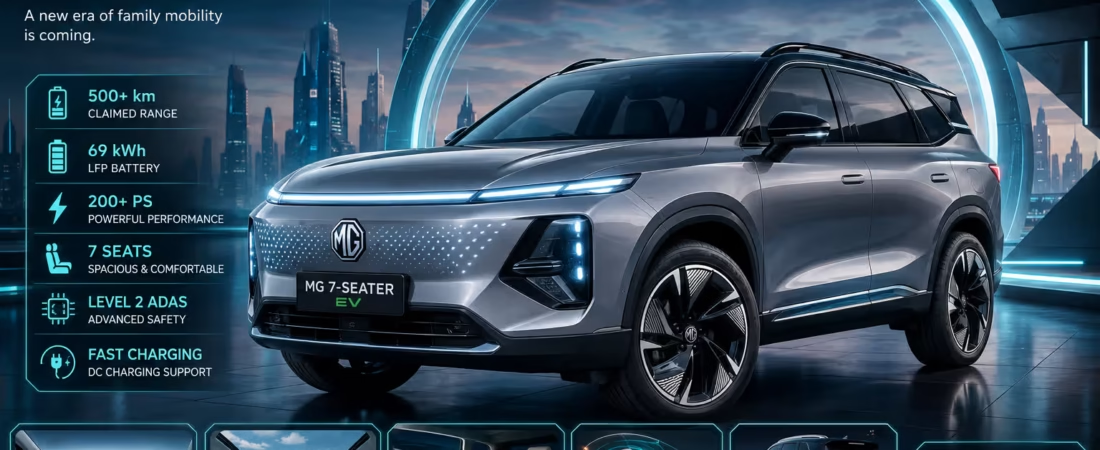
The MG 7-Seater Electric SUV is one of the most closely watched upcoming electric cars in India, and its timing could hardly be more interesting. JSW MG Motor India is preparing to unveil its new three-row electric SUV on 26 August 2026, giving Indian buyers a new option in a segment that is rapidly moving beyond compact five-seat EVs. The company has already opened pre-reservations, while recent teasers and sightings have revealed important clues about the SUV’s design, size and positioning.
What makes this SUV particularly significant is not just its seven-seat layout. It will be the first Indian MG model based on the company’s new ADAPT architecture, a modular platform designed to support multiple electrified powertrains, including battery-electric, plug-in hybrid, hybrid and range-extender configurations. Reports indicate that the electric version will arrive first, with a plug-in hybrid derivative planned later.
The upcoming MG is also expected to compete directly with larger electric SUVs such as the Mahindra XEV 9S, while potentially attracting buyers who are currently considering premium versions of the Tata Harrier EV and other family-oriented electric SUVs.
Range is another major attraction. Test vehicles have been seen carrying “500+ range” graphics, while reports based on the related international model point towards a battery capacity of roughly 69 kWh and a claimed range in the region of 530–600 km, depending on the testing standard and market configuration.
There is, however, an important distinction between what is confirmed and what is expected.
As of 20 August 2026, MG has confirmed the upcoming seven-seat electric SUV, its 26 August debut and the ADAPT platform strategy, but the final India-specification battery capacity, certified range, power output, variant structure and official price have not yet been fully announced. The vehicle is also widely referred to in media reports as the MG Hector Hawk EV or MG Hector Tomahawk EV, but the final commercial name should be treated as unconfirmed until MG officially announces it.
So, what should Indian buyers expect?
This detailed guide examines the MG 7-Seater Electric SUV 2026, including its expected price, launch date, battery, range, performance, dimensions, three-row practicality, interior, technology, charging, safety, competitors, ownership considerations and whether it could become one of India’s most interesting family EVs.
MG 7-Seater Electric SUV Launch Date in India
The most important confirmed date is:
26 August 2026.
JSW MG Motor India has scheduled the unveiling of its new seven-seat electric SUV for this date. Pre-reservations have already opened at ₹21,000, according to current reports.
The launch is strategically important because this will be the first production model in India based on MG’s new ADAPT platform.
The company is effectively using this SUV to introduce a new technical foundation for its next phase of electrified vehicles.
That makes the 2026 MG seven-seater more than another addition to the EV lineup.
It is potentially the beginning of a broader product strategy.
What Is the MG 7-Seater Electric SUV?
The upcoming MG is a three-row, seven-seat electric SUV designed primarily for family use.
Unlike smaller EVs such as the MG Comet EV, the new model is intended for buyers who need substantially more space, longer-distance capability and the ability to carry more passengers.
Reports indicate that the SUV is related to the Wuling Starlight 560/Eksion family, which is sold in international markets under the wider SAIC/Wuling group. The Indian version is expected to receive market-specific styling and equipment.
The basic formula is straightforward:
Large SUV + three rows + seven seats + electric powertrain + long claimed range.
That combination could appeal to a large group of Indian buyers.
Families who previously avoided EVs because they could not find a suitable seven-seat option will suddenly have another vehicle to consider.
Why the MG 7-Seater EV Matters in India
India’s electric-car market has moved rapidly from small city cars toward larger SUVs.
The early EV market was dominated by vehicles aimed at urban commuters.
Today, buyers increasingly want:
- Larger cabins
- More luggage space
- Highway capability
- Long driving range
- Advanced driver assistance
- Premium interiors
- Family-friendly seating
- Fast charging
- Strong performance
The MG 7-Seater Electric SUV addresses nearly all of those requirements.
It is particularly significant because seven-seat EVs remain relatively limited in India’s mass-market segment.
Mahindra’s XEV 9S has already established the idea of a large, purpose-designed electric family SUV, while MG’s new product brings another approach based on a modular architecture designed to accommodate different electrified technologies. Mahindra describes the XEV 9S as a seven-seat electric SUV built on its INGLO platform.
That means buyers will have more choice.
And more choice usually means manufacturers have to compete harder on:
- Price
- Range
- Space
- Features
- Charging
- Warranty
- Technology
- Driving experience
MG 7-Seater Electric SUV: Expected Price in India
Price will probably be one of the biggest factors determining whether this SUV becomes a mainstream success.
The official price has not yet been announced.
Current automotive reports have suggested an expected price around ₹22 lakh, although this is an estimate and should not be treated as the final figure.
Another important clue is that Autocar India has reported that JSW MG is targeting competitive pricing and could potentially position the EV below the Mahindra XEV 9S 70kWh, which has been listed at ₹25.8 lakh ex-showroom.
That creates an interesting possibility.
If MG can offer a genuine seven-seat electric SUV with approximately 500+ km of claimed range at a price around the low-to-mid ₹20 lakh range, it could become highly competitive.
Expected price range
A sensible pre-launch expectation is:
Approximately ₹22 lakh–₹26 lakh ex-showroom, subject to official confirmation.
The actual price could vary significantly depending on:
- Battery size
- Variant
- Equipment
- Charging hardware
- ADAS availability
- Wheel size
- Interior specification
- Government incentives applicable at the time
- MG’s competitive positioning
Until the official price announcement, buyers should treat every figure as an estimate.
MG 7-Seater EV Pre-Reservation
Pre-reservations have reportedly opened for ₹21,000.
The reservation amount is relatively modest compared with the vehicle’s expected purchase price, but buyers should still read the reservation terms carefully before making a payment. Reports indicate that the reservation is being accepted ahead of the 26 August reveal.
A reservation does not necessarily mean that you have finalised the purchase.
Before converting a reservation into a full booking, buyers should confirm:
- Final price
- Variant
- Battery capacity
- Certified range
- Charging speed
- Warranty
- Delivery timeline
- Cancellation and refund conditions
This is especially important for a completely new model.
MG 7-Seater Electric SUV Platform: ADAPT Explained
One of the most important technical developments behind the new SUV is ADAPT.
The platform’s full name is Advanced Drive Architecture Platform Technology.
MG’s new architecture has been designed as a flexible foundation for multiple electrified powertrains.
According to industry reports, ADAPT can support:
- Battery-electric vehicles
- Strong hybrids
- Plug-in hybrids
- Range-extender electric vehicles
It can also accommodate different electrical architectures, including 400V and 800V systems.
This flexibility is strategically important.
Instead of developing a completely different platform for every powertrain, MG can use one architecture for multiple vehicle configurations.
That can potentially reduce development time and allow the company to respond more quickly to changes in consumer demand.
Why a Modular EV Platform Matters to Buyers
The platform itself may sound like an engineering detail, but it has real-world implications.
Suppose the Indian market develops differently over the next five years.
If customers rapidly adopt EVs, MG can expand battery-electric products.
If plug-in hybrids become more attractive because of charging infrastructure or regulatory changes, the same underlying architecture can support those vehicles.
If range-extender technology becomes commercially viable, the platform can accommodate it.
For buyers, the immediate benefit is not necessarily visible.
The larger benefit is that MG is building a technical ecosystem around electrification rather than treating one EV as an isolated product.
MG 7-Seater Electric SUV Battery
The battery is another area where pre-launch reports provide useful clues but not final India-certified figures.
The related international model is reported to use a battery of approximately 69.2 kWh, with an LFP chemistry configuration in some markets. Reports indicate a front-mounted electric motor and a claimed international range of around 530 km under CLTC testing.
Autocar India has separately reported that the upcoming Indian model will use a 69kWh battery and could have an official range around 600 km, depending on the final specification and test cycle.
These numbers should not be mixed together.
Why?
Because different countries use different testing procedures.
A vehicle may have:
- 530 km CLTC range
- A lower WLTP figure
- A different India-certified figure
without the battery or motor physically changing.
Therefore, the final ARAI-certified range for India is the number buyers should use for domestic comparisons.
MG 7-Seater EV Range
Range is expected to be one of the biggest selling points.
Recent test vehicles have been seen with “500+ range” graphics, and several reports suggest a claimed range above 500 km.
That would put the MG in a very useful range category for family buyers.
A 500-plus-kilometre claimed range does not mean that the vehicle will travel exactly 500 km in every situation.
Actual range depends on:
- Highway speed
- Traffic
- Temperature
- Air-conditioning
- Passenger load
- Tyre pressure
- Driving style
- Terrain
- Battery condition
A family travelling on a highway at moderate speeds may achieve considerably better efficiency than a driver constantly accelerating at high speeds.
What Does 500+ km Range Mean in Real Life?
Consider a driver whose vehicle delivers approximately 450 km of practical highway range under a particular set of conditions.
That could allow:
- Pune to Mumbai and back with a comfortable buffer
- Delhi to Jaipur and return with charging planning
- Bengaluru to Mysuru and back
- Mumbai to Nashik and return
- Chennai to Pondicherry and additional local driving
The exact distances vary, but the principle is important.
A long-range EV reduces the number of charging stops required during normal family travel.
That can make electric ownership much easier.
MG 7-Seater EV Motor and Performance
Reports indicate that the international version associated with the upcoming SUV uses a front-mounted electric motor producing around 201–204 PS and approximately 310 Nm.
If the India-spec model uses a similar configuration, it should provide strong performance for a large family SUV.
Electric motors have an inherent advantage in urban driving because maximum torque is available quickly.
That means the MG should feel responsive when:
- Pulling away from traffic lights
- Overtaking slower vehicles
- Joining highways
- Climbing inclines
- Carrying several passengers
The key question will be how MG calibrates the accelerator response.
A family SUV does not need an aggressive throttle map.
Smooth and predictable power delivery is more useful for everyday driving.
Will the MG 7-Seater EV Have AWD?
This remains an important unanswered question.
Current reports about the related vehicle point toward a front-mounted motor and front-wheel drive configuration.
Therefore, buyers should not assume that the India model will have all-wheel drive.
If MG launches the EV with front-wheel drive, that would be perfectly reasonable for its intended use.
Most family SUV buyers spend the majority of their time on:
- City roads
- Expressways
- Highways
- Paved rural roads
rather than difficult off-road terrain.
Front-wheel drive can also help reduce mechanical complexity and potentially improve efficiency.
The final drivetrain configuration should be confirmed at launch.
MG 7-Seater Electric SUV Dimensions
The new MG is expected to be a substantial vehicle.
Reports based on the related international model indicate approximate dimensions of:
- Length: 4,745 mm
- Width: 1,850 mm
- Height: 1,755 mm
- Wheelbase: 2,810 mm
These should be regarded as expected figures until MG publishes the final Indian specification.
A wheelbase of around 2.8 metres is particularly important.
It provides a useful foundation for a three-row cabin.
Why Wheelbase Matters in a Seven-Seater
A seven-seat vehicle is not automatically a good seven-seater.
The real question is:
How usable are the third-row seats?
Wheelbase plays a major role in determining how much room engineers can allocate to the first and second rows while still retaining a practical third row.
A longer wheelbase gives designers more flexibility.
For Indian families, this matters enormously.
A family may have:
- Two adults in the first row
- Three adults or children in the second row
- Two children or adults in the third row
If the third row is used frequently, seat design becomes just as important as the headline seat count.
MG 7-Seater Electric SUV Seating Layout
The upcoming model is expected to provide seven seats.
Reports indicate a conventional three-row layout with a bench-style second row, rather than a luxury six-seat arrangement with two captain chairs.
That makes sense for its target market.
A seven-seat bench layout provides greater flexibility when carrying larger families.
You can potentially accommodate:
- Two adults in front
- Three passengers in the second row
- Two passengers in the third row
The exact usability of the third row will need to be assessed in person.
Is the Third Row Actually Practical?
This is one of the first things a buyer should test.
Do not judge a seven-seater simply because the manufacturer lists seven seats.
Take two adults to the dealership.
Ask one person to sit in the third row.
Then place two adults in the second row.
Check:
- Knee room
- Headroom
- Foot space
- Seat height
- Seat cushion length
- Ease of access
- Air-conditioning
- Visibility
- USB charging
- Cupholders
- Recline angle
If the third row is used only occasionally, modest space may be acceptable.
If it is used every day, the requirements become much higher.
MG 7-Seater Electric SUV Exterior Design
The design appears to be significantly different from MG’s current Hector.
Recent undisguised sightings and reports reveal a more futuristic electric-SUV appearance, with a closed front section, slim lighting elements and a wide stance.
Expected exterior elements include:
- Closed-off front grille
- Slim LED daytime-running lights
- Main headlamps positioned lower
- Illuminated MG branding
- Large lower air intakes
- Black exterior trim
- Roof rails
- Dual-tone alloy wheels
- Strong wheel arches
- Full-width rear lighting elements
The front design appears to follow the current electric-SUV trend of replacing traditional engine cooling grilles with a more aerodynamic closed fascia.
A More Futuristic MG Design
MG has traditionally used a relatively conventional SUV design language in India.
The upcoming electric SUV appears more futuristic.
The lighting signature is particularly important.
Slim DRLs can give the vehicle a wider visual appearance, while the lower-positioned headlamps can create a distinctive front profile.
The overall shape is expected to combine SUV proportions with aerodynamic details.
That is useful for an EV.
Lower aerodynamic drag can contribute to better highway efficiency and therefore improved real-world range.
MG 7-Seater Electric SUV Interior
The interior is expected to be one of the major attractions.
Pre-launch reports point toward:
- Large central touchscreen
- Digital driver’s display
- Panoramic sunroof
- Ventilated front seats
- Powered seats
- Wireless charging
- Automatic climate control
- 360-degree camera
- Connected-car technology
- Rear AC vents
- ADAS
Some reports suggest a 12.8-inch infotainment display and 8.8-inch digital instrument cluster, although these remain expected specifications until MG confirms the India-spec cabin.
Infotainment and Connected Technology
MG has built a strong reputation in India for connected-car technology.
The upcoming SUV is expected to continue that approach.
Potential connected features may include:
- Remote vehicle monitoring
- Remote locking and unlocking
- Charging status
- Vehicle location
- Trip information
- OTA updates
- Emergency assistance
- Voice controls
Connected technology becomes particularly useful in an EV because owners frequently need information about:
- Battery percentage
- Estimated range
- Charging status
- Charging location
- Scheduled charging
A well-designed mobile application can therefore make EV ownership much easier.
Panoramic Sunroof
A panoramic sunroof is expected to be offered.
This is becoming an increasingly popular feature in premium Indian SUVs.
A large glass roof can make the cabin feel more spacious and improve the visual appeal of the interior.
However, buyers should remember that a panoramic roof also adds weight and can increase cabin heat if the shade is not used properly.
The quality of the sunshade and cabin insulation will matter more than the mere presence of the feature.
Ventilated Seats
Ventilated front seats are among the features expected on the new MG SUV.
This is particularly relevant to Indian conditions.
Ventilated seats can improve comfort during hot weather by circulating air through perforated seat surfaces.
For a vehicle expected to serve as a family highway cruiser, this is a useful feature rather than simply a luxury add-on.
MG 7-Seater EV Safety Features
Safety is expected to be a major part of the new SUV’s equipment package.
Reports indicate potential inclusion of:
- Six airbags
- Electronic stability control
- 360-degree camera
- Electronic parking brake
- Advanced driver-assistance systems
- Automatic emergency braking
- Lane-related assistance
- Adaptive cruise control
- Other active safety systems
Pre-launch reports specifically mention Level 2 ADAS as an expected feature.
However, the final ADAS package must be checked once MG releases the official specification.
What Is Level 2 ADAS?
Level 2 driver assistance means the vehicle can assist with certain driving functions simultaneously, such as steering and acceleration/braking under appropriate conditions.
It does not mean the vehicle is fully autonomous.
The driver must remain attentive and responsible.
For Indian highways, systems such as:
- Adaptive cruise control
- Lane keeping assistance
- Automatic emergency braking
can reduce fatigue and add a useful layer of assistance.
But these technologies should never replace active driving attention.
MG 7-Seater Electric SUV Charging
Charging will be one of the most important factors for buyers.
A large EV is only practical if the owner can recharge it conveniently.
Potential charging options include:
Home charging
Best for overnight charging.
Workplace charging
Useful for commuters who have access to charging during the day.
Public DC fast charging
Essential for long-distance travel.
The final charging speed of the India-spec MG has not yet been officially confirmed.
That is one specification buyers should pay close attention to on launch day.
Why Charging Speed Matters More Than Battery Size
Many buyers focus on battery capacity.
But battery size is only half the story.
Imagine two EVs:
EV A
- 70 kWh battery
- Slower DC charging
EV B
- 65 kWh battery
- Much faster DC charging
For long-distance travel, EV B could potentially be more convenient because it spends less time at charging stations.
Therefore, buyers should compare:
- DC charging speed
- 10–80% charging time
- Charging curve
- Public charging compatibility
- Home charger capacity
- Battery warranty
rather than looking only at kWh.
MG 7-Seater EV Battery Chemistry
Reports associated with the international model indicate an LFP battery around 69.2 kWh.
Lithium iron phosphate batteries have several characteristics that can make them attractive for mainstream EVs.
They are generally known for:
- Good thermal stability
- Long cycle life
- Reduced dependence on nickel and cobalt
- Strong durability characteristics
However, actual battery performance depends on the complete battery-management system, cooling architecture, charging strategy and cell design.
Therefore, buyers should focus on the manufacturer’s warranty and real-world charging behaviour rather than chemistry alone.
MG 7-Seater Electric SUV Boot Space
Boot capacity is one of the biggest challenges for any seven-seater.
When all three rows are occupied, luggage space is naturally reduced.
This is true for electric and petrol SUVs alike.
Therefore, buyers should test the MG with:
- Seven passengers
- Two or three bags
- Cabin luggage
- School bags
- Shopping bags
If you frequently travel with seven people and large luggage, you may need to use roof storage or carefully manage luggage.
A seven-seat vehicle should be judged in its most demanding configuration, not with the third row folded.
MG 7-Seater EV Family Practicality
This could be the SUV’s strongest selling point.
A family EV needs to solve more problems than a two-seat commuter vehicle.
The MG could potentially offer:
- Seven seats
- Large cabin
- Flat EV floor
- Multiple storage areas
- Rear AC vents
- USB charging
- Large boot with rows folded
- Long driving range
- Automatic transmission
- Advanced safety technology
That combination makes it much easier to imagine the vehicle as a primary family car.
MG 7-Seater Electric SUV vs Mahindra XEV 9S
The Mahindra XEV 9S is expected to be one of the most direct competitors.
Mahindra has positioned the XEV 9S as a purpose-built seven-seat electric SUV based on the INGLO platform.
The two vehicles therefore have similar philosophies.
MG
- ADAPT architecture
- Expected 69 kWh-class battery
- 500+ km claimed range target
- Seven seats
- Competitive pricing strategy
- Multiple electrified powertrains planned
Mahindra
- INGLO architecture
- Purpose-built EV platform
- Seven-seat layout
- Strong performance focus
- Large-SUV proportions
The final comparison will come down to:
- Price
- Range
- Charging speed
- Interior space
- Third-row comfort
- Ride quality
- ADAS
- Service network
MG 7-Seater EV vs Tata Harrier EV
The Tata Harrier EV is another important benchmark.
Tata Motors has already established a strong EV presence in India.
The Harrier EV benefits from:
- Tata’s large EV customer base
- Strong SUV identity
- Established charging ecosystem partnerships
- Multiple technology features
- Brand familiarity
The MG will attempt to differentiate itself through:
- Seven-seat configuration
- New ADAPT platform
- Long claimed range
- Connected technology
- Competitive pricing
If the MG offers seven usable seats at a competitive price, it could have a strong family-oriented argument.
MG 7-Seater EV vs Kia Carens Clavis EV
The Kia Carens Clavis EV is another important reference point for buyers who need family space.
Kia’s product strategy is particularly relevant because the Carens name is strongly associated with multi-seat family travel.
The MG could appeal to customers who want:
- SUV styling
- Electric power
- Longer range
- Larger road presence
The Kia may appeal more to customers prioritising MPV-like cabin flexibility.
The choice will ultimately depend on how often the third row is used and how much SUV character the buyer wants.
MG 7-Seater EV vs MG M9
Interestingly, MG already sells a seven-seat electric vehicle in India: the MG M9.
But the M9 is a completely different proposition.
MG describes the M9 as a premium luxury MPV, and it was launched in India at an introductory price of ₹69.90 lakh. It uses a 90 kWh NMC battery, produces 245 PS and 350 Nm, and has a claimed range of 548 km.
The upcoming MG seven-seater EV is expected to sit far below the M9 in price.
MG M9
- Luxury MPV
- ₹69.90 lakh introductory price
- 90 kWh battery
- 245 PS
- 350 Nm
- 548 km claimed range
- Premium chauffeur-focused interior
New MG 7-Seater EV
- Family SUV
- Expected around ₹22 lakh-plus
- Approximately 69 kWh battery expected
- Around 200 PS expected
- Seven-seat practicality
- Mass-market positioning
This distinction is important.
The new EV is not intended to replace the M9.
It is intended to bring MG’s electric seven-seat proposition to a much wider audience.
Who Should Buy the MG 7-Seater Electric SUV?
The new SUV could be particularly suitable for several types of buyers.
1. Large Families
If you regularly carry six or seven people, this is one of the most obvious use cases.
2. EV Buyers Who Need More Space
Many current EVs are five-seaters.
The MG addresses the space problem directly.
3. Long-Distance EV Users
A claimed range above 500 km makes it much more suitable for highway travel than small-battery EVs.
4. Buyers Upgrading From an ICE SUV
Someone moving from a conventional seven-seat SUV may not want to sacrifice space or performance.
5. Technology-Oriented Families
ADAS, connected features, digital displays and electric power can create a strong modern-car experience.
Who Should Not Buy It?
The MG seven-seater may not be ideal for everyone.
Consider another vehicle if:
- You rarely carry more than four people.
- You do not have home charging.
- Your driving is almost entirely on remote routes with limited charging infrastructure.
- You need maximum third-row luggage space.
- You prefer diesel for extremely high annual mileage.
- You frequently drive in areas without reliable DC charging.
An EV should fit your infrastructure as well as your lifestyle.
How to Decide If a Seven-Seat EV Is Right for You
Use this simple five-step approach.
Step 1: Calculate Your Annual Mileage
Estimate your yearly driving.
If you drive 10,000 km annually, charging convenience may matter more than fuel savings.
If you drive 25,000 km or more, EV running-cost advantages can become more significant.
Step 2: Check Home Charging
Ask:
- Do I have dedicated parking?
- Can an electrician install a charger?
- Is the electrical connection sufficient?
- Can I charge overnight?
Step 3: Identify Your Typical Passenger Count
Do not say “I need seven seats” automatically.
Count how many people actually travel together.
Step 4: Map Your Frequent Routes
Check charging availability along your regular highways.
Step 5: Test the Third Row
This is essential.
Take your family to the dealership and physically test all three rows.
MG 7-Seater EV Ownership Costs
The purchase price is only one component of EV ownership.
EVs generally have fewer moving mechanical components than conventional internal-combustion vehicles.
There is no conventional:
- Engine oil
- Spark plug
- Exhaust system
- Multi-speed conventional gearbox
However, EV ownership still includes:
- Tyres
- Brake components
- Suspension
- Air-conditioning
- 12V battery
- Software
- High-voltage battery system
- Insurance
Tyre costs can be significant on a large SUV because of its weight and wheel size.
EV Running Cost Advantage
Suppose an EV consumes approximately 18 kWh per 100 km.
At an electricity cost of ₹10 per kWh, energy consumption would be roughly:
₹180 per 100 km
or:
₹1.80 per km.
This is only an illustration, not a guaranteed consumption figure for the MG.
Actual consumption depends on vehicle efficiency, driving conditions and charging losses.
Public fast charging can also cost more than home charging.
Therefore, owners who rely primarily on home charging may see a different running-cost advantage from those who use public charging frequently.
EV Charging Strategy for Families
A large family EV does not need to be charged to 100% every night.
For daily use, many owners can charge within a comfortable operating window and reserve 100% charging for longer journeys, depending on manufacturer recommendations.
For road trips:
- Start with a high state of charge.
- Plan charging stops in advance.
- Keep a backup charging location.
- Avoid arriving at a remote charger with an extremely low battery.
- Consider traffic and weather.
- Allow extra time during peak travel periods.
The goal is to make charging part of the journey rather than an emergency activity.
Common Mistakes to Avoid When Buying the MG 7-Seater EV
Mistake 1: Believing the highest claimed range
A laboratory range figure is not a promise of real-world range.
Mistake 2: Ignoring charging infrastructure
A long-range EV is still inconvenient if you cannot charge it conveniently.
Mistake 3: Buying seven seats without testing them
Seven seats on paper do not guarantee seven comfortable passengers.
Mistake 4: Comparing only battery capacity
Charging speed matters too.
Mistake 5: Ignoring tyre costs
Large SUVs can have expensive tyres.
Mistake 6: Buying before checking the final specification
Pre-launch reports can change.
Mistake 7: Assuming the international specification will be identical
India-specific equipment can differ considerably.
Expert Tips Before Booking the MG 7-Seater EV
Tip 1: Wait for the official India range
Do not compare the vehicle with competitors until the certified Indian figure is available.
Tip 2: Ask for the 10–80% DC charging time
This is more useful for highway planning than a generic charging statement.
Tip 3: Test with seven passengers
This is the best way to assess the real value of the vehicle.
Tip 4: Check third-row air-conditioning
A seven-seat SUV must keep the rear cabin comfortable in Indian summers.
Tip 5: Check the boot with all seats occupied
Do not judge boot capacity with the third row folded.
Tip 6: Ask about battery warranty
The high-voltage battery is one of the most expensive components of an EV.
Tip 7: Compare the on-road price
An attractive ex-showroom price can change significantly after insurance and registration.
What We Know vs What Is Still Unconfirmed
Because the MG 7-Seater Electric SUV has not yet reached its official launch date, readers should separate confirmed information from expectations.
| Item | Current status |
|---|---|
| Seven-seat electric SUV | Confirmed |
| India debut | 26 August 2026 |
| ADAPT platform | Confirmed as platform strategy |
| EV launch first | Reported/expected |
| Plug-in hybrid later | Reported/expected |
| Pre-reservation | Open |
| Reservation amount | ₹21,000 reported |
| Battery | Around 69 kWh expected |
| Motor | Around 200 PS expected |
| Torque | Around 310 Nm expected |
| Range | 500+ km expected; final India figure pending |
| Dimensions | Around 4.75m length expected |
| Official name | Not yet definitively confirmed |
| Official price | Not announced |
| Final variants | Not announced |
| Final charging speed | Not announced |
This distinction is particularly important for SEO content because search results often combine confirmed information with speculation.
The safest approach is to update the article immediately after the official launch.
What to Check on 26 August 2026
When MG officially reveals the vehicle, buyers should focus on these specifications first.
1. Battery capacity
Confirm the exact usable and gross capacity.
2. Certified range
Look specifically for the India-certified figure.
3. DC charging speed
Find out the maximum kW and 10–80% charging time.
4. Motor output
Confirm power and torque.
5. Seating configuration
Check whether all seven seats are standard.
6. Boot capacity
Check capacity with all three rows in use.
7. ADAS
Determine which systems are standard and which belong to higher variants.
8. Warranty
Check both vehicle and battery warranty.
9. Price
Compare the starting price and fully equipped variant price.
10. Delivery timeline
Ask when customer deliveries will begin.
Is the MG 7-Seater Electric SUV Worth Waiting For?
For families considering an EV in 2026, the answer is likely to be yes.
The reason is not that the MG is guaranteed to be better than every competitor.
The reason is that it addresses a genuine market gap.
Many EV buyers want:
More than five seats without moving into an ultra-expensive luxury EV.
That is precisely where the new MG appears to fit.
A vehicle with approximately 69 kWh of battery capacity, around 200 PS of electric power and a claimed range above 500 km would be a strong proposition if MG can combine those specifications with competitive pricing. Reports currently suggest that the company is targeting a price below or around the level of competing large electric SUVs.
The final verdict, however, depends heavily on the details.
MG 7-Seater Electric SUV: Pros and Cons
Expected Advantages
Seven-seat layout
The biggest attraction for large families.
Long claimed range
500+ km could make the SUV suitable for highway travel.
Electric performance
Approximately 200 PS and 310 Nm would provide strong acceleration.
New ADAPT architecture
Provides a modern technical foundation.
Premium technology
ADAS, connected features, panoramic roof and digital displays are expected.
Competitive positioning
MG appears to be targeting an aggressive price point.
Future powertrain flexibility
The ADAPT platform can support multiple electrified technologies.
Potential Disadvantages
Final price is unknown
The estimated price may change.
Final range is unknown
The international and India testing cycles may produce different figures.
Charging speed is unconfirmed
This is critical for long-distance users.
Third-row space needs verification
The seven-seat claim alone does not guarantee excellent third-row comfort.
New-platform ownership uncertainty
As a first-generation product on a new platform, long-term reliability data will naturally be limited at launch.
FWD may limit off-road capability
If the final Indian model uses the expected front-wheel-drive setup, it will be more road-focused than an AWD SUV.
The Importance of MG’s Service Network
EV ownership is not just about charging.
Service support remains important.
MG already has an established presence in India, which gives the company an advantage compared with a completely new automotive entrant.
However, the new SUV introduces a new platform and potentially new battery-management, software and electronic systems.
Buyers should therefore ask their local MG dealership:
- How many EV technicians are trained?
- Where is the nearest EV-certified service centre?
- How long does battery diagnostics take?
- Is roadside assistance included?
- What is the battery warranty?
- Are software updates performed over the air?
- What happens if the vehicle needs high-voltage system repairs?
These questions matter more than they might appear.
MG 7-Seater EV for Highway Travel
A large electric SUV can be an excellent highway vehicle if its range and charging network are well matched.
Electric motors are naturally smooth.
There is no conventional gearshift sensation, and acceleration can be immediate.
A long-wheelbase SUV can also provide stable highway behaviour.
For family travel, the combination of:
- Quiet powertrain
- Spacious cabin
- Large battery
- Automatic operation
- Driver assistance
- Three-row seating
can make long-distance journeys significantly more relaxing.
But planning remains essential.
MG 7-Seater EV for City Driving
The SUV’s size may initially seem challenging in urban environments.
At approximately 4.7 metres long, it will require more parking space than a compact EV.
Fortunately, features such as:
- 360-degree camera
- Parking sensors
- Front and rear cameras
- Automatic parking assistance, if offered
can make urban manoeuvring easier.
Before purchasing, measure your parking space.
Also consider:
- Basement ramps
- Parking-lift dimensions
- Charging access
- Turning radius
- Narrow residential lanes
A large EV is only convenient if it fits your daily environment.
Is a Seven-Seater EV Better Than a Seven-Seater Diesel SUV?
Not automatically.
Each powertrain has advantages.
EV advantages
- Quiet driving
- Instant torque
- Potentially lower energy cost
- Fewer conventional moving components
- Zero tailpipe emissions
- Smooth city driving
Diesel advantages
- Familiar refuelling
- Large highway range
- Quick refuelling
- Established long-distance infrastructure
For someone with home charging and predictable daily travel, the EV can be extremely convenient.
For someone who regularly drives into remote areas with limited charging infrastructure, a conventional powertrain may still be more practical.
Future of MG Electric SUVs in India
The seven-seat EV is important because it is not expected to remain an isolated product.
The ADAPT architecture is designed around multiple electrified powertrains.
MG’s strategy therefore appears to be broader:
EV first, followed by additional electrified variants.
Autocar India has reported that the first model on ADAPT will be available in EV and PHEV versions, while other reports have also discussed hybrid and range-extender possibilities supported by the architecture.
This flexibility could become increasingly valuable as India’s electrification landscape develops.
What the MG 7-Seater EV Means for Indian Car Buyers
The most important impact may be competitive.
Until recently, buyers looking for a spacious electric family SUV had relatively few choices.
Now the market is expanding.
Customers can compare:
- Mahindra XEV 9S
- Tata Harrier EV
- MG’s upcoming seven-seat EV
- Kia’s electrified family offerings
- Premium electric SUVs above this price range
That competition should encourage manufacturers to improve:
- Battery technology
- Charging speed
- Range
- Interior quality
- Software
- Safety
- Warranty
- Pricing
Ultimately, consumers benefit.
Frequently Asked Questions About the MG 7-Seater Electric SUV
1. When will the MG 7-Seater Electric SUV launch in India?
JSW MG Motor India is scheduled to unveil its new seven-seat electric SUV on 26 August 2026. Pre-reservations have already opened.
2. What will the MG 7-Seater Electric SUV price be?
The official price has not yet been announced. Current reports estimate a starting price around ₹22 lakh, although the final figure could be higher or lower depending on variants and equipment.
3. How many seats will the new MG electric SUV have?
The upcoming model is confirmed/reported as a seven-seat, three-row electric SUV. Reports indicate a bench-style second row.
4. What will be the range of the MG 7-Seater EV?
The SUV is expected to offer a 500+ km claimed range. Reports based on the related international model cite around 530 km CLTC, while other reports suggest an India-targeted figure around 600 km. The final India-certified range has not yet been announced.
5. What battery will the MG 7-Seater EV use?
A battery of approximately 69–69.2 kWh is widely reported based on the related international model and pre-launch information. The final India-spec battery capacity remains to be confirmed.
6. How powerful will the MG 7-Seater Electric SUV be?
Reports suggest approximately 200–204 PS and around 310 Nm from a front-mounted electric motor. The final India specification should be confirmed at launch.
7. Will the MG 7-Seater EV have ADAS?
Advanced driver-assistance technology, including Level 2 ADAS, is expected according to pre-launch reports. The exact systems and variant availability will be confirmed by MG.
8. What are the main rivals of the MG 7-Seater EV?
The Mahindra XEV 9S is expected to be one of its closest rivals. The Tata Harrier EV and Kia’s electric family vehicles are also relevant alternatives depending on price, seating configuration and buyer requirements. Mahindra officially positions the XEV 9S as a seven-seat electric SUV.
Final Verdict: Should You Wait for the MG 7-Seater Electric SUV?
The MG 7-Seater Electric SUV could become one of the most important new family EVs in India in 2026.
Its appeal is easy to understand.
You get the potential combination of:
Seven seats + electric power + 500+ km claimed range + around 200 PS + modern technology + competitive pricing.
That is a powerful package.
The new ADAPT architecture adds another layer of importance because it gives MG a platform designed to support several electrified powertrain strategies rather than a single EV configuration.
The biggest attraction for Indian families will probably be the combination of space and range.
A five-seat EV may be perfect for a couple or small family, but larger households need a different solution.
The upcoming MG attempts to solve that problem without moving into the extremely expensive luxury-EV category represented by vehicles such as the MG M9. The M9 currently sits at ₹69.90 lakh and offers a very different luxury-MPV experience.
At the other end of the market, MG’s new SUV could potentially target the ₹22 lakh-plus zone, putting it much closer to mainstream premium family SUVs.
But buyers should not make a final decision based solely on the numbers circulating before launch.
Several crucial details remain to be confirmed:
- Official India price
- Final battery capacity
- India-certified range
- DC charging speed
- Exact motor output
- Variant structure
- Third-row dimensions
- Boot capacity
- ADAS package
- Battery warranty
- Delivery schedule
- Final commercial name
These details could significantly change the buying decision.
The reported 530 km CLTC figure, for example, should not be presented as an Indian real-world or ARAI range. Similarly, the approximately 69 kWh battery and 200-plus PS motor figures are useful indicators, but they remain pre-launch information until MG confirms the India-specification vehicle.
For buyers planning to purchase a seven-seat SUV in 2026, however, waiting a few more days could be worthwhile.
The official unveiling is scheduled for 26 August 2026.
Once MG reveals the final price and specification, compare the vehicle directly with the Mahindra XEV 9S, Tata Harrier EV and other large family EVs.
Most importantly, do not judge it only by the claimed range.
Sit in all three rows.
Test the charging experience.
Check your home-charging installation.
Compare the on-road price.
Ask about the battery warranty.
And take the vehicle on a proper test drive with your family.
If MG can deliver strong real-world range, usable seven-seat space, competitive charging performance and an aggressive price, the new SUV could become a compelling alternative to both conventional seven-seat SUVs and more expensive electric models.
For Indian families looking to make the switch to electric mobility without giving up space, practicality and highway usability, the MG 7-Seater Electric SUV is definitely a model worth watching on 26 August 2026.
Planning to buy a seven-seat SUV this year? Add the new MG electric SUV to your shortlist, compare its official launch specifications with the Mahindra XEV 9S and Tata Harrier EV, and take a family test drive before making your final decision.
MG ZS EV Review 2026: The Premium Electric SUV That Makes Every Journey Smarter