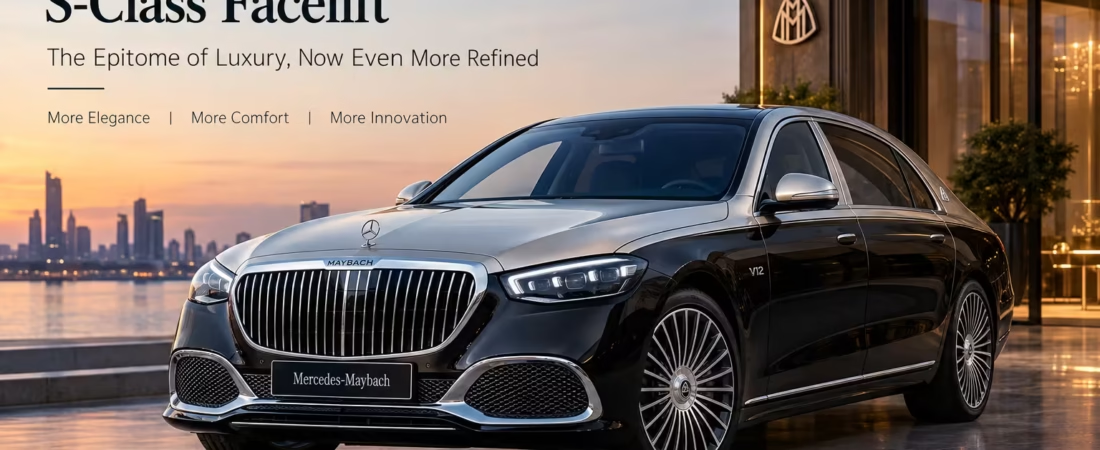
The Mercedes-Maybach S-Class facelift is about to make its India debut, and the updated ultra-luxury sedan brings much more than a cosmetic refresh. Mercedes-Benz is preparing to launch the facelifted Maybach S-Class in India on 5 October 2026, following its global reveal earlier in the year. The update combines a redesigned exterior, a significantly more digital cabin, enhanced rear-seat comfort, expanded personalisation and revised powertrain technology.
For buyers considering an ultra-luxury sedan, the new Maybach S-Class is particularly interesting because its appeal is not based on performance alone. The car is designed around the experience of travelling in the rear seat, while simultaneously offering the engineering, technology and craftsmanship expected from the Maybach name.
The India launch is especially significant because the current Mercedes-Maybach S-Class is already positioned at the top end of Mercedes-Benz India’s sedan range. Mercedes-Benz India currently lists the Maybach S-Class from ₹2.875 crore, before customer-specific options and customisation. The facelift is expected to move into a higher price bracket, although the final India price and variant details are to be confirmed at launch.
So, what exactly changes with the 2026 Mercedes-Maybach S-Class facelift? What technology does it bring? How different is the cabin? Which engines are available internationally? And what should Indian buyers know before considering one?
This comprehensive guide covers the major details.
Mercedes-Maybach S-Class Facelift 2026: Quick Overview
Before going into the details, here are the key points readers should know:
- India launch: 5 October 2026
- Body style: Ultra-luxury sedan
- Model: Mercedes-Maybach S-Class facelift
- Current India Maybach S-Class starting price: ₹2.875 crore, according to Mercedes-Benz India’s current listing
- Expected positioning: Above the current model, with final facelift pricing to be announced
- Major exterior change: Larger illuminated Maybach grille
- Lighting: Redesigned headlights and star-themed LED lighting signatures
- Interior: New Superscreen-style digital layout
- Infotainment: Fourth-generation MBUX and Mercedes-Benz’s MB.OS architecture
- Rear-seat focus: Executive seats with greater reclining capability and enhanced comfort functions
- Personalisation: Expanded MANUFAKTUR options
- International powertrains: Updated V8, plug-in hybrid and S 680 powertrain options depending on market
- India-specific engine/variant lineup: Not yet fully confirmed
The distinction between confirmed and expected specifications matters. Mercedes-Benz India has confirmed the launch date, but it has not yet released the complete India-specific equipment and variant list. Therefore, international specifications should not automatically be treated as India specifications.
What Is the Mercedes-Maybach S-Class Facelift?
The Mercedes-Maybach S-Class facelift is an updated version of the existing Maybach S-Class rather than an entirely new generation.
That distinction is important.
A facelift normally retains the underlying vehicle architecture while introducing substantial improvements to styling, technology, equipment, powertrain calibration and personalisation. In the case of the 2026 Maybach S-Class, Mercedes-Benz has used the update to make the car more technologically advanced while preserving the fundamental Maybach philosophy of rear-seat luxury.
The Maybach S-Class is positioned differently from an ordinary premium sedan. Its primary purpose is not simply to transport the driver from one destination to another.
It is designed to make the rear passenger feel like the most important person in the vehicle.
That philosophy can be seen in the reclining executive seats, entertainment and comfort systems, premium materials, extensive personalisation and chauffeur-oriented cabin design.
The facelift builds on this approach with more digital functionality and additional opportunities for customisation.
Mercedes-Maybach S-Class Facelift India Launch Date
The Mercedes-Maybach S-Class facelift will launch in India on 5 October 2026.
The Indian launch follows the model’s global presentation earlier in 2026. Autocar India reports that the India launch is taking place a little over six months after the global reveal.
This means Indian customers will not have to wait several years after the international introduction to receive the refreshed Maybach.
However, one important point remains.
Mercedes-Benz India has not yet confirmed every India-specific specification, variant and feature combination. The international model offers multiple powertrain possibilities, but the exact configuration available in India needs to be confirmed by Mercedes-Benz India.
For potential buyers, this means the 5 October launch event is likely to be particularly important because it should establish:
- India-specific variants
- Final ex-showroom pricing
- Engine availability
- Standard equipment
- Optional equipment
- Customisation packages
- Delivery timelines
- Booking information
Until those details are officially announced, buyers should treat estimated prices and international specifications as preliminary information.
Exterior Design: A More Expressive Maybach
The Maybach S-Class has always been recognisable because of its imposing proportions and distinctive grille.
The facelift retains that identity but makes the front end more visually prominent.
Larger Illuminated Maybach Grille
One of the most noticeable changes is the redesigned Maybach grille.
The grille is around 20 percent larger than before and incorporates illumination. It continues to feature the characteristic vertical Maybach slats, giving the sedan a distinctive face that separates it from the standard S-Class.
The illuminated treatment is particularly relevant to the Maybach identity.
Instead of relying only on chrome detailing, the new design combines traditional luxury cues with modern lighting technology.
An illuminated Mercedes star is positioned above the grille, while Maybach branding also receives greater visual emphasis.
For a car that is often used for high-profile arrivals, this type of detail is more than decoration. The front design becomes part of the vehicle’s identity.
Redesigned Headlights
The headlights have also been revised.
The new lighting units incorporate three-pointed-star daytime running light signatures. This continues Mercedes-Benz’s broader design language while giving the Maybach a more contemporary appearance.
The lighting treatment becomes particularly noticeable at night, when the vehicle’s front and rear light signatures help establish its identity.
New Maybach Details Around the Bumpers
The updated Maybach S-Class also receives Maybach-specific detailing around the lower air intakes.
The mesh treatment incorporates small Maybach logos, creating a subtle design detail that may not be immediately obvious from a distance but reinforces the model’s exclusive positioning.
This is typical of modern Maybach design.
The changes are not intended to make the sedan look radically different. Instead, they add small visual cues that owners and passengers can appreciate at closer range.
New Alloy Wheels and Exterior Personalisation
Wheels play an important role in the appearance of a chauffeur-driven luxury sedan.
The facelift introduces new forged alloy wheel designs in 20-inch and 21-inch sizes for international markets. Some designs feature a counterweighted Mercedes emblem that remains upright as the wheel rotates.
The design demonstrates how Maybach approaches even ordinary components such as wheels.
Rather than treating the wheel as purely functional equipment, Mercedes-Benz turns it into part of the vehicle’s visual signature.
The facelift also expands the scope of personalisation.
Mercedes-Benz says more Maybach S-Class configurations can access elements of its MANUFAKTUR personalisation programme, including additional exterior colours and two-tone combinations.
For a buyer in this segment, personalisation can be as important as engine output.
A luxury sedan costing several crore rupees is not necessarily purchased because the buyer simply wants the fastest or most powerful vehicle. Individuality and exclusivity are major parts of the ownership experience.
Mercedes-Maybach S-Class Interior: Where the Biggest Changes Matter
If the exterior update is about visual refinement, the cabin update is more significant from a technology perspective.
The facelift brings the Maybach S-Class closer to the latest digital direction of Mercedes-Benz.
The dashboard adopts a large Superscreen-style arrangement combining several displays behind a unified glass surface.
International specifications include:
- 12.3-inch digital instrument display
- 14.4-inch central touchscreen
- 12.3-inch passenger display
The configuration is designed to give front occupants access to information and entertainment while maintaining the sophisticated appearance expected of an S-Class.
MB.OS and Fourth-Generation MBUX
One of the most important technology developments is the introduction of MB.OS alongside fourth-generation MBUX.
MB.OS is Mercedes-Benz’s newer vehicle operating-system architecture and is designed to connect different digital functions of the car more closely.
For Maybach customers, the benefit is not simply having a larger touchscreen.
The more important change is how different functions can be integrated into one digital environment.
That includes areas such as:
- Navigation
- Vehicle settings
- Entertainment
- Connectivity
- Voice interaction
- Driver assistance functions
- Over-the-air software updates
- Personalised digital experiences
The facelift also introduces Maybach-specific graphics and interface elements.
This matters because luxury buyers increasingly expect their vehicles to behave more like sophisticated digital products rather than conventional cars with an infotainment screen added to the dashboard.
AI-Assisted Digital Experience
The updated MBUX system also brings an enhanced virtual assistant with newer generative-AI capabilities.
The purpose of such technology is to make interactions with the vehicle more conversational and context-aware.
Instead of navigating multiple menus, occupants can increasingly use natural language to access functions or information.
However, buyers should distinguish between the capabilities demonstrated internationally and the exact software functions that will be available in India.
Connected-car services can vary by country because of differences in regulations, network availability, subscriptions and local partnerships.
Rear Seat: The Real Centre of the Maybach S-Class
For most luxury cars, the driver is the central user.
The Maybach S-Class takes a different approach.
The rear passenger is arguably the most important occupant.
This is why the rear cabin receives extensive attention.
Executive Rear Seats
The rear executive seats can recline up to 43 degrees in the updated model, compared with 38 degrees cited for the standard S-Class. The seats can also offer heating, ventilation and massage functions depending on specification.
This transforms the rear cabin from a conventional seating area into something closer to a private lounge.
Imagine finishing a long business meeting and getting into the car.
Instead of immediately worrying about traffic, the passenger can adjust the seat, activate massage, regulate the cabin temperature and use the available entertainment features.
That is the experience Mercedes-Maybach is targeting.
New Smartphone-Style Rear Controls
Another interesting cabin change is the replacement of the previous rear tablet-style controller with two smartphone-style remote controllers.
These devices can be used to control different vehicle functions.
The concept is straightforward.
Rear passengers should not have to reach forward or depend on the driver to adjust their environment.
They should have control within easy reach.
This is especially useful when the vehicle is used for long journeys or chauffeur-driven business travel.
Materials and Upholstery
Luxury at this level is not determined by screen size alone.
Materials, stitching, textures and surface finishes play a major role.
The facelift expands the available interior personalisation, including additional upholstery choices.
Internationally, Mercedes-Benz has also introduced a leather-free vegan upholstery option with a dedicated design.
That is notable because alternative materials are becoming increasingly relevant even within ultra-luxury vehicles.
The Maybach buyer therefore gets more choice not only in colour but also in the material philosophy of the cabin.
MANUFAKTUR: Personalisation Becomes a Bigger Part of the Experience
The Mercedes-Maybach brand has long been associated with customisation.
The facelift takes that idea further through an expanded MANUFAKTUR programme.
Depending on market and configuration, customers can choose from more exterior colours, two-tone finishes and interior personalisation options.
This creates an important distinction between Maybach and conventional premium sedans.
A standard luxury sedan may offer a defined selection of colours and interiors.
Maybach is designed to give buyers much more freedom to create a vehicle that reflects their individual taste.
For a high-net-worth buyer, this can be one of the most attractive aspects of ownership.
Mercedes-Maybach S-Class Engine and Powertrain Options
Powertrain specifications require careful explanation because the global Maybach S-Class lineup can differ from market to market.
The updated model is offered internationally with petrol and plug-in hybrid possibilities.
Updated 4.0-Litre V8
The updated S 580 uses a revised 4.0-litre V8.
International reports cite output of approximately 537 hp and 750 Nm, although some sources and markets quote slightly different figures depending on specification and measurement conventions.
The engine is not simply about producing a large peak-power number.
A Maybach powertrain needs to deliver power smoothly.
The ideal experience is effortless acceleration without making the rear passenger feel every gear change or sudden surge.
That is particularly important in a chauffeur-driven luxury sedan.
Mercedes-Maybach S 580e Plug-In Hybrid
Selected international markets also receive the S 580e plug-in hybrid.
This combines a 3.0-litre inline-six petrol engine with an electric motor and a 22 kWh battery.
International specifications cite total system output around 585 hp and 750 Nm, with an electric-only range of up to approximately 98 km under the relevant testing cycle.
The S 580e demonstrates an important direction for the Maybach brand.
Luxury does not necessarily have to mean a large petrol engine alone.
Electric driving can improve refinement because an electric motor can provide smooth, quiet propulsion.
That can be particularly appropriate for a vehicle whose main purpose is passenger comfort.
However, the S 580e should not automatically be assumed to launch in India.
Mercedes-Benz India has not yet confirmed the India-specific powertrain lineup.
Mercedes-Maybach S 680
At the top of the Maybach range, the S 680 represents the traditional high-performance luxury philosophy.
Depending on market, the S 680 can use either a V12 or a more powerful V8 configuration.
International reports cite V12 output in the region of 621 hp and 900 Nm for certain markets, while other markets receive a V8-based powertrain.
The important point for Indian buyers is that international S 680 specifications should not be treated as confirmed India specifications until Mercedes-Benz India announces the local lineup.
For enthusiasts, however, the continued presence of a V12 option in selected markets demonstrates how Maybach still occupies a special position within Mercedes-Benz’s luxury portfolio.
Performance vs Comfort: What Matters More in a Maybach?
A common mistake when evaluating luxury cars is to focus entirely on horsepower.
For a Mercedes-Maybach S-Class, that approach misses much of the story.
Performance matters, but refinement matters just as much.
Consider two different situations.
Situation 1: The driver wants acceleration
The powerful V8 or V12 provides substantial performance.
Situation 2: The rear passenger wants to relax
The ideal experience is smooth, quiet and controlled.
The car should accelerate without making the passenger feel uncomfortable.
That is why Maybach engineering is focused on the combination of power, suspension tuning, sound insulation, seating comfort and electronic control systems.
In other words, the objective is not simply speed.
It is effortless movement.
Ride Comfort and the Chauffeur-Driven Experience
The Maybach S-Class is particularly relevant to buyers who spend significant time in the rear seat.
Business executives, entrepreneurs, celebrities and other customers who use professional chauffeurs may evaluate a luxury sedan very differently from someone buying a performance car.
For them, important questions include:
- How comfortable are the rear seats?
- How easy is it to adjust the cabin?
- How quiet is the vehicle?
- How relaxing is the ride?
- How much legroom is available?
- Can passengers control entertainment and climate functions?
- Does the vehicle provide a premium arrival experience?
The Maybach’s extended wheelbase and rear-focused design address these priorities.
The facelift retains that philosophy while increasing the technology available to rear passengers.
Is the Mercedes-Maybach S-Class a Driver’s Car?
It can be driven enthusiastically, but that is not its primary purpose.
The Maybach S-Class is fundamentally a luxury limousine.
Its design makes the rear passenger experience a central priority.
That does not mean the driver is ignored.
The V8 and other powertrain options provide substantial performance, while advanced chassis and driver-assistance systems help make the vehicle easier to operate.
But if your main objective is sporty handling, a dedicated performance sedan may be more appropriate.
If your priority is arriving relaxed after a long journey, the Maybach’s philosophy makes much more sense.
Safety and Driver Assistance
The S-Class family has traditionally served as a technology showcase for Mercedes-Benz.
The Maybach benefits from this technology direction as well.
Modern Mercedes-Benz luxury vehicles can incorporate a broad range of driver-assistance technologies, although exact equipment varies according to market and specification.
Potential systems can include functions related to:
- Adaptive cruise control
- Lane assistance
- Parking assistance
- Surround-view cameras
- Collision warning
- Emergency braking
- Blind-spot monitoring
- Highway assistance
- Driver monitoring
However, buyers should always check the India-specific equipment list before assuming that a particular function is standard.
Luxury vehicles often offer advanced technology as optional packages, and equipment can differ by variant.
Mercedes-Maybach S-Class Price in India
The current Mercedes-Benz India website lists the Mercedes-Maybach S-Class from ₹2.875 crore.
The facelift is expected to command a higher price.
Several automotive publications have published estimates around or above the ₹3 crore mark, but these are not official Mercedes-Benz India prices. Autocar India currently estimates approximately ₹3.10 crore to ₹3.20 crore, while other automotive publications have published different estimates.
Therefore, the safest way to understand the price is:
Current Maybach S-Class: ₹2.875 crore starting price listed by Mercedes-Benz India.
Facelift: Expected to cost more, with final India pricing to be announced.
The final on-road price will also depend heavily on:
- Registration
- Insurance
- Local taxes and charges
- Optional equipment
- Customisation
- MANUFAKTUR selections
- Accessories
At this price level, personalisation can significantly affect the final invoice.
Why the Price Can Increase Substantially with Options
Luxury vehicles often operate differently from mainstream cars.
A mainstream car may have several variants with clearly defined equipment.
A Maybach buyer can potentially specify a large number of details.
For example:
- Exterior paint
- Two-tone finish
- Wheel design
- Interior colour
- Upholstery
- Trim
- Rear-seat equipment
- Entertainment systems
- Comfort packages
- Custom MANUFAKTUR elements
This means the advertised starting price should be treated as a reference rather than the final price of every customer-configured vehicle.
Mercedes-Maybach S-Class vs Standard S-Class
The Maybach S-Class shares its broader technical family with the S-Class, but the two vehicles target different buyers.
Standard S-Class
The S-Class focuses on combining:
- Luxury
- Technology
- Performance
- Safety
- Executive comfort
It can be used equally by drivers and rear passengers.
Maybach S-Class
The Maybach adds another layer:
- Greater exclusivity
- More extensive rear-seat comfort
- Distinctive exterior styling
- More customisation
- More elaborate interior details
- Maybach-specific design elements
The difference is therefore not simply about engine size.
It is about the ownership experience.
Mercedes-Maybach S-Class vs BMW 7 Series
The BMW 7 Series is one of the most relevant competitors in the large luxury sedan space.
BMW generally emphasises a combination of luxury, technology and driving dynamics.
Maybach places greater emphasis on exclusivity and chauffeur-oriented comfort.
For a buyer comparing the two, the most useful questions are:
- Will I drive the car myself?
- Will I usually sit in the rear?
- How important is customisation?
- Do I prefer Mercedes-Benz’s digital interface?
- Which rear-seat features matter most?
- How important is brand image?
- What is my total budget after options?
There is no universal answer because luxury-car preferences are highly individual.
Mercedes-Maybach S-Class vs Rolls-Royce
Rolls-Royce occupies an even more exclusive portion of the luxury market.
The comparison is useful because both brands focus heavily on craftsmanship, comfort and personalisation.
However, their product philosophies are not identical.
Maybach sits within the Mercedes-Benz ecosystem and benefits from Mercedes-Benz technology, engineering and service infrastructure.
Rolls-Royce operates with a more bespoke, coachbuilt-inspired luxury philosophy.
For a buyer considering both, the decision is likely to depend heavily on the desired level of exclusivity, customisation, ownership experience and budget.
Who Should Consider the Mercedes-Maybach S-Class Facelift?
The facelift makes the most sense for a buyer who values several of the following:
1. Rear-seat comfort
If you regularly travel with a chauffeur, the rear cabin becomes one of the most important factors.
2. High-end personalisation
Maybach provides a much broader canvas for creating an individual specification.
3. Technology
The new digital architecture and Superscreen-style dashboard make the facelift significantly more contemporary.
4. Strong road presence
The large grille, long proportions and Maybach detailing create a distinctive appearance.
5. Effortless performance
The available powertrains deliver substantial power without turning the vehicle into a traditional sports sedan.
Who May Not Need a Maybach S-Class?
The Maybach is not automatically the right vehicle for everyone with a large car budget.
If you rarely use the rear seat, a conventional premium sedan or performance-oriented vehicle may offer a more suitable ownership experience.
Similarly, if you primarily want:
- Maximum driving involvement
- A compact performance car
- An electric-only luxury vehicle
- SUV practicality
- Lower running costs
then another model may fit your requirements better.
The Maybach’s greatest strength is its focus.
It is designed around luxury, comfort, prestige and passenger experience.
Common Mistakes Buyers Should Avoid
Buying an ultra-luxury car requires a different approach from buying an ordinary vehicle.
Mistake 1: Looking Only at the Starting Price
The headline price does not necessarily represent the final cost.
Options and personalisation can substantially change the price.
Mistake 2: Assuming International Specifications Apply to India
This is particularly important for the 2026 facelift.
The global model has multiple powertrain and equipment combinations, but Mercedes-Benz India has not yet confirmed every local specification.
Always verify the final India brochure.
Mistake 3: Focusing Only on Horsepower
A Maybach is about more than performance.
Seat comfort, ride quality, noise insulation, digital systems and rear-seat functionality are equally important.
Mistake 4: Ignoring Service Support
At this price point, after-sales support matters.
Before purchasing, understand:
- Service intervals
- Warranty coverage
- Maintenance packages
- Insurance costs
- Replacement-part availability
- Dealer support
- Roadside assistance
Mistake 5: Choosing a Specification Without Sitting in the Rear
The rear seat is arguably the most important part of the Maybach experience.
A prospective owner should spend meaningful time in the rear cabin before finalising the vehicle.
How to Evaluate the Mercedes-Maybach S-Class Before Buying
A structured evaluation can make the buying decision easier.
Step 1: Confirm the India Variant
Start by identifying the exact variant Mercedes-Benz India is offering.
Do not rely solely on international reviews.
Step 2: Check Standard Equipment
Create a list of the features included in the base configuration.
Then identify which features cost extra.
Step 3: Decide How You Will Use the Car
Ask yourself:
- Chauffeur-driven?
- Self-driven?
- Mostly city use?
- Long-distance travel?
- Business travel?
- Airport transfers?
- Family use?
The answer can influence the ideal specification.
Step 4: Sit in the Rear
Test the executive seats, legroom, reclining function and controls.
Step 5: Test the Digital Systems
Try:
- MBUX
- Voice assistant
- Rear controls
- Entertainment
- Climate controls
- Navigation
- Connectivity
Step 6: Compare the Total Ownership Cost
Do not compare only ex-showroom prices.
Calculate the likely on-road price and recurring costs.
Step 7: Finalise Personalisation Carefully
Choose colours and materials that you can live with for several years.
What Makes the 2026 Facelift Different?
The facelift is significant because Mercedes-Benz has updated several layers of the vehicle at the same time.
Exterior
The grille is larger and illuminated, while lighting and wheel designs are revised.
Interior
The dashboard receives a new large-screen layout.
Software
MB.OS and fourth-generation MBUX bring a newer digital architecture.
Rear passenger experience
Executive seating and control systems receive meaningful updates.
Personalisation
MANUFAKTUR options expand.
Powertrain
The international lineup includes updated petrol and plug-in hybrid technologies.
This makes the facelift more substantial than a simple styling refresh.
The Importance of MB.OS for the Future
The introduction of MB.OS is arguably one of the most important long-term changes.
Automotive technology is moving toward software-defined vehicles.
That means a car’s capabilities are increasingly influenced by software rather than hardware alone.
Over-the-air updates can allow manufacturers to improve or modify certain functions after the vehicle has been delivered.
For a luxury car expected to remain technologically relevant for years, this is important.
The Maybach S-Class therefore becomes not only a luxury transportation product but also a software-rich digital platform.
Is the Maybach S-Class Still Relevant in the Electric Era?
The luxury-car market is changing.
Electric vehicles have demonstrated that silent operation and instant torque can fit naturally with luxury transportation.
The Maybach brand itself already has an electric SUV in the Mercedes-Maybach EQS range, while the S-Class family also includes electrified powertrain technology.
The plug-in hybrid Maybach S 580e available in selected markets is another indication that electrification can coexist with traditional luxury.
For the Maybach S-Class, the transition does not necessarily mean abandoning petrol engines immediately.
Instead, the brand can offer different technologies for different customer requirements.
Some customers may prioritise V8 or V12 character.
Others may prefer quiet electric driving.
The future of luxury mobility is likely to contain both approaches for some time.
Practical Buying Checklist
Before booking the Mercedes-Maybach S-Class facelift, consider this checklist.
Vehicle
- Confirm India variant
- Confirm engine
- Confirm transmission
- Confirm drivetrain
- Check dimensions
- Check boot space
- Review safety equipment
Rear cabin
- Test executive seats
- Check maximum recline
- Test massage
- Test ventilation
- Test heating
- Try rear controllers
- Evaluate legroom
Technology
- Test MBUX
- Explore MB.OS functions
- Check passenger display
- Test voice assistant
- Review connected services
- Check smartphone integration
Ownership
- Confirm warranty
- Ask about service packages
- Compare insurance quotes
- Understand annual maintenance
- Check dealer support
- Review delivery timeline
Personalisation
- Select exterior colour
- Consider two-tone paint
- Select wheels
- Select upholstery
- Review MANUFAKTUR options
- Confirm option pricing
Frequently Asked Questions
1. When will the Mercedes-Maybach S-Class facelift launch in India?
The facelifted Mercedes-Maybach S-Class is scheduled to launch in India on 5 October 2026.
2. What will be the price of the new Mercedes-Maybach S-Class?
Mercedes-Benz India currently lists the existing Maybach S-Class from ₹2.875 crore. The facelift is expected to cost more, with several automotive publications estimating a price around or above ₹3 crore. However, the final India price will be announced by Mercedes-Benz.
3. What are the biggest changes in the Maybach S-Class facelift?
The major changes include a larger illuminated grille, revised lighting, new wheel designs, a redesigned digital cabin, fourth-generation MBUX, MB.OS, upgraded rear-seat controls, expanded personalisation and revised powertrain options.
4. Does the new Maybach S-Class get a V8 engine?
Yes. The international S 580 version uses an updated 4.0-litre V8. International specifications cite approximately 537 hp and 750 Nm. The exact India specification remains to be confirmed.
5. Is there a plug-in hybrid Maybach S-Class?
Yes. The S 580e plug-in hybrid is available in selected international markets. It combines a 3.0-litre inline-six petrol engine, electric motor and 22 kWh battery, with international specifications citing approximately 585 hp and up to 98 km of electric-only range. Availability in India has not yet been confirmed.
6. What is special about the rear seats?
The executive rear seats can recline up to 43 degrees in the updated international model and can offer functions such as heating, ventilation and massage. The facelift also introduces new smartphone-style rear controllers.
7. Does the facelift get MB.OS?
Yes. MB.OS makes its Maybach S-Class debut alongside fourth-generation MBUX. The system supports the vehicle’s newer digital architecture and Maybach-specific interface experience.
8. Should buyers wait until the October launch?
For anyone specifically interested in the facelift, waiting until the official India launch makes sense from an information perspective because the final price, variant lineup and India-specific equipment can then be confirmed. International specifications should not be assumed to apply unchanged to India.
What Buyers Should Watch After the 5 October Launch
Once Mercedes-Benz officially launches the facelift in India, prospective buyers should pay attention to several details.
First, check which powertrain is actually offered.
Second, compare the standard equipment list with the international model.
Third, examine the pricing of optional features and MANUFAKTUR personalisation.
Fourth, check whether the most desirable rear-seat features are standard or optional.
Finally, calculate the complete on-road cost rather than relying on the headline ex-showroom figure.
The launch event should provide a much clearer picture of the India-specific Mercedes-Maybach S-Class.
Final Verdict: What the Facelift Represents
The 2026 Mercedes-Maybach S-Class facelift is an evolution of an already highly specialised luxury sedan.
Its biggest changes are not limited to the exterior.
The redesigned grille and lighting give it a fresher visual identity, while the new Superscreen-style cabin and MB.OS bring the digital experience closer to Mercedes-Benz’s latest technology direction.
But the heart of the Maybach remains unchanged: the rear passenger.
Executive seats, reclining capability, massage, ventilation, heating, dedicated rear controls and extensive personalisation continue to define the vehicle’s purpose.
The updated powertrain range also shows how Mercedes-Maybach is adapting to changing expectations. Traditional V8 and V12 power remain part of the global Maybach story, while plug-in hybrid technology provides an alternative for markets where electrification is increasingly important.
For Indian buyers, the most important date is 5 October 2026. That is when the final India-specific price, variants and equipment should become clearer.
Until then, estimated pricing and international specifications should be treated as indicative rather than final.
If you are considering an ultra-luxury sedan, the best next step is to compare the final India-spec Maybach S-Class with its closest alternatives, calculate the complete ownership cost and, most importantly, spend time in the rear cabin before making a purchase decision.
The new Maybach S-Class is not simply about getting from one place to another.
It is about making the journey itself part of the luxury experience.
https://www.mercedes-benz.co.in
MG ZS EV Review 2026: The Premium Electric SUV That Makes Every Journey Smarter