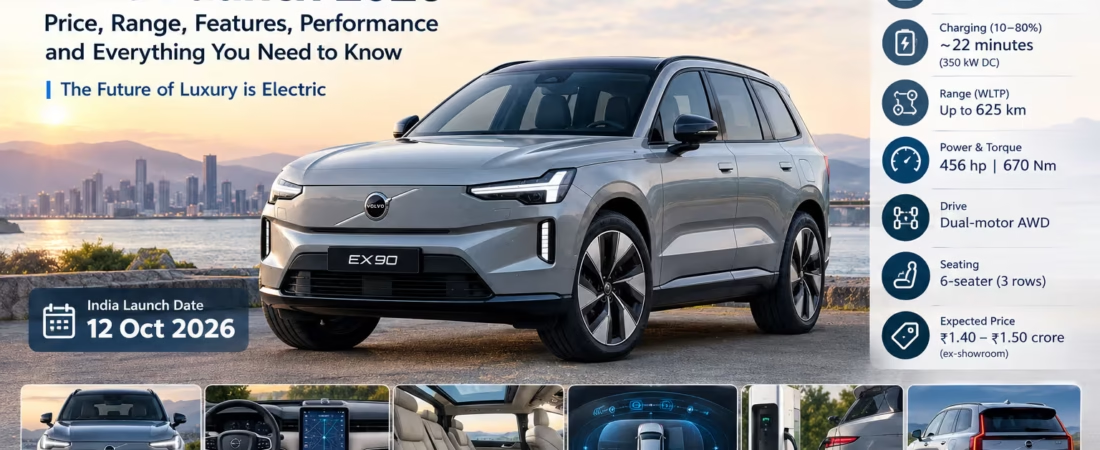
The Volvo EX90 is set to become one of the most important additions to Volvo’s electric vehicle portfolio in India. Positioned as the brand’s flagship electric SUV, the EX90 combines a large three-row luxury-SUV body with a high-capacity battery, dual-motor all-wheel drive, advanced driver-assistance technology, a premium Scandinavian cabin and an increasingly software-defined vehicle architecture.
For Indian luxury-car buyers, the timing is particularly interesting. Volvo Cars India has confirmed that the EX90 will arrive in the country on 12 October 2026, alongside the all-electric ES90 sedan. The EX90 is expected to sit above the XC90 in Volvo’s SUV hierarchy and compete in the premium electric-SUV space against models such as the BMW iX, Mercedes-Benz EQS SUV and Kia EV9.
The international specification of the EX90 is equally significant. Volvo Cars India currently lists a 106kWh battery, 800V electrical architecture, dual-motor AWD, 456hp, 670Nm, a claimed range of up to 625km and 10–80 percent DC charging in about 22 minutes when using a 350kW charger. The Indian specification and final equipment list can still differ from other markets, so buyers should treat market-specific details as subject to final confirmation.
This guide looks at everything that matters about the upcoming Volvo EX90 in India—from expected price and launch date to battery range, charging, performance, interior, technology, safety, practicality and its position against rival luxury EVs.
Volvo EX90 India Launch Date
The Volvo EX90 India launch date is 12 October 2026.
Volvo Cars India has confirmed the date for the EX90 and ES90, making October an important month for the company’s Indian electric-vehicle strategy. The EX90 will represent Volvo’s flagship SUV offering in the Indian market.
The launch is particularly significant because the EX90 is not simply an electric replacement for a smaller Volvo SUV. It is designed as a large, premium, technology-heavy electric vehicle that sits at the top of Volvo’s SUV range.
According to current Indian automotive-industry reports, the EX90 is expected to be offered in a highly equipped configuration, with Autocar India reporting an expected Ultra variant for the Indian market.
Volvo EX90 India launch at a glance
| Item | Volvo EX90 |
|---|---|
| India launch date | 12 October 2026 |
| Body style | Luxury electric SUV |
| Seating | 6 seats listed by Volvo Cars India |
| Battery | 106kWh nominal |
| Architecture | 800V |
| Drive | Dual-motor AWD |
| Maximum power | 456hp |
| Maximum torque | 670Nm |
| Claimed range | Up to 625km |
| 0–100km/h | 5.5 seconds |
| Top speed | 180km/h |
| DC charging | Up to 350kW |
| 10–80% charging | About 22 minutes |
| Expected price | Around ₹1.40–₹1.50 crore, ex-showroom |
| Expected trim | Ultra |
The specifications above combine Volvo Cars India’s current published data with Indian launch information. The expected price remains an estimate until Volvo officially announces the Indian price.
Volvo EX90 Expected Price in India
The Volvo EX90 expected price in India is around ₹1.40 crore to ₹1.50 crore, ex-showroom, according to current Indian automotive-industry estimates. This is not an official final price and should be treated as an expected range until Volvo Cars India announces the price at launch.
At this level, the EX90 will move Volvo into a significantly more expensive category than models such as the EX30 and EC40.
The positioning makes sense because the EX90 is a much larger vehicle with three-row capability, a substantially larger battery, dual electric motors, advanced suspension technology and a long list of premium comfort and safety features.
What will affect the final on-road price?
Indian buyers should remember that the ex-showroom price is only one part of the purchase cost.
The final on-road price can include:
- Registration charges
- Insurance
- Road tax, where applicable
- Handling or logistics-related charges, if applicable
- Optional accessories
- Extended warranty packages
- Service packages
- Home-charging equipment and installation
- Finance-related costs
Because the EX90 is positioned as a flagship luxury EV, buyers should compare the complete ownership package, not simply the headline ex-showroom price.
Volvo EX90 Design: Large, Premium and Unmistakably Scandinavian
The Volvo EX90 follows the modern Scandinavian design direction established by Volvo’s newer electric models.
Instead of relying on excessive exterior decoration, the SUV uses clean surfaces, a tall but aerodynamic body and distinctive lighting elements to create a premium appearance.
The design is deliberately restrained compared with some large luxury SUVs.
That approach may appeal to buyers who want an expensive vehicle without an overly aggressive or attention-seeking appearance.
Front Design
The front of the EX90 is dominated by Volvo’s modern interpretation of the traditional grille area.
Because the vehicle is fully electric, the front design does not require a conventional engine-air intake grille in the same way as a petrol or diesel SUV.
The lighting signature becomes one of the most recognisable design elements.
The EX90 uses Volvo’s modern LED lighting technology, while its overall front-end design keeps the vehicle visually related to the rest of the Volvo family.
Side Profile
The EX90 is a large SUV.
Volvo Cars India lists the vehicle at approximately 5,037mm long, 1,964mm wide and 1,744mm high, with a wheelbase of around 2,985mm.
Those dimensions provide an important clue about its positioning.
This is not a compact urban EV designed primarily around easy parking. It is a full-size premium SUV intended to provide substantial passenger space and long-distance comfort.
The long wheelbase should also help create useful interior room between the front and rear axles.
Rear Design
The rear follows the same minimalist philosophy.
Vertical and sculpted lighting elements give the EX90 a distinctive appearance without making the tail section excessively complicated.
For buyers who prefer understated luxury, this may be one of the SUV’s strongest visual qualities.
Volvo EX90 Dimensions and Practicality
Large luxury electric SUVs need to do more than provide impressive acceleration. They need to work as family vehicles.
The EX90’s dimensions are therefore important.
Key dimensions
- Length: approximately 5,037mm
- Width: approximately 1,964mm
- Height: approximately 1,744mm
- Wheelbase: approximately 2,985mm
- Turning circle: approximately 12 metres
- Gross vehicle weight: approximately 3,310kg
- Maximum trailer weight: up to 2,200kg
These figures come from Volvo Cars India’s published specification data.
The EX90 is therefore substantial in every direction.
That size should benefit highway stability and interior space, but buyers living in older urban areas should consider parking dimensions before purchasing.
Is the Volvo EX90 suitable for Indian cities?
Yes, but with an important qualification.
The EX90 can be used in Indian cities, but its size means that owners should be comfortable driving a large luxury SUV.
Features such as cameras, driver-assistance systems and parking aids can reduce the stress of manoeuvring, but electronic assistance does not change the physical dimensions of the vehicle.
For homes with narrow gates, basement parking or tight ramps, buyers should measure the available space before booking.
This is especially important for a vehicle that is nearly five metres long and almost two metres wide.
Volvo EX90 Battery and Electric Powertrain
The EX90’s powertrain is one of its biggest technical highlights.
Volvo Cars India lists the SUV with a 106kWh battery and dual electric motors driving all four wheels. The system produces 335kW, equivalent to 456hp, and 670Nm of maximum torque.
Unlike an internal-combustion SUV, the EX90 does not need a conventional multi-speed gearbox.
Electric motors deliver torque directly through the vehicle’s electric drive system, which allows the EX90 to respond quickly to accelerator inputs.
Dual-motor AWD
The dual-motor setup means there is an electric motor at the front and another at the rear.
Volvo’s published technical data shows:
- Front motor: 177hp
- Rear motor: 279hp
- Combined maximum output: 456hp
- Combined maximum torque: 670Nm
The result is an all-wheel-drive system capable of delivering strong traction and rapid acceleration.
For Indian conditions, AWD can be useful beyond outright performance.
It can improve traction on wet roads and loose surfaces, although tyres, road conditions and driver inputs remain crucial.
Volvo EX90 Performance
Despite its size, the EX90 is a quick SUV.
Volvo Cars India lists a 0–100km/h time of 5.5 seconds and a top speed of 180km/h.
That acceleration figure puts the EX90 firmly in the performance-luxury category.
However, the more important characteristic may be how the power is delivered.
Electric torque is available immediately, so acceleration does not require waiting for engine revs or gear changes.
This makes the EX90 particularly well suited to:
- Highway overtaking
- Joining fast-moving traffic
- Smooth urban acceleration
- Hill roads
- Fully loaded family journeys
The 180km/h top-speed limit is consistent with Volvo’s long-standing emphasis on controlled performance and safety rather than unrestricted maximum speed.
Volvo EX90 Range: How Far Can It Travel?
Range is one of the first questions prospective luxury-EV buyers ask.
The Volvo EX90 currently has a claimed WLTP range of up to 625km in the specification listed for the 106kWh configuration.
That number is useful as a benchmark, but buyers should not interpret it as a guaranteed real-world driving distance.
Actual range can vary according to:
- Driving speed
- Ambient temperature
- Air-conditioning usage
- Traffic
- Terrain
- Passenger and luggage load
- Tyre pressure
- Driving style
- Battery condition
- Wheel and tyre configuration
- Charging and battery-conditioning strategy
For Indian conditions, highway driving at sustained high speeds will generally use more energy than slower mixed driving.
What does a 625km WLTP range mean in practical terms?
A claimed 625km WLTP range provides a strong theoretical buffer for long-distance travel.
However, a sensible EV owner should not plan every journey around reaching the absolute claimed figure.
Instead, consider the vehicle’s usable range as a planning window.
For example, a road trip of several hundred kilometres becomes much easier when the route contains reliable fast chargers at sensible intervals.
That is why charging infrastructure is just as important as battery capacity.
Volvo EX90 Charging Time
The EX90’s 800V architecture is a major advantage.
Volvo Cars India lists DC charging of up to 350kW, with a claimed 10–80 percent charging time of approximately 22 minutes under the stated charging conditions.
This does not mean every charging station will deliver 350kW.
The actual charging speed depends on:
- Charger output
- Battery state of charge
- Battery temperature
- Vehicle charging conditions
- Charger availability
- Electrical infrastructure
- Charging-curve behaviour
The headline figure is therefore best understood as the vehicle’s fast-charging capability rather than a guaranteed charging experience at every station.
Why 800V matters
An 800V architecture allows high-power charging with lower current for a given power level compared with a lower-voltage system.
That can help enable faster charging and efficient power delivery.
For an expensive long-distance SUV, fast charging is particularly important because owners may use the vehicle for intercity travel rather than only short daily commutes.
Home Charging the Volvo EX90
Public DC fast charging is useful during road trips, but most EV owners benefit from doing most charging at home or at their regular parking location.
The Volvo EX90 specification lists an 11kW onboard charger and home-charging equipment support.
A home charger is useful because the car can be connected overnight.
Instead of waiting at a public charger every time the battery needs energy, an owner can start most days with a high state of charge.
Before buying the EX90, prospective owners should check:
- Whether their home has suitable electrical capacity.
- Whether parking is legally and practically suitable for charger installation.
- Whether the building’s housing society permits EV charging.
- Whether a dedicated electrical connection is required.
- How the charger cable will be routed safely.
- Whether the installer provides adequate protection and earthing.
- Whether the charger location is protected from water and physical damage.
These considerations are particularly important for apartment owners.
Volvo EX90 Interior
The cabin is where the EX90’s luxury positioning becomes most apparent.
Volvo has taken its Scandinavian design philosophy and translated it into a large electric SUV with a focus on clean surfaces, high-quality materials, technology and passenger comfort.
The India specification page lists features including:
- 14.5-inch centre display
- Six seats
- Front-seat massage
- Ventilated seats
- Four-zone climate control
- Heat pump
- Air purification
- Google built-in
- 5G connectivity
- Wireless Apple CarPlay
- Wireless Android Auto
- Wireless phone charging
- Bowers & Wilkins high-fidelity audio
- Over-the-air updates
Feature availability can vary by market and equipment level, so the final Indian equipment list should be confirmed at launch.
Six-Seat Configuration
One of the most interesting aspects of the India-listed EX90 is its six-seat configuration.
Instead of a conventional three-person bench in the second row, the six-seat arrangement uses individual second-row seats.
That can create a more premium atmosphere and provide easier movement through the cabin.
For families, however, there is a trade-off.
A six-seat configuration may not be ideal for every family because a conventional middle seat is unavailable in the second row.
For chauffeur-driven luxury, business users and families who value individual seating, the captain-chair layout can be highly attractive.
Volvo EX90 Third Row
The EX90 is designed as a three-row SUV, and Volvo specifically positions its large SUV cabins around three-row usability.
The company also highlights full-sized seating and practical storage throughout the cabin.
Third-row usability is one of the areas where the EX90 can have an advantage over large five-seat electric SUVs.
However, prospective buyers should physically test the third row rather than judging it only from specifications.
A proper test drive should include:
- Sitting in the third row
- Checking knee and legroom
- Checking headroom
- Testing second-row access
- Checking child-seat arrangements
- Testing luggage capacity with all seats occupied
For a family SUV, these details matter more than a large touchscreen or impressive acceleration figure.
Volvo EX90 Boot Space and Storage
Volvo Cars India lists substantial storage flexibility.
The published specifications show:
- Up to 324 litres with the third row in use under one measurement
- Up to 690 litres with the second row in use
- Up to 1,212 litres with seats folded under the listed open-capacity measurement
- Up to 2,135 litres under the maximum luggage-capacity measurement
- 46-litre front load compartment
Volvo also provides a separate frunk for storing items such as charging equipment.
This flexibility makes the EX90 more practical than a luxury EV designed purely for five occupants.
For family road trips, the ability to rearrange seating and cargo space can be more useful than maximum boot capacity with all seats folded.
Volvo EX90 Technology
The EX90 is designed as a software-defined vehicle.
This means technology is not treated as something that remains unchanged after the vehicle leaves the factory.
Volvo supports over-the-air software updates that can introduce improvements and additional functions without requiring every update to be installed manually at a workshop.
Volvo’s support documentation confirms ongoing EX90 software updates and notes that features can vary by market and vehicle specification.
This approach is important because the useful life of a premium EV may extend for many years.
A vehicle whose software can evolve has the potential to remain technologically relevant for longer.
14.5-inch central display
The large portrait-style central display acts as the main interface for vehicle functions, navigation, media and connected services.
Google built-in services are part of the EX90 technology ecosystem, while wireless Apple CarPlay and Android Auto provide smartphone integration.
The challenge with a highly screen-focused interior is usability.
Drivers should be able to perform common tasks without excessive menu navigation.
This is one reason a test drive should include everyday functions such as:
- Adjusting climate settings
- Changing audio volume
- Setting navigation
- Switching driving assistance functions
- Adjusting seat controls
- Checking charging information
A technically advanced cabin is only useful if it remains intuitive while driving.
Google Built-In and Connected Services
Google services are integrated into the EX90 platform.
The system can support navigation, voice interaction and connected applications, while Volvo also supports the Volvo Cars app and remote vehicle functions.
Volvo states that Google services are subject to digital-service terms and that certain connected services may be included for a defined period depending on market and package.
This means buyers should check exactly what connectivity and subscription benefits are included with the Indian vehicle.
Bowers & Wilkins Audio System
The EX90 can be equipped with a premium Bowers & Wilkins High Fidelity audio system.
Volvo says the system uses 25 speakers and 1,610 watts of amplification, with Dolby Atmos support.
This is more than a conventional upgraded car stereo.
Speaker placement is integrated into the cabin design, helping create a more immersive listening environment.
Volvo has also introduced an Abbey Road Studios Mode for EX90 vehicles fitted with the Bowers & Wilkins system. The feature is delivered through software and provides different sound profiles inspired by the famous recording studio.
For buyers who spend significant time travelling, premium audio can be a meaningful luxury feature rather than simply a specification-sheet item.
Volvo EX90 Safety Features
Safety remains central to the EX90’s identity.
Volvo has equipped the vehicle with a wide range of sensors and driver-support technologies, while the company continues to develop the vehicle’s software after production.
Depending on specification and market, EX90 technology can include:
- Collision avoidance assistance
- Driver monitoring
- Pilot Assist
- Parking assistance
- Surround-view camera functions
- Connected safety information
- Emergency assistance
- Advanced sensor systems
- Lidar on applicable vehicles
The precise Indian specification should be verified before purchase because driver-support hardware and features can vary by market.
Lidar and the EX90
Lidar is one of the technologies associated with the EX90’s advanced safety architecture.
Volvo explains that lidar uses infrared light to collect information about objects around the vehicle. It can assist several driver-support functions.
However, Volvo has also produced EX90 model-year vehicles without lidar because of hardware supply constraints.
The company states that these vehicles continue to meet its safety standards and use other sensors and computing systems for driver support.
This is an important reminder for buyers: do not assume that every EX90 in every market has identical sensor hardware.
Always verify the equipment of the specific Indian vehicle.
Volvo EX90 Hardware and Software Upgrades
One of the most interesting aspects of the EX90 story is how Volvo has continued to upgrade the vehicle.
For the 2026 version, Volvo announced an 800V electrical system and a more powerful computing platform based on NVIDIA DRIVE AGX Orin technology.
The company said the upgrades support faster charging and new or improved safety, collision-avoidance and driver-support functions.
Volvo has also described complimentary core-computer upgrades for eligible earlier EX90 vehicles in certain markets, demonstrating how the company is attempting to extend the vehicle’s technological capability after delivery.
For a software-heavy luxury EV, this matters.
The EX90 is not merely an electric SUV with a large battery. It is increasingly being developed as a computing platform on wheels.
Volvo EX90 Air Suspension and Ride Comfort
Large luxury SUVs are expected to deliver comfort, and the EX90 uses sophisticated suspension technology to support that goal.
Volvo Cars India describes a self-levelling dual-chamber air suspension system designed to maintain ride height according to load.
The system can also lower the vehicle at higher speeds to improve efficiency and stability.
Air suspension can be particularly useful in India because road surfaces vary considerably.
However, suspension sophistication does not mean every road becomes perfectly smooth.
Large wheels, low-profile tyres and heavy vehicle weight can still influence how the car feels over potholes, sharp edges and broken surfaces.
The best way to judge the EX90’s suitability for your local roads is therefore a proper test drive.
Volvo EX90 Driving Experience
The EX90’s driving philosophy is different from that of a performance-oriented electric SUV.
Its 456hp output is substantial, but the vehicle’s character is more focused on effortless performance and comfort.
The dual-motor system can deliver strong acceleration when required, while the air suspension and insulated cabin are designed to keep occupants relaxed.
This combination makes the EX90 particularly attractive for:
- Long-distance highway travel
- Family road trips
- Chauffeur-driven use
- Premium urban commuting
- Buyers who want performance without a harsh ride
The quietness of an EV also complements the luxury positioning.
Without the vibration and conventional engine noise of an internal-combustion engine, cabin insulation becomes even more noticeable.
Volvo EX90 vs Volvo XC90
The most natural comparison within Volvo’s own lineup is the XC90.
The XC90 remains associated with the traditional luxury three-row SUV formula, while the EX90 moves that formula into a fully electric architecture.
EX90 advantages
- Fully electric powertrain
- 800V architecture
- Faster DC charging capability
- 106kWh battery
- Dual-motor AWD
- Advanced software architecture
- Strong acceleration
- Modern electric platform
XC90 advantages
- Conventional powertrain familiarity
- Established refuelling infrastructure
- Different powertrain choices
- Potentially easier long-distance refuelling
The right choice depends largely on usage.
If home charging is available and the majority of journeys fit comfortably within the vehicle’s real-world range, the EX90 makes a compelling alternative.
If long-distance travel involves remote areas with limited charging infrastructure, a conventional or hybrid SUV may still offer greater convenience.
Volvo EX90 vs BMW iX
The BMW iX is one of the most obvious competitors for buyers considering a premium electric SUV.
The two vehicles approach luxury differently.
The BMW traditionally places greater emphasis on driving dynamics and driver engagement, while the EX90 focuses heavily on Scandinavian minimalism, family practicality, comfort and safety technology.
The EX90 also offers three-row seating in its larger configuration, which can make it more useful for larger families.
The BMW iX, depending on variant, may appeal more strongly to buyers who prioritise a sportier driving experience.
For buyers deciding between the two, the best comparison is not simply power output.
Evaluate:
- Seating requirements
- Rear-seat comfort
- Charging network
- Ride quality
- Infotainment
- Driving feel
- Service support
- Resale expectations
- Home-charging availability
Volvo EX90 vs Mercedes-Benz EQS SUV
The Mercedes-Benz EQS SUV is another premium electric SUV that will naturally enter the conversation.
The EQS SUV is particularly strong in luxury presentation, rear-seat comfort and high-end cabin technology.
The EX90 takes a somewhat different approach.
Its design is quieter and more minimalist, while Volvo puts considerable emphasis on safety and family-oriented usability.
The final decision will likely come down to personal priorities.
Choose the EX90 if you prefer:
- Scandinavian design
- Understated luxury
- Six-seat family practicality
- Volvo’s safety philosophy
- Software-based vehicle development
- Strong electric performance
The Mercedes may appeal more to buyers seeking maximum visual drama and traditional German luxury ambience.
Volvo EX90 vs Kia EV9
The Kia EV9 is another important reference point because it combines three-row practicality with a fully electric powertrain.
The key difference is positioning.
The EX90 sits firmly in the luxury segment, with premium materials, high-end audio, sophisticated suspension and a more exclusive brand position.
The EV9 can make a strong case for buyers who prioritise practicality and value.
For a buyer with a large family, the seating layout and actual third-row usability may matter more than brand prestige.
Who Should Buy the Volvo EX90?
The EX90 makes the most sense for a specific type of buyer.
1. Luxury SUV buyers ready to switch to EVs
If you already own a premium SUV and have reliable home charging, the EX90 can provide an electric alternative without sacrificing size or luxury.
2. Large families
The three-row layout and six-seat configuration make the EX90 particularly relevant for families that regularly carry multiple passengers.
3. Chauffeur-driven customers
The quiet cabin, premium seating and individual second-row seats can make the EX90 attractive for rear passengers.
4. Technology-focused buyers
The EX90 is heavily dependent on software, connected services and driver-assistance technology.
If you enjoy technology and frequent software improvements, this is a major attraction.
5. Long-distance EV users
The combination of a 106kWh battery, claimed 625km WLTP range and 350kW DC charging capability makes the EX90 suitable for serious EV road-trip use—provided the route has adequate fast-charging infrastructure.
Who Should Think Twice Before Buying?
The EX90 is not automatically the right vehicle for every luxury-car buyer.
Consider alternatives if:
- You do not have access to home charging.
- Your regular routes have poor public charging coverage.
- You frequently travel to remote areas.
- Your parking space is too small for a large SUV.
- You strongly prefer conventional driving dynamics.
- You want the lowest possible running cost regardless of purchase price.
- You rarely carry more than four or five passengers.
- You prefer physical controls over screen-based interfaces.
A premium EV should be purchased according to actual lifestyle requirements, not simply because the specification sheet looks impressive.
How to Prepare for Buying the Volvo EX90 in India
The best time to evaluate an EV is before booking it.
Step 1: Calculate your daily driving
Write down your typical weekday distance.
If you drive 30–50km per day, the EX90’s large battery provides substantial flexibility.
If you regularly drive several hundred kilometres daily, charging access becomes much more important.
Step 2: Check home charging
Confirm whether you can install an appropriate charger.
For apartment owners, obtain permission before booking the vehicle.
Step 3: Map your regular highways
Identify fast-charging locations along your common routes.
Do not rely on one charger.
A better strategy is to identify several alternatives.
Step 4: Test the third row
Take the entire family for a test drive.
Have the tallest passenger sit in the third row.
Check access, comfort and luggage space.
Step 5: Test the technology
Do not let the salesperson demonstrate only the entertainment system.
Try:
- Navigation
- Climate controls
- Driver-assistance settings
- Parking cameras
- Charging information
- Voice controls
- Smartphone connectivity
Step 6: Compare the total cost
Ask for:
- Ex-showroom price
- On-road price
- Insurance
- Service package
- Warranty
- Home charger
- Installation
- Extended warranty
- Finance options
This provides a much clearer picture than comparing headline prices alone.
Volvo EX90 Ownership: What Buyers Should Consider
Buying a premium EV involves more than battery range.
Battery warranty
Ask Volvo for the exact battery warranty applicable to the Indian vehicle.
Battery warranty conditions can differ by market.
Software support
Because the EX90 is software-heavy, ask how long software and connected-service support will remain available.
Volvo already provides over-the-air updates for the EX90, but connected-service terms can vary.
Service network
Check whether your nearest Volvo service facility is equipped to handle high-voltage EV systems.
Tyres
Large luxury EVs are heavy, and tyre wear can be influenced by weight, torque and driving style.
Charging equipment
Confirm exactly what charging hardware is included with the vehicle.
Insurance
A high-value luxury EV can have substantial insurance costs.
Compare several policies and check EV-specific coverage.
Common Mistakes to Avoid When Buying a Luxury EV
Mistake 1: Believing the advertised range completely
WLTP range is a standardised test figure, not a guarantee of real-world range.
Use it as a comparison benchmark.
Mistake 2: Ignoring charging infrastructure
A 350kW-capable car is not useful if your regular destinations have no compatible high-speed charger.
Mistake 3: Choosing based only on horsepower
A luxury family SUV is not a drag-racing car.
Ride comfort, seats, cabin noise, storage and charging convenience can matter more.
Mistake 4: Ignoring vehicle dimensions
The EX90 is a large SUV.
Measure your garage and driveway.
Mistake 5: Not checking the exact specification
Luxury cars often have market-specific equipment.
Confirm whether features such as lidar, audio systems, seating configurations and driver-support functions are included on the exact Indian vehicle.
Mistake 6: Forgetting the charging curve
Maximum charging power is only part of the story.
Ask about the typical charging time from 10–80 percent and how the vehicle manages charging at different battery levels.
Expert Tips for Getting the Most From the Volvo EX90
Keep the battery in a sensible operating range
For daily use, avoid treating 100 percent charging as necessary every day unless your driving needs require it.
Use scheduled charging
Charging at home overnight can be more convenient than depending on public chargers.
Precondition the battery
Battery conditioning can help prepare the vehicle for faster DC charging under suitable conditions.
Volvo’s software ecosystem includes charging-management functions and battery preconditioning options.
Plan road trips around charging stops
Choose reliable chargers near restaurants, cafés or rest areas.
A 20–30 minute charging stop is easier when it coincides with a meal or break.
Keep software updated
Because EX90 features can evolve through software updates, keeping the vehicle updated is part of ownership.
Learn the driver-assistance systems
Understand what each assistance system can and cannot do.
Driver assistance is not autonomous driving, and the driver remains responsible for monitoring the road.
Is Volvo EX90 a Good Family EV?
The EX90 has many characteristics that make it suitable for family use.
It provides three rows, substantial storage, a large battery, all-wheel drive, a quiet cabin and a strong focus on safety.
The six-seat layout can also give second-row passengers a more premium experience.
However, its large dimensions and high expected purchase price mean it is not a conventional family SUV.
It is better understood as a luxury family EV.
For families who already spend significant amounts on premium vehicles and have access to home charging, the EX90 can make a strong case.
Is Volvo EX90 Good for Long Road Trips?
Potentially, yes.
The combination of a claimed 625km WLTP range and up to 350kW DC charging capability gives the EX90 the technical ingredients needed for long-distance EV travel.
But road-trip convenience will ultimately depend on India’s charging network.
Before a long journey, owners should:
- Start with a high battery level.
- Check the route.
- Identify multiple charging options.
- Account for weather and traffic.
- Avoid planning around the absolute maximum range.
- Keep a reasonable battery reserve.
- Use charging stops as rest breaks.
The EX90 can be a capable road-trip vehicle, but EV road-trip planning remains different from simply driving into any petrol station.
Volvo EX90: Key Pros and Cons
Pros
- Large premium electric SUV
- 800V architecture
- 106kWh battery
- Dual-motor AWD
- 456hp and 670Nm
- Claimed range of up to 625km
- Fast DC charging capability
- Six-seat configuration
- Three-row practicality
- Air suspension
- Advanced safety technology
- Large 14.5-inch central display
- Google built-in
- Wireless Apple CarPlay and Android Auto
- Premium Bowers & Wilkins audio option
- Over-the-air software updates
- Scandinavian minimalist design
Cons
- Expected price above ₹1.4 crore
- Very large exterior dimensions
- High vehicle weight
- Public charging availability remains important
- Some features can vary by market
- Heavy reliance on touchscreen interfaces
- Final Indian specifications need confirmation
- Luxury EV depreciation can be difficult to predict
Volvo EX90: What Makes It Different?
The EX90’s biggest strength is not one individual feature.
It is the way several technologies work together.
The large battery provides long-distance capability.
The 800V electrical system supports fast charging.
Dual motors provide performance and all-wheel drive.
Air suspension focuses on comfort.
Three rows improve family practicality.
Connected software provides ongoing updates.
Advanced sensors support driver assistance.
Premium materials and audio create the luxury environment expected from a flagship SUV.
That combination gives the EX90 a distinctive position.
Future of Volvo’s Electric SUV Strategy
The EX90 also offers a glimpse into where Volvo’s product strategy is heading.
The company is increasingly treating vehicles as connected software platforms rather than static machines.
The EX90’s continued software updates, advanced computing hardware and connected services are examples of this approach.
For consumers, this creates both advantages and new questions.
The advantage is that a vehicle can receive improvements after purchase.
The challenge is understanding which features depend on hardware, which can be delivered through software, and which connected services may require subscriptions.
That distinction will become increasingly important as premium EVs become more software-driven.
Volvo EX90 vs BMW X1 LWB: Why They Should Not Be Confused
The original search-intent placeholder in this brief mentions the BMW X1 LWB, but that is a different vehicle category from the Volvo EX90.
The EX90 is a large flagship luxury electric SUV expected around the ₹1.4–₹1.5 crore ex-showroom range, while the BMW X1 LWB is positioned much lower in the premium-SUV market.
Therefore, someone specifically searching for “BMW X1 LWB” should not be directed to an EX90 article as a direct buying guide.
For this article, the correct search intent is:
Volvo EX90 India launch, price, range, specifications, features and electric SUV review.
That distinction is important for both readers and SEO. Matching the article to the actual vehicle prevents misleading search traffic and produces a more useful resource.
Frequently Asked Questions About Volvo EX90
1. When will the Volvo EX90 launch in India?
The Volvo EX90 is scheduled to launch in India on 12 October 2026. Volvo is also scheduled to introduce the ES90 electric sedan on the same date.
2. What is the expected price of the Volvo EX90 in India?
Current Indian automotive-industry estimates put the EX90 at approximately ₹1.40 crore to ₹1.50 crore ex-showroom. This is an estimated price range and not the official final price.
3. What is the Volvo EX90 battery capacity?
Volvo Cars India’s current specification lists a 106kWh battery for the Twin Motor configuration.
4. What is the Volvo EX90 range?
The Volvo EX90 is listed with a claimed WLTP range of up to 625km. Real-world range will vary according to speed, weather, traffic, driving style, load and other conditions.
5. How powerful is the Volvo EX90?
The listed Twin Motor AWD configuration produces 456hp and 670Nm. Volvo Cars India lists a 0–100km/h time of 5.5 seconds.
6. How quickly can the Volvo EX90 charge?
With suitable DC charging equipment, the EX90 is listed as capable of charging at up to 350kW, with a claimed 10–80 percent charging time of around 22 minutes. Actual charging speed depends on battery and charger conditions.
7. How many people can the Volvo EX90 seat?
Volvo Cars India’s current specification page lists the EX90 with six seats. Volvo also describes the EX90 family as a three-row SUV, and market-specific configurations can differ.
8. Is the Volvo EX90 a good alternative to the BMW iX and Mercedes EQS SUV?
It can be, particularly for buyers who prioritise three-row practicality, Scandinavian design, comfort, safety technology and long-distance electric capability. The BMW iX and Mercedes-Benz EQS SUV have different strengths, so buyers should compare seating, driving dynamics, charging, service support and total ownership costs before making a decision.
Final Verdict: Should You Wait for the Volvo EX90?
The Volvo EX90 is one of the most significant premium electric SUVs coming to India in 2026.
Its appeal goes well beyond its 456hp output.
The vehicle combines a large 106kWh battery, 800V electrical architecture, dual-motor AWD, a claimed 625km WLTP range, fast DC charging, three-row practicality, advanced driver-support technology and a high-end Scandinavian cabin.
Its expected price of around ₹1.40–₹1.50 crore places it firmly in the luxury segment, so it will not be a mass-market EV. But for buyers already considering premium SUVs in this price category, the EX90 offers a compelling alternative to conventional luxury SUVs and established electric rivals.
The most important questions for potential buyers are not simply “How much power does it have?” or “How fast does it charge?”
Instead, ask:
Can I charge it conveniently at home?
Does its six-seat layout work for my family?
Is its size practical for my parking space?
Are fast chargers available on my regular highway routes?
Do I prefer comfort and technology over sporty driving dynamics?
If the answers are favourable, the EX90 deserves serious consideration.
With its 12 October 2026 India launch, Volvo is moving directly into the premium electric-SUV space with a product that combines luxury, family practicality and next-generation EV technology.
For prospective buyers, the best next step is to follow the official Indian launch announcement, confirm the final price and equipment list, and schedule a detailed test drive. Pay particular attention to third-row comfort, ride quality, charging options, cabin technology and the exact safety hardware offered on the Indian-spec vehicle.
The EX90 may not be the right electric SUV for everyone—but for the buyer looking for a large, sophisticated, three-row luxury EV with Volvo’s safety-focused identity, it is one of the most important new launches to watch in India this year.
MG ZS EV Review 2026: The Premium Electric SUV That Makes Every Journey Smarter