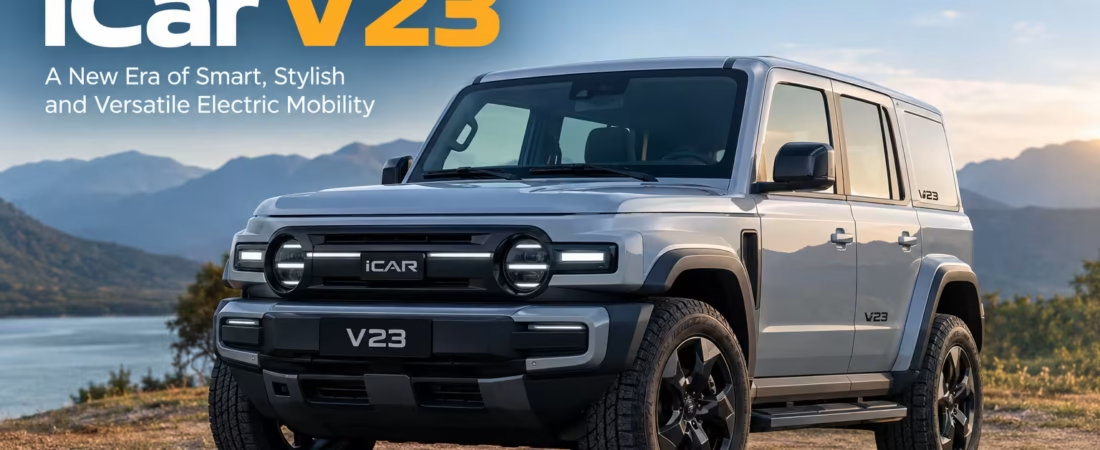
The JSW Chery iCar V23 is an upcoming electric SUV that could bring a distinctive boxy design, modern technology and an adventure-inspired appearance to India’s growing electric vehicle market. Based on the iCAR V23 sold in China, the India-focused model is expected to be introduced under JSW Motors, which is preparing to expand its passenger vehicle portfolio through its partnership with Chinese automaker Chery.
Unlike conventional electric SUVs that prioritise smooth, aerodynamic styling, the iCar V23 follows a more upright design philosophy. Its squared-off proportions, round-inspired headlamp styling, chunky wheel arches and practical-looking bodywork give it a character that appeals to buyers who want an electric vehicle with a strong visual identity.
But appearance alone does not determine whether an electric SUV is worth buying. Potential customers also need answers about its expected Indian price, battery capacity, driving range, charging speed, interior features, practicality, safety equipment and competition.
This guide examines what is known about the JSW Chery iCar V23, what the international model offers, and what Indian buyers should verify before making a purchase decision. Because the Indian version has not yet been fully confirmed, specifications from China and projected Indian-market details are clearly distinguished throughout the article.
JSW Chery iCar V23 at a glance


5
International iCAR V23 images for reference. The final Indian model may differ.
The Indian-market model has an official JSW Motors product page, which lists a maximum power output of 211 PS, maximum torque of 292 Nm, a claimed NEDC range of 430 km, and two-wheel-drive and four-wheel-drive configurations. These details are more relevant to Indian buyers than estimates based solely on the Chinese model, although final variant-wise Indian specifications and prices should still be checked at launch.
| Specification | Available information |
|---|---|
| Model | JSW Motors iCar V23 |
| Vehicle type | Fully electric SUV |
| Design | Retro-inspired, upright and boxy |
| Maximum power | 211 PS, as listed on JSW Motors’ product page |
| Maximum torque | 292 Nm, as listed on the product page |
| Claimed range | Up to 430 km, NEDC |
| Drivetrain | Two-wheel drive and four-wheel drive listed |
| Length | 4,220 mm for the international model |
| Width | 1,915 mm for the international model |
| Height | 1,845 mm for the international model |
| Wheelbase | 2,735 mm for the international model |
| Indian launch date | Not confirmed here as a final official date |
| Expected Indian price | Market estimates vary; final pricing is awaited |
Source note: Indian product information is from JSW Motors’ V23 page. Dimensions and other international-model specifications are reference figures, not a guarantee of identical Indian specifications.
1. What Is the JSW Chery iCar V23?
The JSW Chery iCar V23 is an electric SUV being prepared for the Indian market through JSW Motors’ association with Chery Automobile. The original iCAR V23 is an electric vehicle sold in international markets, particularly China, where it has established a recognisable identity through its retro-inspired styling and modern electric powertrain.
The proposed Indian version is significant for two reasons. First, it gives JSW Motors an opportunity to enter the electric SUV segment with a product that looks different from many mainstream crossovers. Second, it reflects the company’s strategy of using international vehicle platforms and adapting them for Indian customers.
JSW Motors is separate from JSW MG Motor India, the joint venture through which JSW Group is involved with MG. The new JSW Motors business is developing its own passenger vehicle portfolio, with Chery-based products forming part of its plans.
Why is the iCar V23 attracting attention?
Several factors make this SUV worth following:
- Distinctive styling: Its boxy proportions and upright stance appeal to buyers who prefer a rugged-looking vehicle.
- Electric powertrain: It offers the prospect of lower routine energy costs than a comparable petrol SUV, depending on charging prices and usage.
- Two- and four-wheel-drive options: The international range includes different drivetrain configurations, while the Indian product page also lists 2WD and 4WD.
- Technology-focused cabin: The international model features a large central touchscreen and connected entertainment functions.
- A different kind of EV: It prioritises a characterful SUV appearance rather than the smooth, coupe-like styling common among some electric crossovers.
The real question is whether these features will be matched by competitive pricing, suitable charging performance, a reliable service network and specifications adapted to Indian driving conditions.
Is it an SUV or an off-roader?
The iCar V23 has an SUV-like body, a relatively tall stance and design elements inspired by traditional utility vehicles. However, an adventurous appearance does not automatically make a vehicle suitable for demanding off-road use.
The international model’s approach and departure angles, ground clearance and available drivetrain are relevant to its capabilities. Even so, buyers should not assume that every version is designed for serious off-roading.
For Indian customers, the more useful distinction is between an urban electric SUV with rugged styling and a vehicle equipped for sustained off-road driving. The final Indian model’s tyres, suspension tuning, underbody protection, water-wading specifications and traction systems will determine where it sits on that spectrum.
2. JSW Chery iCar V23 Launch Date in India
The launch timeline is one of the most frequently searched details about the iCar V23. Reports in 2026 have discussed the SUV as part of JSW Motors’ upcoming product programme, but published estimates have not been consistent.
An Autocar India report dated March 6, 2026, described the India-bound vehicle as a model expected after the Jetour T2-based vehicle and Jaecoo J5-based electric SUV. That report discussed a possible 2028 introduction. Other automotive listings have displayed earlier estimated dates, illustrating why a listing should not be mistaken for a confirmed launch announcement.
What should buyers understand about the launch timeline?
There are several milestones that are often confused:
- Testing: A vehicle may be seen on Indian roads before its launch.
- Brand or product announcement: The manufacturer may confirm its plans without announcing a final sale date.
- Unveiling: The vehicle’s design and features may be revealed publicly.
- Price announcement: The manufacturer discloses variant-wise prices.
- Bookings and deliveries: Customers can place orders, with deliveries beginning according to the company’s schedule.
These milestones can occur months apart.
For buyers, the most reliable information will come from JSW Motors’ official announcements, dealership communications and published booking terms. Until the company confirms a final date, any specific launch month should be treated as provisional.
Will the Indian model be the same as the Chinese iCAR V23?
Not necessarily. The basic design and platform may remain similar, but the Indian version could differ in its battery choices, feature list, software, safety equipment, charging compatibility, interior trim and warranty coverage.
Manufacturers routinely adapt vehicles for local regulations, customer expectations and pricing targets. The final Indian specification sheet will therefore matter more than photographs or feature lists from another country.
3. Expected JSW Chery iCar V23 Price in India
The expected price is likely to play a major role in determining the iCar V23’s success.
Automotive publications have published different estimates. Autocar India has listed an estimated range of ₹17 lakh to ₹20 lakh, while CarDekho and ZigWheels have displayed estimates around ₹20 lakh to ₹25 lakh. These are predictions rather than an announced Indian price list.
Indicative estimated price range from automotive listings
₹17 lakh–₹25 lakh
Estimated ex-showroom pricing only. Not an official price or a confirmed variant range.
What could affect the final price?
Several factors could influence how JSW Motors positions the V23.
Battery capacity: Larger batteries typically increase material costs but can provide greater driving range. A smaller-battery version could make the SUV more accessible.
Drivetrain: A single-motor two-wheel-drive configuration and a dual-motor four-wheel-drive configuration have different hardware costs and performance characteristics.
Local assembly: Local assembly and sourcing can influence costs, although the actual benefit depends on component sourcing, production volumes, taxes and logistics. Reports have discussed assembly at JSW Motors’ Chhatrapati Sambhajinagar facility, but the final manufacturing arrangement and its effect on retail pricing should be confirmed by the company.
Features and safety equipment: Driver-assistance systems, cameras, parking technology, interior materials and convenience equipment can all affect the price of a particular variant.
Competition: JSW Motors will need to consider the prices and equipment of established electric SUVs and newer entrants.
How much could the on-road price be?
The on-road price is normally higher than the ex-showroom price. Depending on the state and applicable rules, it may include registration charges, insurance, taxes, handling-related charges where permitted, and accessories or optional packages.
For illustration, if a future variant were priced at ₹20 lakh ex-showroom, the final on-road cost would depend on the actual insurance premium, registration treatment and other applicable charges. This example is not a prediction of the V23’s final on-road price.
Before paying a booking amount, ask the dealer for a written quotation that separates:
- Ex-showroom price
- Registration and applicable taxes
- Insurance premium
- Optional accessories
- Extended warranty or service packages
- Home charger and installation charges, if applicable
- Any launch offer or exchange benefit
This makes it easier to compare the V23 with rival electric SUVs on a like-for-like basis.
4. Exterior Design: A Boxy Electric SUV With Retro Character


6
Design is one of the iCar V23’s strongest distinguishing features. Many modern SUVs use sloping rooflines, narrow lighting elements and rounded bodywork to improve aerodynamic efficiency. The V23 takes a different approach, with an upright silhouette and squared-off proportions that recall traditional utility vehicles.
Front styling
The international model has a broad, upright front end with prominent circular-inspired headlamp styling. The flat-looking bonnet and upright face contribute to its rugged appearance.
The front design is intended to give the vehicle a recognisable identity even when viewed from a distance. Lighting details and trim can vary by market and variant, so Indian buyers should check the final production model rather than assume every pictured feature will be standard.
Side profile
The side view reveals the V23’s tall body, squared wheel arches and relatively upright glasshouse. Its proportions are noticeably different from those of a conventional coupe-style electric SUV.
The tall body can help create a feeling of openness inside the cabin, although actual comfort depends on seat design, floor height and headroom. The wide body also needs consideration when driving through narrow lanes or parking in older residential buildings.
Rear styling
The rear continues the boxy theme, with a nearly vertical tailgate and distinctive horizontal lighting elements. International versions have a utility-inspired rear design that complements the front styling.
The tailgate area may also influence how easily luggage can be loaded. Buyers should check the opening height, loading lip and usable boot dimensions in person, rather than relying on exterior photographs.
Is the design practical for Indian roads?
The upright shape has advantages and compromises.
Potential advantages:
- A commanding driving position, depending on seat height
- A distinctive appearance compared with ordinary crossovers
- A tall cabin shape that may help headroom
- A body style suited to customers who prefer rugged-looking vehicles
Potential disadvantages:
- The wide body may make tight parking more challenging
- Upright surfaces can increase aerodynamic drag compared with a more streamlined design
- Large wheels or specialised tyres may cost more to replace
- The tall stance does not automatically guarantee better ride quality or off-road ability
The best way to judge the design is to sit in the vehicle, inspect visibility from the driver’s seat and try parking it in spaces similar to those used regularly.
5. Dimensions and Cabin Space
The international iCAR V23 measures approximately 4,220 mm in length, 1,915 mm in width and 1,845 mm in height, with a wheelbase of 2,735 mm. These dimensions are published for the international model and should not be assumed to be final for every Indian variant.
| Dimension | International-model reference |
|---|---|
| Length | 4,220 mm |
| Width | 1,915 mm |
| Height | 1,845 mm |
| Wheelbase | 2,735 mm |
What does the wheelbase mean for passengers?
The wheelbase is the distance between the front and rear wheels. A longer wheelbase can create more opportunity for passenger space, but it does not guarantee generous legroom.
Seat position, battery packaging, floor height and the shape of the front and rear seatbacks all influence cabin comfort. A vehicle with a flat floor may offer useful foot space, but battery placement can also affect the position of the seats.
Will it be suitable for families?
The V23 could interest small families who want a distinctive electric SUV for commuting and weekend trips. However, buyers should verify the following before choosing it as their main family vehicle:
- Rear-seat legroom with the front seats adjusted for taller occupants
- Headroom for adults in both rows
- The number of officially approved seating positions
- Child-seat anchor points and installation space
- Rear-door opening angle
- Air-conditioning performance for rear passengers
- Boot capacity with all seats in use
- Space for a stroller, shopping bags or holiday luggage
These checks matter more than a vehicle’s external dimensions alone.
What about boot space?
The international iCAR V23’s official product information highlights flexible cabin arrangements and expandable luggage space. The exact usable capacity depends on the configuration and measurement method, and should be checked against the Indian version’s final specifications.
When viewing the car, test it with the items you normally carry. A boot that looks large in photographs may have a high loading lip, a shallow floor or an awkward shape that reduces practical usefulness.
For a family vehicle, check whether the boot accommodates cabin bags, shopping, a folded stroller and charging equipment without requiring the rear seats to be folded.
6. Battery Options, Motor Performance and Drivetrain
The battery and motor configuration will have a major effect on the JSW Chery iCar V23’s performance, range and price.
The international model has been offered with different battery and drivetrain combinations. Earlier specifications include a 59.93 kWh battery paired with a rear-mounted motor producing 136 hp and 180 Nm, as well as an 81.76 kWh battery with an all-wheel-drive setup producing approximately 211 hp and 292 Nm. The official international specifications have also evolved across versions, so figures should be matched to the exact variant being discussed.
The Indian JSW Motors product page lists 211 PS and 292 Nm, with 2WD and 4WD options. That does not, by itself, confirm that every international battery and motor combination will be offered in India.
What is the difference between 2WD and 4WD?

Two-wheel drive (2WD)
Typically simpler and potentially more affordable, depending on the final configuration. It can be suitable for commuting and ordinary road use.

Four-wheel drive (4WD)
Can provide improved traction when power is distributed to both axles. It may also deliver stronger acceleration, with additional cost and energy use.
The right drivetrain depends on how the vehicle will be used.
For city driving, regular commuting and highway journeys, a two-wheel-drive variant may be sufficient. Buyers who frequently encounter slippery surfaces, loose gravel or challenging terrain may appreciate four-wheel drive, provided the vehicle’s tyres and ground-clearance capabilities are suitable.
However, four-wheel drive does not automatically make a vehicle an off-roader. Tyres, traction control, suspension, underbody protection, approach angles and driver skill remain important.
How quick could the iCar V23 be?
The international all-wheel-drive version has been reported with a 0–100 km/h acceleration time of approximately 7.5 seconds, while a rear-wheel-drive version has been reported at around 11 seconds. These are international-model figures and should not be treated as verified performance results for the Indian version.
Electric motors deliver torque without the gear changes associated with conventional multi-speed petrol vehicles. This can make the V23 feel responsive when pulling away from traffic lights or merging into a moving lane.
Still, acceleration is only one part of the driving experience. Suspension tuning, steering response, braking, tyre grip and stability at highway speeds are equally relevant.
What should buyers check on a test drive?
During a test drive, assess:
- How smoothly the SUV accelerates from a complete stop.
- Whether power delivery feels predictable in slow traffic.
- How easily it maintains speed on an incline.
- Whether steering feels manageable in tight turns.
- How confidently it brakes from ordinary city speeds.
- Whether the suspension handles broken roads without excessive bouncing.
- How much motor, tyre and wind noise enters the cabin.
- Whether the regenerative braking settings suit your driving style.
A short test drive may not reveal every issue, but it can help determine whether the vehicle feels comfortable and natural to drive.
7. Driving Range: How Far Can the JSW Chery iCar V23 Travel?
Driving range is one of the most important considerations when buying an electric vehicle.
JSW Motors’ V23 product page lists a maximum NEDC range of 430 km. International specifications have also advertised different range figures, including 401 km and up to 510 km under the Chinese CLTC test cycle, depending on the version. These figures should not be compared as if they were measured under identical conditions.
NEDC, CLTC and real-world range explained
Different test cycles use different procedures to estimate energy consumption and driving range.
- NEDC: An older test cycle that can produce optimistic range estimates compared with many real-world driving conditions.
- CLTC: A Chinese test cycle designed around its own driving profile and test conditions.
- Real-world range: The distance an owner actually achieves, affected by traffic, weather, speed, terrain, load and driving habits.
A 430 km NEDC claim does not mean that every driver will travel 430 km on a full charge. Nor should a CLTC figure be used as a direct substitute for an Indian real-world estimate.
What affects electric SUV range in India?
Highway speed: Driving fast generally requires more energy because aerodynamic resistance increases with speed.
Air conditioning: Cooling the cabin consumes electricity, especially in hot weather and during long journeys.
Traffic conditions: Stop-start traffic can increase energy use, although regenerative braking can recover some energy during deceleration.
Road surface and elevation: Rough roads, steep climbs and repeated acceleration can increase consumption.
Passenger and luggage load: A heavier vehicle generally needs more energy to accelerate and climb.
Tyres and wheel choice: Tyre pressure, rolling resistance and wheel specifications can influence efficiency.
Battery temperature: Battery temperature and thermal management can affect efficiency and charging performance.
How should you estimate your usable range?
Rather than relying only on a published figure, use a conservative planning approach.
Suppose an EV has an illustrative usable battery capacity of 60 kWh and averages 18 kWh per 100 km in your actual driving conditions. The arithmetic gives:
\[ \text{Estimated range}=\frac{60}{18}\times100\approx333\text{ km} \]
This is an example, not a prediction for the V23. Its usable battery capacity, consumption and real-world range in India must be verified for the final model.
The example demonstrates why battery capacity and energy consumption are more useful together than a range figure alone.
Is the V23 suitable for long-distance journeys?
It could be, provided the final Indian version has a suitable range and the route offers dependable charging facilities.
Before a long trip, check the charger locations along the route, charging speeds, expected stops and alternative stations. Do not plan a journey around the assumption that every advertised charging point will be operational or available.
For an unfamiliar route, preserve a reasonable battery reserve instead of targeting arrival with almost no charge remaining. This is especially useful when travelling through areas with fewer charging stations.
8. Charging Time and Charging Infrastructure
Charging convenience can determine whether an electric SUV works well for your lifestyle.
The international iCAR V23 specifications have listed DC fast-charging support in the approximate 85 kW to 104 kW range for earlier configurations. Charging capability varies with the exact battery and version, and the Indian vehicle’s final charging specifications should be confirmed before purchase.
Home charging
Home charging can be convenient for owners who have a dedicated parking space and access to a suitable electrical installation.
A home charger lets drivers replenish the battery while the vehicle is parked overnight or during other periods when it is not needed. The actual charging time depends on the battery’s size, charger output, vehicle limits and charging losses.
Before installing a charger, ask the dealer and a qualified electrician about:
- Whether your electrical connection can support the required load
- The recommended charger rating
- Earthing and electrical protection
- Cable routing and parking-space access
- Housing-society or apartment permissions
- Installation cost and warranty
- Whether the quoted vehicle price includes the charger
Do not assume that every EV includes a home wall box as standard.
Public AC charging
AC charging is often useful when a vehicle remains parked for several hours, such as at a workplace, hotel or shopping centre.
The charging speed is limited by the vehicle’s onboard charger and the power available at the station. A high-capacity public AC point cannot necessarily charge a car faster than the car’s own onboard hardware allows.
DC fast charging
DC fast charging is useful for highway stops because it can replenish the battery more quickly than typical home AC charging.
However, peak charging power is not sustained throughout an entire session. Charging rates can fall as the battery fills, particularly at higher states of charge or when the battery is outside its preferred temperature range.
For this reason, a claim such as “up to 100 kW” should not be interpreted as a guarantee that every charging session will run at 100 kW.
How to calculate charging time
A simple estimate is:
\[ \text{Time (hours)}\approx \frac{\text{Energy added (kWh)}}{\text{Average charging power (kW)}} \]
For example, adding 30 kWh at an average rate of 30 kW would take approximately one hour before accounting for losses and changes in charging speed.
Actual charging time depends on the car, charger, battery temperature, starting charge level and charging curve.
What Indian buyers should verify
Before booking the V23, ask the dealership to confirm the charging connector standard, maximum AC input, DC fast-charging capability, expected charging time over a stated battery percentage range, and compatibility with public charging networks.
Also check whether the vehicle can precondition its battery before a fast-charging stop, whether charging information appears in the navigation system, and whether the manufacturer offers roadside support for charging-related problems.
These practical details are particularly important for buyers who regularly travel beyond their home city.
9. Interior, Infotainment and Connected Technology


8
The international iCAR V23 combines a modern touchscreen-oriented cabin with the practical proportions of a boxy SUV.
Official international product information lists a 15.4-inch, 2.5K central display, a Qualcomm Snapdragon 8155-based infotainment system and Apple CarPlay support. It also highlights flexible cabin arrangements and connected entertainment functions. The precise equipment available in India may differ.
Infotainment screen
A large central display can make navigation, media and vehicle settings easier to access, provided the software is responsive and the interface is well organised.
Screen size alone is not a reliable measure of usability. The quality of the menus, voice controls, touch response and physical controls matters just as much.
When evaluating the Indian model, check whether frequently used functions can be operated without navigating through several menus. Climate controls, demisting, camera views and driving settings should be straightforward to access.
Smartphone connectivity
Apple CarPlay is listed on the international product page, but buyers should verify the exact Indian equipment list and whether connectivity is wired or wireless.
Also check Android smartphone compatibility, Bluetooth call quality, USB ports and whether navigation works reliably in areas with weak mobile coverage.
A good infotainment system should not require the driver to interact with the screen excessively while moving.
Seats and driving position
The high-roof design may contribute to a spacious feeling, but comfort depends on the seat’s shape, cushioning, lumbar support and adjustment range.
During a test drive, check:
- Whether the driver’s seat offers adequate adjustment
- Whether the steering wheel can be positioned comfortably
- Whether the front seats support your thighs and lower back
- Whether rear passengers have enough knee and headroom
- Whether the front and rear headrests are suitable for occupants
- Whether the cabin offers convenient storage for phones, bottles and small items
A vehicle may look premium in photographs yet feel uncomfortable on a two-hour drive. Seat comfort should therefore be assessed in person.
Cabin storage and flexible space
The V23’s upright proportions and flexible interior arrangements could make it useful for everyday items, shopping and weekend luggage.
Look at the centre console, door pockets, glovebox, cupholders and storage compartments. If you regularly carry a laptop bag, work equipment or children’s belongings, test those items in the actual vehicle.
Check whether the rear seats fold easily and whether the resulting cargo area is sufficiently flat for your needs.
Audio and entertainment
Entertainment features can add convenience when the car is parked or when passengers are travelling. Nevertheless, the most valuable features are those that work reliably rather than those that simply look impressive on a specification sheet.
Ask whether the Indian version includes navigation, connected-car services, voice assistance, over-the-air software updates and a branded audio system. Confirm which features require a subscription or an internet connection.
10. Safety Features and Driver Assistance
Safety deserves more attention than exterior design or screen size when evaluating a new electric SUV.
International iCAR V23 materials describe a range of assistance features, including forward collision warning and braking, rear collision warning, blind-spot monitoring and reversing assistance. The availability of each system depends on the exact variant and market.
Active safety systems
Depending on the final Indian specification, relevant features to look for may include:
- Automatic emergency braking
- Forward collision warning
- Blind-spot monitoring
- Rear cross-traffic alert
- Lane-departure warning or lane-keeping assistance
- Adaptive cruise control
- Rear parking sensors
- A reversing camera or surround-view camera system
- Electronic stability control
- Tyre-pressure monitoring
This is a checklist of features worth verifying, not a claim that every item will be offered on every V23 variant in India.
Why driver-assistance features matter
Automatic emergency braking may help reduce the severity of certain forward collisions, while blind-spot monitoring can alert drivers to vehicles that are difficult to see in the mirrors.
Parking cameras and sensors can be particularly useful for a wide vehicle in crowded urban environments.
However, these systems have limitations. Cameras may be obscured by dirt or heavy rain, sensors can struggle in certain conditions, and lane-assistance systems may not work consistently on poorly marked roads.
Driver assistance should support attentive driving, not replace it.
Battery safety
Battery protection is another critical consideration in an electric vehicle.
The international model’s official materials describe reinforced battery protection and structural safety measures. Those claims relate to the specified international vehicle and do not replace independent testing of the Indian version.
Before purchasing, check whether the India-spec model has undergone recognised crash testing, whether the results apply to the exact variant, and what safety equipment is standard across the range.
Also ask about battery warranty coverage, high-voltage system servicing, roadside recovery procedures and what happens if the battery is damaged.
What should buyers look for in crash-test results?
A meaningful safety assessment should consider:
- The identity of the testing organisation.
- The model and variant tested.
- The applicable testing protocol.
- Adult and child occupant protection.
- The availability of active safety systems on the tested vehicle.
- Whether the tested model is equivalent to the Indian production version.
Do not treat a manufacturer’s general statement about structural strength as equivalent to an independent crash-test rating.
11. Ride Quality, Handling and Urban Driving
A boxy SUV can be appealing to drive, but its styling does not reveal how it will behave on real roads.
The V23’s actual ride quality will depend on suspension tuning, tyre size, wheel design, body weight and the condition of the roads it encounters.
City driving
For daily commuting, smooth low-speed power delivery is a significant benefit of an electric drivetrain. There is no conventional multi-speed transmission shifting through gears, which can make driving in traffic feel more straightforward.
The upright seating position may also help some drivers judge the vehicle’s position on the road. However, the V23’s width is worth considering in cities with narrow lanes, congested parking areas and tight residential entrances.
Broken roads and speed breakers
Indian roads can include uneven surfaces, potholes, abrupt speed breakers and unfinished stretches. These conditions make suspension tuning and ground clearance particularly important.
During a test drive, look for excessive impact through the cabin, repeated bouncing after a bump and scraping on common speed breakers. Test the vehicle at sensible speeds and in safe conditions.
Do not assume that a rugged appearance means the suspension will absorb every road imperfection comfortably.
Highway driving
On highways, assess straight-line stability, steering confidence, cabin noise and overtaking response.
An upright body can create more aerodynamic drag than a streamlined crossover. This may affect high-speed energy consumption and cabin wind noise.
A good highway test should include a range of legal speeds and road surfaces. Pay attention to whether the vehicle feels settled rather than judging it solely by acceleration.
Regenerative braking
Electric vehicles often use regenerative braking to recover some energy when the driver slows down.
The system can vary from gentle deceleration to a stronger one-pedal-style experience, depending on the vehicle’s settings. Check which levels are available in the Indian V23 and whether the braking behaviour feels predictable.
Some drivers prefer strong regeneration in stop-start traffic, while others favour a more conventional coasting experience. The ability to select a preferred setting can improve comfort.
12. Practicality for Indian Families and Everyday Owners
The iCar V23 could be an interesting option for people who want an EV that does not look like a conventional city crossover. But its practicality will depend on how closely the vehicle matches everyday needs.
Daily commuting
For regular office travel, school runs and local errands, an electric SUV can be convenient when charging is available at home or work.
The most important questions are whether the real-world range covers the usual daily distance, whether charging can be completed during parking time and whether the vehicle is easy to manoeuvre.
A driver covering 30–50 km per day has different requirements from someone who travels 150 km every day. The right battery choice should reflect the actual routine, not simply the highest available range.
Weekend trips
The V23’s SUV styling may appeal to buyers who enjoy weekend outings and road trips.
For this use, evaluate boot space, passenger comfort, charging options outside major cities and the availability of roadside assistance. A route with dependable chargers can be practical, while a remote route with limited infrastructure may require more planning.
Apartment living
Charging can be more complicated for buyers who live in apartment buildings without an assigned charging point.
Before buying, confirm permission to install a charger, access to a dedicated parking space, the building’s electrical capacity and the method used to bill electricity consumption.
Public charging may work as an alternative, but depending entirely on public chargers can add time and inconvenience to daily routines.
First-time EV buyers
First-time EV owners should understand that battery percentage, energy consumption and charging time become regular parts of vehicle planning.
They should also learn how to locate compatible chargers, interpret charging speeds and preserve a reasonable battery reserve on longer trips.
A dealer demonstration and a realistic test drive can answer many of these questions before purchase.
13. JSW Chery iCar V23 vs Rivals in India
The V23 will enter a competitive market in which established manufacturers and newer electric-vehicle brands are offering different combinations of range, performance, practicality and technology.
Potential alternatives include the Mahindra BE 6, Hyundai Creta Electric, MG ZS EV, Tata Curvv EV, Maruti Suzuki e Vitara and VinFast VF 6. The relevance of each rival will depend on the V23’s final price and configuration.

Mahindra BE 6
A performance- and design-focused electric SUV to consider if driving dynamics, technology and a futuristic exterior matter more than traditional boxy styling.

Hyundai Creta Electric
Worth considering for buyers who prefer a familiar SUV format and want to compare comfort, equipment, charging and local service support.

MG ZS EV
An alternative for shoppers comparing a conventional electric SUV design, passenger comfort and ownership support.

Tata Curvv EV
A useful comparison for buyers who prefer a coupe-inspired silhouette and want to evaluate design, space and charging practicality.

Maruti Suzuki e Vitara
Another electric SUV to consider when comparing everyday usability, charging access and the ownership experience offered by an established Indian-market brand.

VinFast VF 6
A newer-market electric SUV that may appeal to buyers comparing technology, design and the support available from a newer brand.
These are shopping alternatives, not a verified ranking. Their specifications, variants and prices change over time, and the comparison should be updated when the Indian V23 price list becomes available.
What could make the V23 different?
Its clearest potential differentiator is its design. A boxy electric SUV can appeal to buyers who want something visually closer to a compact utility vehicle than a conventional rounded crossover.
The international model also offers a choice of drivetrains, while JSW Motors’ Indian product page lists both 2WD and 4WD. The value of those options will depend on which versions are actually sold and how they are priced.
What could give established rivals an advantage?
An established model may have advantages in dealer coverage, service familiarity, charging support arrangements and resale-market awareness.
A newer brand can overcome these concerns, but it needs to demonstrate consistent after-sales support, transparent warranty terms, reliable software and access to spare parts.
Buyers should compare the full ownership experience rather than selecting a vehicle purely because it has the most distinctive styling.
14. Running Costs: Could the iCar V23 Be Cheaper to Own?
Electric vehicles can reduce day-to-day energy expenses compared with petrol SUVs, particularly when owners can charge at home. However, the actual savings depend on the vehicle’s consumption, electricity tariff, petrol price, annual distance and maintenance requirements.
Example: Electric charging cost versus petrol
Consider a hypothetical driver who travels 1,000 km per month. Assume an electric SUV consumes 18 kWh per 100 km and home electricity costs ₹8 per kWh.
The estimated monthly energy requirement would be:
\[ \frac{1,000}{100}\times18=180\text{ kWh} \]
At ₹8 per kWh, the estimated charging cost would be ₹1,440 per month, excluding charging losses and any additional charges.
Now consider a hypothetical petrol SUV delivering 15 km per litre, with petrol costing ₹105 per litre.
\[ \frac{1,000}{15}\times105=₹7,000 \]
Under these assumptions, the petrol vehicle would cost ₹7,000 per month in fuel, compared with ₹1,440 in electricity for the EV.
Illustrative calculation only. These are assumed inputs, not measured consumption figures or a price forecast for the JSW Chery iCar V23.
The difference in this example is ₹5,560 per month. Real-world savings could be lower or higher depending on the actual vehicles and charging arrangements.
What other costs should you include?
A complete ownership calculation should include:
- Purchase price and any financing costs
- Home charger and electrical installation
- Electricity or public charging fees
- Insurance
- Tyres and wheel replacement
- Routine servicing
- Battery and high-voltage system warranty conditions
- Depreciation and resale value
- Roadside assistance and repair costs
Electric vehicles generally have fewer routine powertrain maintenance requirements than conventional petrol vehicles, but they are not maintenance-free. Tyres, brakes, suspension components, cabin filters, air-conditioning systems and other parts still require attention.
Will the iCar V23 have lower maintenance costs?
It is reasonable to expect fewer conventional engine-related service items in a fully electric vehicle. However, the actual cost of maintaining a new model depends on service schedules, parts prices, labour rates and the availability of trained technicians.
Until the Indian model’s service plan and warranty are published, buyers should avoid assuming that maintenance will be a specific percentage cheaper than a petrol SUV.
Ask the dealership for a written maintenance schedule and estimated service costs over the first five years.
15. Warranty, Servicing and Ownership Support
A new vehicle brand must establish confidence in its after-sales operations. This is especially important for electric vehicles, where repairs to high-voltage systems require appropriate training and equipment.
Battery warranty
The battery is one of the most expensive components of an EV. Buyers should read the battery warranty carefully instead of relying on a verbal promise.
Confirm:
- Warranty duration and kilometre limit
- Whether coverage applies to the complete battery pack
- Any defined battery-capacity or degradation threshold
- Conditions for battery replacement or repair
- Exclusions involving misuse, accidents or unauthorised modifications
- Whether warranty coverage transfers to a second owner
- The process for obtaining warranty service
The battery warranty may differ from the general vehicle warranty, so both documents should be reviewed.
Service network
Before buying the JSW Chery iCar V23, check whether an authorised service centre is available near your home or workplace.
Ask whether the dealership has trained EV technicians, diagnostic equipment, access to replacement parts and a procedure for handling a vehicle that cannot be driven.
A nearby showroom is not necessarily a fully equipped service centre.
Roadside assistance
Roadside assistance is particularly valuable for first-time EV owners. Ask whether the package covers battery depletion, towing to a compatible charging station, tyre problems and breakdown recovery.
Also check the distance limits, service hours, number of covered incidents and any charges for long-distance towing.
Software and connected services
Modern vehicles rely on software for infotainment, battery management and driver-assistance features.
Check whether software updates can be installed remotely, whether updates require a dealership visit and whether connected features depend on a paid subscription. Ask how the manufacturer handles software issues that affect charging, navigation or vehicle operation.
These details can influence long-term satisfaction as much as the hardware itself.
16. Who Should Consider Buying the JSW Chery iCar V23?
The V23 could be a suitable choice for several types of buyer, provided the final Indian model meets their requirements.
1. Buyers who want a distinctive electric SUV
If you find many conventional crossovers visually similar, the V23’s upright, boxy design may appeal to you.
It offers a different aesthetic without requiring a conventional petrol engine.
2. Urban commuters with home charging
Drivers with reliable home charging and predictable daily distances may find an electric SUV convenient for everyday use.
Charging can take place while the vehicle is parked, reducing the need for regular fuel-station visits.
3. Technology-oriented buyers
The international model’s large infotainment display and connected features could appeal to buyers who enjoy modern vehicle technology.
However, the Indian equipment list should be verified before assuming a particular feature will be available.
4. Buyers interested in occasional outdoor trips
The SUV-style body and available international four-wheel-drive configuration may attract people who travel to campsites, hill stations or rural destinations.
The suitability of the Indian vehicle for those journeys will depend on its ground clearance, tyres, traction systems, battery protection and charging access.
5. Buyers prepared to evaluate a new brand
Some customers are comfortable purchasing from a newly established automotive brand if the product offers the right combination of design, equipment and price.
Such buyers should still investigate warranty terms, service locations, parts availability and the manufacturer’s long-term support commitments.
17. Who Should Wait Before Buying?
The V23 may not be the right choice for everyone, particularly while important Indian-market details remain unconfirmed.
Buyers who need a car immediately: If you need a replacement vehicle in the next few weeks, waiting for an unconfirmed launch could be inconvenient. Compare currently available alternatives instead.
Drivers who frequently travel long distances through remote areas: If charging infrastructure is limited on your regular routes, a vehicle with a different powertrain or a proven charging network may be more practical.
Customers who prioritise established after-sales support: A new brand needs time to build service coverage and a strong ownership track record. Check the support available in your specific city.
Budget-conscious buyers: The final on-road price, insurance and charger installation may matter more than the advertised ex-showroom estimate. Wait for a written price list before deciding.
Buyers who require a specific safety rating: Do not assume the international model’s equipment or safety performance automatically applies to the Indian version. Wait for verifiable India-specific information.
18. How to Prepare for the iCar V23 Launch
If the vehicle matches your requirements, you can use the period before its official launch to evaluate your charging arrangements, budget and alternatives.
Step 1: Set a realistic budget
Decide the maximum amount you can spend on the vehicle, insurance, charging equipment and accessories.
If you intend to use a loan, compare the total interest cost and monthly instalment rather than focusing only on the down payment.
Step 2: Calculate your daily driving distance
Review your typical weekly travel, including commuting, shopping, school runs and weekend trips.
Estimate the longest regular journey, not just the average day. This will help determine whether the available battery options and real-world range are suitable.
Step 3: Confirm your charging access
Check whether you can install a home charger or use a dependable workplace charging facility.
If you will rely on public charging, identify compatible stations near your home and along your most common routes.
Step 4: Compare the alternatives
Test-drive at least two or three electric SUVs in a similar budget range.
Compare their rear-seat comfort, boot space, visibility, ride quality, charging arrangements and service access. This creates a useful benchmark for the V23 when it becomes available.
Step 5: Monitor official announcements
Look for confirmed information about:
- Indian variant names and prices
- Battery capacity and certified range
- Charging connector and charging speeds
- Safety equipment and crash-test information
- Warranty and service packages
- Booking terms and delivery timelines
Avoid paying a large amount to an unofficial intermediary based solely on speculative launch information.
Step 6: Book only after reviewing the terms
Once bookings officially open, read the refund policy, estimated delivery timeline and terms covering price changes.
Keep a copy of the booking confirmation and payment receipt. Confirm whether the booking amount is refundable and under what conditions.
19. Best Practices for Choosing an Electric SUV
The iCar V23 is an interesting vehicle to follow, but the same evaluation principles apply to any electric SUV.
Compare range using the same test cycle
Do not compare a CLTC figure for one vehicle directly with an NEDC or another test-cycle figure for a second vehicle without explaining the difference.
Look for real-world range tests conducted under similar conditions whenever possible.
Evaluate the whole charging experience
A car’s peak DC charging figure is only one part of the story.
The charging curve, connector compatibility, navigation support and access to reliable charging stations can matter more during ownership.
Prioritise safety over cosmetic features
A large screen, panoramic roof or distinctive lighting may be attractive, but safety systems, braking performance, crash protection and visibility should carry more weight in a purchase decision.
Check rear-seat comfort with actual passengers
If you regularly travel with family, take them along for the test drive. Verify space, air-conditioning performance, ease of entry and exit, and comfort over a longer journey.
Think about resale value
Resale values for a new model from a new brand are difficult to predict. Consider the warranty transfer policy, brand support, battery condition reporting and likely demand for the vehicle in your region.
Do not base your decision on an assumed future resale price.
20. Common Mistakes to Avoid When Buying the JSW Chery iCar V23
Mistake 1: Treating an expected price as final
Online listings can display different price ranges because they use estimates and different assumptions.
Better approach: Wait for the official variant-wise price list and obtain an on-road quotation from an authorised dealership.
Mistake 2: Assuming the advertised range is guaranteed
Certified range is not a promise that the same distance will be achieved on every journey.
Better approach: Consider your speed, climate, traffic and charging opportunities. Leave a reasonable battery reserve for unexpected delays.
Mistake 3: Choosing the largest battery automatically
A larger battery may be useful, but it can also increase the purchase price. If your daily travel is modest and charging is easy, a less expensive configuration may be sufficient.
Better approach: Match battery size to your actual driving habits and the longest regular trips you make.
Mistake 4: Assuming a rugged appearance means serious off-road ability
An upright body and chunky wheel arches do not guarantee that a vehicle can handle difficult trails.
Better approach: Check the drivetrain, tyres, ground clearance, approach and departure angles, underbody protection and manufacturer guidance.
Mistake 5: Ignoring the local service network
A vehicle can look attractive on paper but become inconvenient if authorised repair facilities are far away.
Better approach: Identify your nearest authorised service centre and ask about EV technician availability, spare parts and roadside assistance.
Mistake 6: Overlooking charging installation costs
A home charger may require electrical upgrades, installation work or housing-society approval.
Better approach: Obtain an installation quotation before finalising the total purchase budget.
Mistake 7: Buying based on international features
A vehicle sold in another country may have different equipment, software or battery options.
Better approach: Verify the Indian brochure, variant-specific equipment list and warranty documentation.
Mistake 8: Making a decision without a test drive
Specifications cannot fully explain steering feel, ride comfort, visibility or seat ergonomics.
Better approach: Drive the car on the kinds of roads you use regularly, once official test drives become available.
21. What Could Determine the V23’s Success in India?
The iCar V23 has a recognisable design, but its success will depend on several factors beyond appearance.
Competitive pricing
Indian EV buyers compare purchase prices carefully because the initial cost can be higher than that of some petrol alternatives. JSW Motors will need to offer a convincing combination of range, performance and equipment at the final price.
A useful range rather than a headline number
Buyers need an EV that comfortably covers daily travel and offers a manageable charging experience on longer trips. Transparent range information and reliable charging support can build confidence.
Local manufacturing and parts availability
Local assembly, if implemented as reported, could support production and supply arrangements. But its actual benefits will depend on the level of localisation, manufacturing volumes and access to replacement parts.
Strong customer support
A new brand must demonstrate that customers can obtain timely servicing, software support, repairs and warranty assistance. These are essential to long-term ownership satisfaction.
Software that works reliably
Modern EVs rely on software for charging, navigation, vehicle settings and driver assistance. A stable and easy-to-use system can improve everyday usability more than a long list of rarely used features.
A clear identity
The V23’s boxy design gives it a distinct identity in a crowded market. If JSW Motors can combine that character with practical equipment, credible safety information and dependable support, it could attract buyers looking for something different.
The important point is that these are factors that could determine its success, not guarantees of future sales or market performance.
22. Future Outlook for the JSW Chery iCar V23
The Indian electric SUV market continues to offer opportunities for vehicles that combine useful range, competitive pricing and distinctive styling. The V23 could occupy an interesting position if JSW Motors offers it at a price that makes its design and equipment attractive to a broad range of buyers.
Its international specification provides a useful starting point for understanding the vehicle’s concept. The Indian product page also gives potential buyers an indication of the intended power and drivetrain offering. But the final decision should rest on confirmed Indian specifications rather than assumptions about the overseas model.
Three developments will be especially worth watching:
- The final variant lineup: Which battery sizes, motor configurations and equipment packages will be offered?
- The official price and launch schedule: How will JSW Motors position the vehicle against established electric SUVs?
- The ownership package: What charging support, warranty, service coverage and roadside assistance will accompany the car?
These details will determine whether the V23 is merely an interesting design or a compelling everyday electric SUV.
23. Frequently Asked Questions About the JSW Chery iCar V23
1. What is the JSW Chery iCar V23?
The JSW Chery iCar V23 is an upcoming Indian-market electric SUV based on the iCAR V23 developed by Chery. It features a boxy, retro-inspired design and is part of JSW Motors’ planned passenger vehicle portfolio.
2. What is the expected price of the JSW Chery iCar V23 in India?
Automotive listings have published estimates ranging from approximately ₹17 lakh to ₹25 lakh, ex-showroom. These figures are provisional, and the official Indian price has to be confirmed by JSW Motors.
3. When will the JSW Chery iCar V23 launch in India?
The final launch date should be confirmed through an official company announcement. Automotive publications have discussed a later launch following other JSW Motors models, while some third-party listings have shown earlier estimated dates. Buyers should not treat those estimates as confirmed.
4. What is the driving range of the JSW Chery iCar V23?
JSW Motors’ product page lists a maximum NEDC range of 430 km. International versions have advertised different figures under other test cycles, including CLTC. Actual Indian driving range will depend on the final variant, driving conditions, speed, weather and charging habits.
5. What is the battery capacity of the iCar V23?
International specifications have included 59.93 kWh and 81.76 kWh battery configurations. The final battery capacity and variant combinations for India should be checked in the official Indian brochure.
6. Will the JSW Chery iCar V23 offer four-wheel drive?
JSW Motors’ product page lists both two-wheel-drive and four-wheel-drive configurations. The exact Indian variant lineup, availability and specifications should be confirmed at launch.
7. What features can buyers expect in the iCar V23?
The international model offers a large central touchscreen, connected infotainment functions and driver-assistance features, depending on the version. The Indian equipment list may differ, so buyers should verify features such as smartphone connectivity, cameras, parking assistance, automatic emergency braking and adaptive cruise control before booking.
8. Should you wait for the JSW Chery iCar V23 or buy another EV?
Waiting could make sense if you specifically want a boxy electric SUV and your current vehicle meets your needs. If you need a car immediately, compare available alternatives based on real-world range, charging access, total ownership cost, safety, comfort and service support. The V23’s final price and Indian specifications should guide the ultimate decision.
Conclusion: Is the JSW Chery iCar V23 Worth Waiting For?
The JSW Chery iCar V23 is an electric SUV worth watching for buyers who want a distinctive design rather than another conventional-looking crossover. Its international versions demonstrate the concept’s potential, while JSW Motors’ Indian product page lists a claimed 430 km NEDC range, 211 PS and 292 Nm, with two-wheel-drive and four-wheel-drive options.
However, a sensible purchase decision requires more than promising specifications. The official Indian price, final battery choices, charging capability, safety equipment, service network and warranty terms will determine how competitive the vehicle becomes.
For buyers who can charge at home, want an individualistic SUV and are comfortable evaluating a newer brand, the V23 could be an interesting future option. Those who need a vehicle immediately or prioritise an established ownership track record should compare currently available alternatives as well.
Your next step: Follow official JSW Motors announcements, review the final Indian brochure when it becomes available, and arrange a test drive before placing a booking. Compare the complete on-road cost and charging arrangements—not just the advertised range or starting price—before making your decision.
https://www.jswmotorsindia.com
Denza D9: Luxury Electric MPV Review, Features, Interior, Range, Price Expectations and Buying Guide