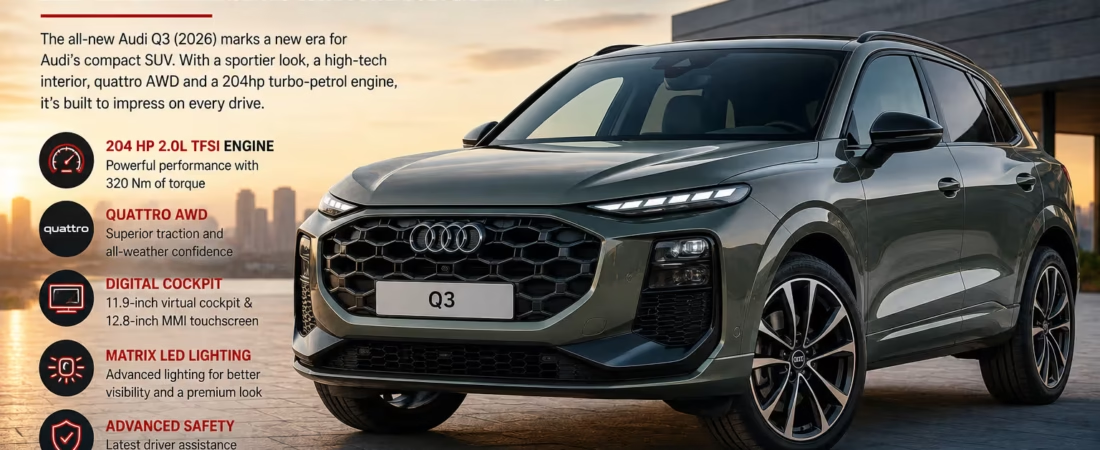
The Audi Q3 (2026) is shaping up to be one of the most important new luxury SUVs for Indian buyers this year. The third-generation Q3 brings a substantially redesigned exterior, a more advanced digital cabin, updated technology, improved practicality and a new-generation platform while retaining the compact dimensions that have made the Q3 popular among premium-SUV buyers.
For someone shopping between the BMW X1, Mercedes-Benz GLA and Audi Q3, the 2026 model is particularly interesting because Audi has not treated this as a routine facelift. This is a new-generation Q3, with a completely revised design and a significant technology upgrade.
Globally, Audi offers the new Q3 with several powertrain choices, including petrol, diesel and plug-in hybrid options. However, the India-specification model is expected to be much more focused. Current industry reporting indicates that India will receive a 2.0-litre turbo-petrol engine producing 204 hp, paired with a seven-speed dual-clutch automatic transmission and quattro all-wheel drive as standard.
The new SUV is also noticeably different visually. Audi has adopted split lighting, a wider and more expressive grille, muscular bodywork and a redesigned rear section. Inside, the Q3 gets a technology-heavy dashboard featuring an 11.9-inch digital instrument display and 12.8-inch MMI touchscreen, with a head-up display also available in the global model.
So, what exactly can Indian buyers expect from the Audi Q3 2026? What could it cost? How powerful will it be? Will it offer quattro as standard? How does it compare with the BMW X1 and Mercedes-Benz GLA? And most importantly, should you wait for the new Q3 before buying a luxury compact SUV?
This comprehensive guide covers the expected Audi Q3 2026 price in India, launch timeline, specifications, dimensions, engine, features, interior, safety, performance, competitors, ownership considerations and buying advice.
Important: This article distinguishes between specifications officially confirmed for the global third-generation Q3 and information reported or expected specifically for India. Audi India’s final variant-wise specifications and pricing should be treated as definitive once officially announced.
Audi Q3 2026: What Is New?
The biggest thing to understand about the 2026 Q3 is that this is not simply a cosmetic update.
It is the third-generation Audi Q3.
Audi describes the new Q3 as a new-generation compact SUV with a stronger design, enhanced digital technology, new lighting systems, updated assistance features and revised powertrain technology.
The changes cover almost every major area of the vehicle:
- New exterior design
- Split-headlamp arrangement
- New LED and Matrix LED lighting technology
- Larger and more expressive grille
- Revised body proportions
- Updated interior
- Larger infotainment display
- Digital instrument cluster
- Head-up display
- Improved storage and cabin packaging
- Updated driver-assistance systems
- New-generation suspension technology
- Petrol, diesel and plug-in hybrid options globally
- 204 hp 2.0-litre petrol expected for India
- Standard quattro expected for the India-spec petrol model
This is why the Audi Q3 2026 India launch matters to buyers who are considering an X1 or GLA today.
The new Q3 could effectively reset the competitive benchmark in the segment.
Audi Q3 2026 India Launch Date
Audi has planned the third-generation Q3 for India during 2026.
Current Indian automotive-industry reporting places the launch in the late-2026 timeframe, with earlier reports pointing towards the third quarter. Autocar India’s latest new-Q3 listing currently indicates a late-2026 launch window and an estimated price range of ₹50 lakh–₹55 lakh.
The timeline has shifted somewhat from earlier expectations.
In September 2025, reports indicated that Audi was working to bring the Q3 to India during 2026, possibly within the third quarter.
That makes one thing clear for prospective buyers:
The new Q3 is an imminent India-market product rather than a distant future model.
If you are already planning to purchase a luxury compact SUV, it makes sense to compare the new Q3 against current-generation competitors before committing to a purchase.
Audi Q3 2026 Price in India
The official India price of the new-generation Q3 has not yet been announced.
Current estimates put the expected starting price around the ₹50 lakh–₹55 lakh ex-showroom range, with some reports placing the likely starting point close to ₹55 lakh.
This would represent a meaningful increase over the outgoing Q3.
For context, the current-generation Q3 is listed in India at approximately ₹43.67 lakh to ₹53 lakh ex-showroom, depending on variant.
The current Q3’s three variants are:
- Premium 40 TFSI
- Premium Plus 40 TFSI
- Technology 40 TFSI
The current model uses a 2.0-litre turbo-petrol engine and seven-speed dual-clutch automatic transmission with quattro all-wheel drive.
The new model is expected to sit at a higher price point because it brings a new generation of technology, design and equipment.
Expected Audi Q3 2026 price
| Item | Expected position |
|---|---|
| Expected starting price | Around ₹50–55 lakh |
| Expected top-end positioning | Potentially above ₹55 lakh |
| Price type | Ex-showroom |
| Official price | To be announced |
| Main rivals | BMW X1, Mercedes-Benz GLA |
The final on-road price will depend on the buyer’s location, insurance, registration charges and other applicable costs.
For example, the current Q3’s estimated on-road price in Pune is listed at approximately ₹52.19 lakh for the base variant and ₹63.34 lakh for the top variant.
That illustrates why buyers should never compare luxury SUVs solely on ex-showroom prices.
Audi Q3 2026 Engine and Performance
The engine is one of the strongest reasons to pay attention to the new Q3.
Audi’s global third-generation Q3 range includes several powertrains. These include:
- 1.5-litre TFSI petrol
- 2.0-litre TFSI petrol
- 2.0-litre TDI diesel
- Plug-in hybrid powertrain
Audi’s global specification for the 2.0 TFSI quattro produces 204 PS and 320 Nm, while a more powerful 2.0 TFSI version produces 265 PS and 400 Nm.
For India, current reports indicate the 204 hp 2.0-litre turbo-petrol will be the relevant engine, paired with a seven-speed dual-clutch gearbox and quattro AWD.
2.0-Litre Turbo-Petrol Engine
The expected Indian engine configuration is:
- Engine: 2.0-litre turbo-petrol
- Cylinders: 4
- Power: Approximately 204 hp
- Torque: Approximately 320 Nm
- Transmission: 7-speed dual-clutch automatic
- Drivetrain: quattro all-wheel drive
Audi’s official global specification for the 204 PS version lists 320 Nm of torque, with the engine producing that torque across a broad operating range. The global Q3 2.0 TFSI quattro is rated at 0–100 km/h in 7.1 seconds.
That makes the engine substantially more powerful than the outgoing India-spec Q3’s 190 hp unit.
The extra output is not merely a specification-sheet advantage.
A 204 hp engine paired with all-wheel drive should provide strong acceleration for:
- Highway overtaking
- Expressway driving
- Mountain roads
- Fully loaded family trips
- High-speed cruising
Will the Audi Q3 2026 Get Quattro in India?
Current reports indicate yes.
The India-bound Q3 is expected to feature quattro all-wheel drive as standard with the 204 hp petrol engine.
This could become one of the Q3’s strongest differentiators.
The BMW X1 and Mercedes-Benz GLA compete directly in this category, but drivetrain configurations vary by market and variant.
For Indian buyers who frequently drive on:
- Wet roads
- Hill stations
- Loose surfaces
- High-speed highways
- Poor-weather conditions
all-wheel drive can provide additional traction.
However, quattro should not be misunderstood as an invitation to drive aggressively in unsafe conditions.
Its practical benefit is better traction and power distribution, not immunity from physics.
Audi Q3 2026 Acceleration
The global 204 PS Q3 2.0 TFSI quattro has an official 0–100 km/h acceleration figure of approximately 7.1 seconds.
That is quick enough to make the Q3 feel genuinely sporty without pushing the vehicle into performance-SUV territory.
For most Indian buyers, the more important characteristic will probably be mid-range response.
The ability to accelerate from approximately 60 to 100 km/h smoothly is particularly useful when overtaking on highways.
The turbocharged engine’s torque delivery should make the Q3 feel responsive without requiring constant high-rpm driving.
Audi Q3 2026 Transmission
The new Q3 uses Audi’s seven-speed S tronic dual-clutch automatic transmission.
A dual-clutch transmission uses two clutch systems to prepare the next gear while the current gear is engaged.
The intended result is:
- Fast gear changes
- Strong acceleration
- Smooth cruising
- Good efficiency
- Quick response to throttle inputs
For urban driving, the automatic transmission eliminates the need for manual clutch operation.
For enthusiastic driving, paddle shifters and selectable driving modes can provide greater driver involvement.
Audi Q3 2026 Mileage
Mileage is one area where buyers need to distinguish between international testing figures and Indian real-world driving.
Audi’s global 204 PS Q3 TFSI quattro is officially listed at approximately 7.7–8.4 litres per 100 km depending on configuration and test conditions, equivalent to roughly 11.9–13.0 km/l.
Indian reports have cited around 12.36 km/l under WLTP-related testing for the expected India model.
But real-world Indian mileage can be lower.
Urban traffic, air-conditioning use, driving style, road conditions and congestion all influence fuel consumption.
A realistic owner should therefore budget for fuel based on actual usage rather than relying on the highest published number.
Audi Q3 2026 Dimensions
The new Q3 grows compared with the outgoing generation.
Current published specifications for the new model indicate approximately:
- Length: 4,531 mm
- Width: 1,859 mm
- Height: 1,628 mm
- Wheelbase: 2,682 mm
These figures are listed by current automotive-industry specifications for the new Q3.
The new model is approximately 40 mm longer than its predecessor, according to reporting on the third-generation Q3.
That increase is important because Audi is attempting to improve both road presence and practicality without moving the Q3 into the much larger SUV category.
Audi Q3 2026 Dimensions Table
| Dimension | New Audi Q3 |
| Length | Approx. 4,531 mm |
| Width | Approx. 1,859 mm |
| Height | Approx. 1,628 mm |
| Wheelbase | Approx. 2,682 mm |
| Seating capacity | 5 |
| Boot space | Around 488 litres |
The exact India-specification figures should be confirmed once Audi releases its final homologation and equipment information.
Audi Q3 2026 Exterior Design
The exterior design is probably the most obvious change.
The previous Q3 had a relatively conservative interpretation of Audi’s SUV design language.
The third-generation Q3 is much more expressive.
Audi has introduced:
- Split headlights
- High-set daytime running lights
- Pixel LED technology
- Large octagonal grille
- Stronger shoulder lines
- More sculpted bumpers
- New alloy-wheel designs
- Revised rear lighting
- More muscular proportions
The result is a Q3 that looks considerably more dramatic than its predecessor.
Split Headlights: The Biggest Styling Change
The new Q3 adopts a split-headlamp arrangement.
The main lighting elements sit lower, while the daytime running-light signature is positioned higher on the front fascia.
This is a major departure from the outgoing Q3.
Audi has increasingly used sophisticated digital lighting to distinguish its new-generation vehicles, and the Q3 follows that approach.
The global model can be equipped with advanced Matrix LED technology, while Audi describes the latest Q3’s digital Matrix LED headlights as a major technology highlight.
Audi Q3 2026 Grille
The grille is larger and more prominent.
Audi has moved away from a restrained compact-SUV appearance toward a more aggressive front-end design.
The grille’s shape and positioning also make the Q3 visually closer to larger Audi SUVs.
This matters for buyers who want a luxury vehicle that looks expensive without necessarily buying a large SUV.
Audi Q3 2026 Rear Design
The rear has also been redesigned.
A key feature is the new full-width-style lighting treatment and sharper lamp design.
The rear bumper is more sculpted, and the bodywork gives the Q3 a wider stance.
The overall design is cleaner but more muscular.
Audi’s goal appears to be clear: make the Q3 look less like an entry-level luxury SUV and more like a smaller member of the company’s premium SUV family.
Audi Q3 2026 Interior
The interior is arguably an even bigger upgrade than the exterior.
The third-generation Q3 receives a much more digital dashboard, with Audi integrating the driver’s display and central infotainment system into a modern cockpit layout.
The global model features:
- 11.9-inch Audi virtual cockpit
- 12.8-inch MMI touch display
- Head-up display
- New steering-wheel controls
- Improved storage
- Customisable ambient lighting
- Premium audio options
Audi’s own interior announcement confirms the 11.9-inch digital instrument cluster and 12.8-inch MMI touchscreen.
12.8-Inch Infotainment Display
The 12.8-inch central display becomes one of the visual focal points of the dashboard.
A larger touchscreen allows:
- Navigation
- Media control
- Vehicle settings
- Smartphone integration
- Connected functions
- Climate-related controls, depending on configuration
However, larger screens do not automatically mean better usability.
The real test will be how quickly drivers can access commonly used functions while driving.
Audi’s advantage is that it combines touchscreen technology with steering-wheel controls and digital instrumentation.
11.9-Inch Digital Instrument Cluster
The driver’s display measures 11.9 inches.
It can provide:
- Speed
- Navigation information
- Driving data
- Media information
- Vehicle status
- Assistance-system information
The advantage of a digital cockpit is flexibility.
Drivers can change the information layout depending on the type of journey.
For example, highway drivers may prefer navigation information, while urban drivers may want a simpler speed-focused display.
Head-Up Display
A head-up display is also part of the new Q3’s global technology package.
The system projects selected information into the driver’s field of view.
This can reduce the need to repeatedly look down at the instrument cluster or central screen.
Depending on the final India specification, buyers should check whether the feature is standard or limited to higher variants.
Audi Q3 2026 Sound System
The new Q3 can be equipped globally with a SONOS premium sound system.
Audi’s interior information describes a 12-speaker SONOS system with 420 watts of amplifier power.
For music lovers, this could become one of the most attractive optional features.
A premium audio system is particularly valuable in a luxury SUV because owners often spend significant amounts of time commuting in the vehicle.
However, buyers should check the India-spec equipment list before assuming that the complete global audio package will be offered.
Audi Q3 2026 Cabin Comfort
The Q3’s cabin is designed to balance driver orientation with family practicality.
The longer body helps create a more spacious overall package.
Rear passengers should have sufficient legroom for normal adult use, while the SUV’s upright shape makes entry and exit relatively straightforward.
The Q3 also remains compact enough for urban use.
That combination is one of its biggest advantages.
You get:
Luxury SUV proportions without the footprint of a large premium SUV.
Audi Q3 2026 Boot Space
The new Q3 offers approximately 488 litres of boot capacity, according to current published specifications.
That is useful for:
- Airport luggage
- Weekend travel
- Family shopping
- Office equipment
- Children’s bags
For a five-seat compact luxury SUV, boot space of this size makes the Q3 practical enough for everyday family use.
The shape of the boot also matters.
A wide and relatively square loading area is often more useful than a larger number on a specification sheet.
Audi Q3 2026 Features
The exact India-specific feature list is yet to be finalised, but the global third-generation Q3 introduces a substantial equipment upgrade.
Potential highlights include:
Exterior
- LED headlights
- Matrix LED technology
- Digital lighting signatures
- LED rear light bar
- New alloy wheels
- Panoramic roof depending on market and variant
Interior
- 12.8-inch touchscreen
- 11.9-inch digital instrument display
- Head-up display
- Ambient lighting
- Premium audio
- Digital connectivity
- Wireless smartphone integration
- Modern steering-wheel controls
Comfort
- Automatic climate control
- Electrically adjustable seats
- Heated seats depending on specification
- Power tailgate
- Parking assistance
Safety and driver assistance
- Adaptive cruise-related systems
- Lane assistance
- Emergency braking
- Parking camera systems
- Blind-spot-related assistance
- Traffic-sign recognition depending on market and configuration
The final Indian feature list should be checked variant by variant.
Audi Q3 2026 Safety
Safety is another area where the new Q3 moves forward.
Audi’s third-generation model introduces more advanced assistance technology derived from systems used higher in the brand’s lineup. Audi itself highlights driver-assistance technology and lighting technology from the full-size segment as part of the new Q3’s appeal.
Depending on the final India specification, buyers can expect a package built around:
- Multiple airbags
- Electronic stability control
- Anti-lock braking
- Traction control
- Electronic braking assistance
- ISOFIX child-seat mounting points
- Parking sensors
- Camera assistance
- Lane-related assistance
- Collision warning
- Autonomous emergency braking
- Adaptive cruise functionality on applicable variants
Do not assume that every international safety feature will be standard in India.
Luxury manufacturers frequently adjust equipment according to market, pricing and homologation requirements.
Audi Q3 2026 Ride and Handling
The Q3 has traditionally been positioned as a balance between comfort and driving involvement.
The new model continues this philosophy while introducing updated suspension technology.
Audi highlights a new damper system as one of the third-generation Q3’s engineering changes.
This matters because a premium compact SUV has to perform several jobs.
It must:
- Handle broken city roads
- Remain stable at highway speeds
- Feel comfortable over long journeys
- Provide predictable cornering
- Control body movement
- Remain easy to park
A well-tuned suspension is therefore more important than simply fitting large wheels.
Audi Q3 2026 Driving Experience
The expected 204 hp petrol engine gives the Q3 enough performance to feel distinctly premium.
The combination of:
2.0-litre turbo-petrol + 320 Nm + seven-speed dual-clutch + quattro
should make the vehicle feel confident across different driving conditions.
The Q3 is not intended to be a hardcore performance SUV.
Its strengths are more likely to be:
- Strong mid-range acceleration
- High-speed stability
- Refined cruising
- Secure traction
- Easy automatic driving
- Comfortable daily use
That balance is exactly what many premium SUV buyers want.
Audi Q3 2026 vs BMW X1
The BMW X1 is one of the Q3’s most important rivals.
The BMW has traditionally attracted buyers who prioritise:
- Driving dynamics
- Modern cabin technology
- Compact dimensions
- Premium branding
- Strong petrol and diesel choices
The new Q3 counters with:
- New-generation design
- 204 hp petrol engine
- Standard quattro expected in India
- Large digital displays
- More expressive exterior styling
- Advanced lighting technology
The BMW X1 can feel more driver-oriented, while the Audi Q3’s appeal lies in its combination of technology, design and all-weather traction.
The upcoming BMW X1 LWB adds another complication because its longer wheelbase places greater emphasis on rear-seat comfort.
For a family buyer, the decision may therefore come down to:
BMW X1 LWB for rear-seat space and long-wheelbase practicality
versus:
Audi Q3 for new-generation design, technology and quattro capability.
Audi Q3 2026 vs Mercedes-Benz GLA
The Mercedes-Benz GLA is another direct competitor.
The GLA’s strongest arguments include:
- Premium interior ambience
- Mercedes brand image
- Comfortable urban dimensions
- Modern infotainment
- Attractive styling
The Q3 responds with:
- Larger 2.0-litre petrol engine
- Expected 204 hp output
- quattro AWD
- New-generation technology
- New digital lighting
- Fresh exterior design
The Mercedes may appeal more to buyers who prioritise luxury ambience, while the Audi could appeal to those looking for a more technology-oriented and performance-capable package.
Audi Q3 2026 vs Volvo XC40
The Volvo XC40 has traditionally occupied the same broad premium compact-SUV category.
Volvo is strongly associated with:
- Safety
- Scandinavian design
- Comfortable interiors
- Practicality
- Distinctive styling
The Q3 counters with its German engineering, quattro system, powerful petrol engine and new digital technology.
The decision should ultimately be based on driving preferences and ownership requirements rather than brand reputation alone.
Audi Q3 2026 vs BMW X1 LWB
This is likely to become one of the most interesting comparisons for Indian buyers.
The two SUVs take different approaches.
Audi Q3
Focuses on:
- New-generation technology
- Performance
- Quattro AWD
- Digital cabin
- Compact dimensions
- Sporty styling
BMW X1 LWB
Focuses on:
- Longer wheelbase
- Rear-seat room
- Family comfort
- BMW driving experience
- Premium cabin
- Local production
For a chauffeur-driven buyer, the BMW may have an advantage.
For a buyer who drives personally and values performance and technology, the Q3 may be more attractive.
Who Should Buy the Audi Q3 2026?
The new Q3 makes the most sense for several types of buyers.
1. Buyers upgrading from a mainstream SUV
If you currently own a Hyundai, Kia, Toyota, Volkswagen or Skoda SUV and want to enter the luxury segment, the Q3 provides a relatively manageable transition.
2. Urban luxury-car buyers
Its dimensions are still suitable for city driving.
3. Highway travellers
The 2.0-litre engine and quattro system should make the Q3 particularly capable on long-distance journeys.
4. Technology-focused buyers
The new digital cabin will appeal to customers who want a modern interface.
5. Buyers who want a powerful petrol SUV
The expected 204 hp engine is considerably more powerful than many mainstream compact SUVs.
6. Customers who prefer AWD
Quattro gives the Q3 a distinct advantage for buyers who specifically want all-wheel drive.
Who Should Avoid the Audi Q3 2026?
The Q3 is not ideal for every buyer.
You may want to consider another vehicle if:
- Your priority is maximum rear-seat space.
- You need seven seats.
- Your annual mileage is extremely high and you specifically want a diesel.
- You want a fully electric luxury SUV.
- You want the lowest possible ownership cost.
- You rarely use the vehicle and do not need premium equipment.
Luxury-car ownership involves more than purchase price.
Insurance, tyres, servicing, fuel and depreciation should all be considered.
Audi Q3 2026 Buying Guide
If you are seriously considering the new Q3, use a structured buying process rather than choosing a variant based solely on appearance.
Step 1: Determine Your Budget
Set an all-in budget.
Do not stop at the ex-showroom price.
Include:
- Registration
- Insurance
- Accessories
- Extended warranty
- Service package
- Finance interest
- Fuel
Step 2: Decide Your Usage
Ask yourself:
- How many kilometres do I drive each year?
- Mostly city or highway?
- How many passengers?
- Do I need AWD?
- Do I travel to hill stations?
- Do I carry large luggage?
Step 3: Compare Variants
Do not pay for a higher trim simply because it has a longer list of features.
Identify the features you actually use.
Step 4: Test the Rear Seat
Even if you normally drive yourself, ask family members to sit in the rear.
Step 5: Test the Infotainment
Check whether the interface feels intuitive.
Step 6: Test the Ride
Drive over rough surfaces.
Step 7: Compare Competitors
Drive:
- BMW X1
- BMW X1 LWB
- Mercedes-Benz GLA
- Volvo XC40
A proper comparison can change your decision.
Common Mistakes to Avoid
Mistake 1: Assuming the global specification equals the India specification
It does not.
Always verify the India-specific equipment list.
Mistake 2: Comparing only horsepower
A vehicle’s performance depends on weight, gearing, drivetrain, tyres and calibration.
Mistake 3: Ignoring after-sales costs
A luxury SUV can be affordable to purchase and expensive to maintain.
Mistake 4: Buying the highest variant automatically
The top model may contain equipment you never use.
Mistake 5: Ignoring boot space
If the vehicle is used by a family, luggage capacity matters.
Mistake 6: Not checking parking dimensions
The Q3 may be compact by luxury-SUV standards, but parking spaces still matter.
Mistake 7: Making a decision before the official India price
Wait for Audi India’s final announcement if pricing is the deciding factor.
Expert Tips for Buying the Audi Q3 2026
Tip 1: Compare on-road prices
A ₹2 lakh difference in ex-showroom pricing can become much larger after taxes and insurance.
Tip 2: Ask about service packages
Get a written estimate for scheduled maintenance.
Tip 3: Negotiate insurance
Dealer insurance is convenient but not always the only option.
Tip 4: Check tyre replacement costs
Premium tyres can be expensive.
Tip 5: Test every driving mode
Do not evaluate the car only in normal mode.
Tip 6: Drive at highway speed
This is where the Q3’s engine, suspension and quattro system can be better evaluated.
Tip 7: Test the infotainment in sunlight
A screen that looks excellent indoors should also remain readable in bright Indian conditions.
Is the Audi Q3 2026 Worth Waiting For?
For many buyers, yes.
The reason is that the third-generation Q3 represents a substantial change.
The outgoing model remains a capable premium SUV, but the new generation introduces:
- Fresh design
- More powerful India-bound engine
- New-generation digital cockpit
- Improved lighting
- More advanced driver assistance
- Updated suspension
- More modern cabin packaging
The new Q3 also arrives at a time when the premium compact SUV market is becoming increasingly competitive.
BMW is expanding its X1 family with the long-wheelbase X1.
Mercedes-Benz continues to compete with the GLA.
Volvo offers its own distinctive premium proposition.
Audi therefore needs the new Q3 to offer more than a badge.
The third-generation vehicle appears designed to do exactly that.
Audi Q3 2026: Key Pros and Cons
Pros
- New-generation design
- Attractive split-headlight styling
- Powerful 204 hp expected India engine
- 320 Nm torque
- Quattro AWD expected as standard
- Seven-speed dual-clutch automatic
- Advanced digital cabin
- 12.8-inch touchscreen
- 11.9-inch digital instrument display
- Strong highway performance
- Premium compact dimensions
- Approximately 488-litre boot
Cons
- Expected price significantly higher than outgoing Q3
- Final India pricing not yet confirmed
- India-specific equipment list still needs confirmation
- No certainty that every global powertrain will be offered
- Premium ownership costs
- Five-seat layout only
- Real-world fuel economy will depend heavily on driving conditions
Frequently Asked Questions About Audi Q3 2026
1. What is the Audi Q3 2026?
The Audi Q3 2026 is the third-generation version of Audi’s compact luxury SUV. It introduces a completely redesigned exterior, a more advanced digital cabin, new lighting technology, updated suspension and modern driver-assistance systems.
2. What will be the Audi Q3 2026 price in India?
The official price has not yet been announced. Current estimates suggest a starting price around ₹50 lakh–₹55 lakh ex-showroom, with some reports expecting approximately ₹55 lakh.
3. What engine will the new Audi Q3 get in India?
Current reports indicate that India will receive a 2.0-litre turbo-petrol engine producing around 204 hp, paired with a seven-speed dual-clutch automatic transmission.
4. Will the Audi Q3 2026 have quattro AWD?
Yes, the India-bound 204 hp Q3 is expected to feature quattro all-wheel drive as standard.
5. How fast is the Audi Q3 2026?
The global 204 PS 2.0 TFSI quattro Q3 has an official 0–100 km/h time of approximately 7.1 seconds.
6. What is the Audi Q3 2026 boot space?
The new Q3 offers approximately 488 litres of boot space, according to current published specifications.
7. What are the Audi Q3 2026 dimensions?
Published specifications list approximately 4,531 mm length, 1,859 mm width, 1,628 mm height and a 2,682 mm wheelbase.
8. What are the main Audi Q3 2026 rivals?
The most important competitors include the BMW X1, BMW X1 LWB and Mercedes-Benz GLA. Depending on price and buyer requirements, the Volvo XC40 and other premium compact SUVs can also be considered.
Final Verdict: Should You Buy the Audi Q3 2026?
The Audi Q3 (2026) has the potential to be a very strong contender in India’s premium compact SUV market.
Audi has addressed several weaknesses that can make an ageing luxury SUV less attractive: exterior freshness, cabin technology, lighting, digital interfaces and driver assistance.
The biggest improvement is that the new Q3 feels like a genuine new-generation product rather than a minor update.
The expected India-specification combination is particularly appealing:
204 hp + 320 Nm + 2.0-litre turbo-petrol + seven-speed DCT + quattro AWD.
That gives the Q3 a strong technical proposition against its German rivals. Audi’s global specifications confirm the 204 PS engine and 320 Nm torque, while Indian reports indicate that this configuration is the one planned for India.
The interior is equally important.
The combination of an 11.9-inch digital cockpit, 12.8-inch infotainment screen and available head-up display gives the Q3 a far more contemporary cabin than the outgoing model.
However, the final decision will depend heavily on pricing.
If Audi positions the new Q3 too close to larger luxury SUVs, buyers may start considering alternatives. If the company keeps the price competitive against the BMW X1 and Mercedes-Benz GLA, the Q3 could become one of the most attractive petrol-powered compact luxury SUVs in India.
For family buyers, there is another consideration.
The new BMW X1 LWB is expected to compete by offering greater rear-seat space, while the Q3 appears to focus more strongly on technology, performance and quattro traction.
That means there may not be one universally correct choice.
The best SUV depends on how you actually use your car.
If you want a compact luxury SUV with strong performance, all-wheel drive, advanced digital technology and a striking new design, the Audi Q3 2026 deserves a place on your shortlist.
If rear-seat comfort is your highest priority, compare it directly with the BMW X1 LWB.
If cabin ambience and Mercedes styling matter more to you, test the GLA.
And if you want an electric luxury SUV, the comparison needs to move toward Audi’s Q6 e-tron and competing EVs.
The smartest approach is simple: wait for the official India price and variant list, then compare the Q3’s real on-road cost and equipment with its closest rivals before booking.
Planning to buy a luxury SUV in 2026? Add the new Audi Q3 to your test-drive list, compare it with the BMW X1, BMW X1 LWB and Mercedes-Benz GLA, and choose the model that best fits your actual driving and family needs.
https://www.audi.in/en/models/q3/q3/
BMW X1 LWB: The Bigger, More Spacious Luxury SUV BMW Is Bringing to India in 2026