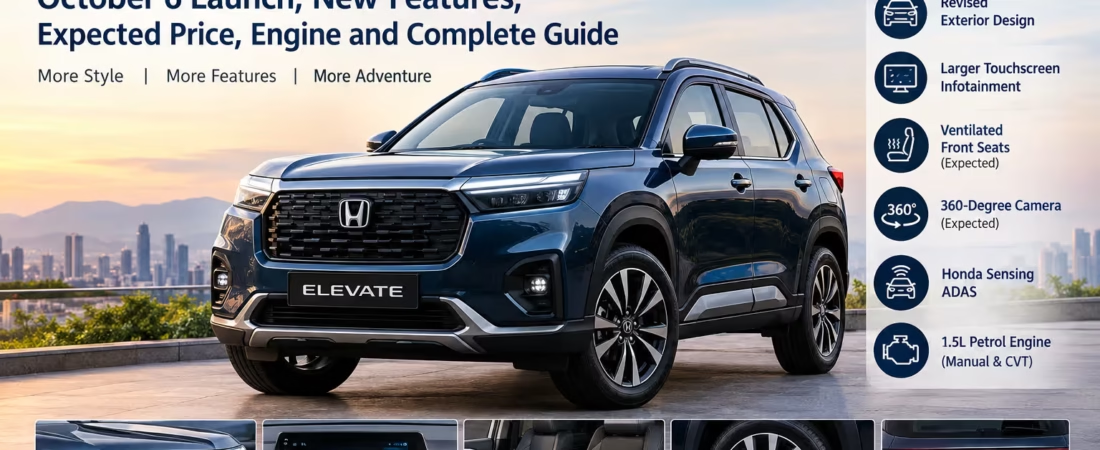
The Honda Elevate facelift is set to arrive in India on 6 October 2026, bringing the first major update to Honda’s mid-size SUV since its Indian introduction in 2023. The facelift is expected to focus on styling, equipment and cabin technology rather than a complete mechanical overhaul. For buyers considering a Hyundai Creta, Kia Seltos, Maruti Suzuki Grand Vitara, Toyota Urban Cruiser Hyryder, Volkswagen Taigun, Skoda Kushaq or other mid-size SUVs, the updated Elevate could become an important option to consider.
The original Honda Elevate established itself with a naturally aspirated petrol engine, a spacious cabin, generous ground clearance, a large boot and Honda Sensing driver-assistance technology. Honda’s official specifications currently list a 1.5-litre i-VTEC petrol engine, 6-speed manual and CVT automatic transmissions, 220mm ground clearance and 458 litres of boot space.
The facelift is therefore less about changing the fundamental character of the SUV and more about addressing some of the areas where the existing model has faced newer competitors.
Among the expected upgrades are revised exterior styling, new alloy wheels, a larger touchscreen, ventilated front seats and potentially a factory-fitted 360-degree camera. Honda has previously indicated that features such as ventilated seats and a 360-degree camera, currently available through the accessory route, could be brought into the main vehicle lineup.
However, not every facelift specification has been officially confirmed at the time of writing. Expected features and prices should therefore be distinguished from information published by Honda Cars India.
This guide explains what is known about the Honda Elevate facelift 2026, what buyers can reasonably expect, what could remain unchanged, how it compares with its rivals and what you should check before booking one.
Honda Elevate Facelift 2026: Quick Highlights
Here is a quick overview of the upcoming SUV:
- India launch date: 6 October 2026
- Segment: Mid-size SUV
- Seating: Expected 5-seater configuration
- Current engine: 1.5-litre naturally aspirated petrol
- Current power: 121 PS
- Current torque: 145 Nm
- Current transmissions: 6-speed manual and CVT
- Current claimed mileage: 15.31 km/l MT and 16.92 km/l CVT
- Current ground clearance: 220mm
- Current boot capacity: 458 litres
- Expected exterior: Revised grille, bumpers, lighting and alloy wheels
- Expected interior: New trim and equipment updates
- Expected feature additions: Larger touchscreen, ventilated front seats and potentially a 360-degree camera
- ADAS: Honda Sensing is already offered on the Elevate
- Hybrid: Not confirmed for the facelift
- Expected price: Higher than the current model is possible, but official facelift pricing will be announced at launch
Honda’s current official website lists the existing Elevate from ₹11,80,700 ex-showroom Delhi, although this is the outgoing model’s current price and should not be treated as the facelift’s final price.
What Is the Honda Elevate Facelift?
A facelift is a mid-cycle update to an existing vehicle.
Unlike an all-new generation, a facelift generally retains the basic platform, engine architecture and overall proportions while introducing changes to the exterior, interior, technology and equipment.
That description fits the upcoming Honda Elevate.
The Elevate was introduced in India in 2023 as Honda’s entry into the highly competitive mid-size SUV segment. Honda designed it around a straightforward formula: a naturally aspirated petrol engine, SUV ground clearance, spacious packaging, Honda Sensing safety technology and a relatively clean cabin layout.
The 2026 update is expected to preserve that formula.
The objective is instead to make the SUV more competitive against newer products and increasingly feature-rich rivals.
This is particularly relevant because the Indian mid-size SUV market has changed rapidly since the Elevate’s launch.
Customers now expect features such as:
- Larger infotainment screens
- Ventilated seats
- 360-degree cameras
- Advanced connected-car functions
- Modern LED lighting
- Premium cabin finishes
- Multiple drive modes
- Advanced driver assistance
- Panoramic or large sunroofs in some competitors
The Elevate already offers several useful features, but the facelift is expected to address some of the equipment gaps.
Honda Elevate Facelift Launch Date in India
The Honda Elevate facelift is scheduled to launch in India on 6 October 2026.
Multiple automotive publications have reported the same date, with the Financial Express reporting that Honda Cars India will launch the mid-life update on October 6.
The launch timing is significant because October is traditionally an important period for Indian automobile manufacturers.
The festive season can bring increased showroom traffic and purchase activity, making the beginning of October a strategically important period for a new model or facelift.
For Honda, the Elevate facelift also arrives after updates to other products in its Indian portfolio.
The company therefore has an opportunity to refresh one of its most important SUV products before the festive buying season gets fully underway.
Why the Elevate Facelift Matters
The Honda Elevate already has several strengths.
Honda’s official specifications highlight:
- 220mm ground clearance
- 458-litre boot
- 1.5-litre i-VTEC engine
- Manual and CVT options
- Honda Sensing ADAS
- Six airbags
- Vehicle stability assistance
- Rear parking sensors
- Multiple safety technologies
But the market around it has become increasingly competitive.
The Hyundai Creta and Kia Seltos offer extensive equipment and multiple powertrain choices.
The Toyota Hyryder and Maruti Suzuki Grand Vitara bring strong-hybrid technology.
The Volkswagen Taigun and Skoda Kushaq appeal to buyers looking for European driving characteristics.
Newer products such as the Maruti Suzuki Victoris and Tata Sierra further increase the number of options available to SUV buyers.
The facelift therefore needs to improve the Elevate without losing what existing customers like about it.
Honda Elevate Facelift Exterior Design
The biggest visual changes are expected at the front and rear of the SUV.
The Elevate’s existing design is relatively upright and straightforward.
Its proportions emphasise practicality rather than a highly aggressive coupe-like appearance.
For the facelift, reports indicate changes to areas such as:
- Front grille
- Front bumper
- Lighting elements
- Rear bumper
- Tail-light graphics
- Alloy wheels
CarWale reported that test vehicles have shown revised rear lighting graphics, while the facelift is also expected to receive bumper and alloy-wheel changes.
The objective is likely to make the Elevate look newer without changing its fundamental identity.
Revised Front Grille
The grille is one of the most effective ways for a manufacturer to refresh a vehicle’s appearance.
The facelift is expected to receive a revised grille design.
Rather than creating a completely different face, Honda could use a sharper grille pattern and updated surrounding trim to make the SUV appear more contemporary.
For buyers, this is useful because a facelifted vehicle should feel visually distinct from the pre-facelift version without losing the recognisable Elevate silhouette.
Updated LED Lighting
Lighting elements are another expected area of change.
Reports have indicated revised lighting graphics and LED elements.
Modern SUV buyers increasingly judge a vehicle’s appearance by its lighting signature, particularly at night.
A redesigned LED daytime-running-light or tail-light pattern can make even a relatively minor facelift appear substantially newer.
New Alloy Wheels
The facelift is also expected to receive redesigned alloy wheels.
Wheel design may appear like a small detail, but it can significantly change the side profile of an SUV.
A new alloy design can make the vehicle appear more premium while allowing Honda to refresh the model without changing its underlying body structure.
Rear Design Changes
The rear end could receive revised bumper treatment and updated tail-light graphics.
These changes are likely to be subtle rather than transformative.
That would be consistent with the overall expectation that the Elevate facelift is a mid-cycle refresh rather than a new generation.
Honda Elevate Facelift Interior Updates
The interior is another area where the facelift could make a meaningful difference.
The existing Elevate already has a functional cabin with a straightforward dashboard layout.
However, technology expectations have increased considerably since the SUV launched.
The facelift is therefore expected to receive updates to:
- Infotainment
- Instrumentation
- Upholstery
- Interior trim
- Comfort equipment
- Camera technology
One of the most frequently reported changes is a larger touchscreen infotainment system. The Financial Express has reported a larger touchscreen as part of the facelift’s feature upgrades.
A larger screen can improve navigation visibility, smartphone integration and general usability.
But screen size alone should not be the deciding factor.
The more important question is how responsive and intuitive the system is.
Larger Touchscreen: Why It Matters
Infotainment systems have become central to modern vehicles.
Drivers increasingly use the screen for:
- Navigation
- Music
- Phone calls
- Vehicle settings
- Smartphone connectivity
- Camera views
The Elevate facelift’s expected larger touchscreen could therefore improve everyday usability.
For someone spending several hours a day in traffic, a well-designed infotainment interface can make a greater difference than a decorative interior feature.
Honda should ideally maintain physical controls for frequently used functions such as climate settings and important vehicle controls.
That combination tends to be easier to use while driving than forcing every function into a touchscreen menu.
Ventilated Front Seats Could Be a Major Addition
One of the most anticipated feature additions is ventilated front seats.
This is particularly relevant to India.
Summer temperatures in many parts of the country can make a vehicle’s seat surfaces uncomfortably hot after parking.
Ventilation allows air to circulate through the seat surface, improving comfort.
Honda already provides ventilated front-seat-related functionality for the Elevate through accessories, but Honda Cars India’s Kunal Behl indicated that the company could consider bringing features such as ventilated seats into the mainline vehicle specification.
If the facelift receives factory-fitted ventilated seats, it would address one of the equipment areas frequently discussed when comparing the Elevate with rivals.
360-Degree Camera: Another Important Upgrade
A 360-degree camera could be another useful addition.
The existing Elevate can be equipped with a 360-degree surround-view camera through Honda’s accessory programme.
Making such a system available directly from the factory would improve convenience.
A 360-degree camera is particularly useful when:
- Parking in narrow spaces
- Manoeuvring in crowded urban areas
- Approaching walls or pillars
- Navigating tight basement parking
- Positioning the SUV accurately
For a relatively large SUV, visibility technology can make everyday driving easier.
However, buyers should verify whether the camera is standard, variant-specific or optional once the final brochure is released.
Honda Elevate Engine: What Is Expected to Remain?
One of the most important points about the facelift is that the existing 1.5-litre naturally aspirated petrol engine is expected to continue.
The current Elevate uses Honda’s 1.5-litre i-VTEC DOHC petrol engine with VTC.
Honda’s published specifications quote:
- Displacement: 1,498cc
- Power: 121 PS
- Torque: 145 Nm
- Manual: 6-speed
- Automatic: CVT
The Financial Express has also reported that the facelift will retain the existing 1.5-litre petrol engine with manual and CVT transmission choices.
This is important because Honda is not apparently using the facelift as an opportunity for a complete powertrain transformation.
Instead, the company appears to be focusing on improving the ownership package around an already established engine.
Is the 1.5-Litre Naturally Aspirated Engine Still Relevant?
In a market increasingly filled with turbocharged engines and hybrids, a naturally aspirated petrol engine may seem less exciting on paper.
But there are practical advantages.
A naturally aspirated engine generally delivers power in a predictable manner.
The Elevate’s 1.5-litre engine is also already familiar within Honda’s product portfolio.
For buyers who value linear throttle response and straightforward petrol-engine behaviour, this can be appealing.
The engine’s 121 PS and 145 Nm figures are adequate for a mid-size SUV, although buyers expecting strong low-end turbo-like torque should understand the difference in character.
The engine tends to reward smoother driving and higher revs rather than relying on a large burst of torque at low engine speeds.
Honda Elevate Manual vs CVT
The facelift is expected to continue offering both manual and CVT transmissions.
Choosing between them depends heavily on how you drive.
6-Speed Manual
The manual gearbox may appeal to drivers who:
- Enjoy controlling gear selection
- Frequently drive on open roads
- Prefer a more involved driving experience
- Want a traditional manual transmission
The manual version also gives the driver direct control over engine speed.
CVT Automatic
The CVT is more suitable for buyers who spend substantial time in traffic.
Its strengths include:
- Smooth acceleration
- Easy stop-and-go driving
- Reduced clutch fatigue
- Convenient urban operation
Honda’s official figures currently list 16.92 km/l for the CVT and 15.31 km/l for the manual under the applicable test conditions.
Actual fuel economy will depend on traffic, driving style, vehicle load, tyre pressure, road conditions and climate-control use.
Will the Honda Elevate Facelift Get a Hybrid Engine?
This is one of the most searched questions surrounding the facelift.
The answer, at present, requires caution.
There has been speculation that Honda could introduce hybrid technology because the company already sells hybrid versions of other models in India.
However, reporting around the Elevate facelift has not established a confirmed hybrid powertrain for the October 6 launch.
CarWale reported earlier in 2026 that a hybrid derivative could have been considered, but also noted Honda had ruled out this option at that stage.
Therefore, buyers should not assume that the Elevate facelift will launch with a strong-hybrid powertrain simply because competitors offer hybrid SUVs.
Until Honda Cars India officially announces a hybrid Elevate, the safest assumption is that the facelift will continue with the existing petrol architecture.
Honda Elevate Fuel Economy
The current Honda Elevate has official claimed mileage figures of:
- Manual: 15.31 km/l
- CVT: 16.92 km/l
These numbers are useful for comparison but should not be interpreted as guaranteed real-world mileage.
For example, a CVT Elevate used primarily in heavy urban traffic can deliver different results from one driven mostly on highways.
Factors affecting actual fuel consumption include:
- Traffic density
- Average speed
- Acceleration habits
- Air-conditioning usage
- Tyre pressure
- Vehicle load
- Road gradient
- Driving mode and conditions
- Maintenance condition
Potential buyers should therefore use official mileage figures as a benchmark rather than a promise.
Honda Elevate Ground Clearance
One of the Elevate’s strongest practical attributes is its 220mm ground clearance.
Honda itself highlights this as a key feature.
This is useful for Indian driving conditions.
Consider common situations such as:
- Large speed breakers
- Broken roads
- Uneven village roads
- Steep parking ramps
- Deep potholes
- Rough monsoon surfaces
High ground clearance does not make an SUV immune to damage, but it provides greater underbody clearance in many everyday situations.
This is one area where the Elevate’s SUV-focused engineering is immediately relevant to Indian buyers.
Honda Elevate Boot Space
The current Elevate offers 458 litres of boot space.
That makes the SUV practical for everyday family use.
For example, the boot can be useful for:
- Large grocery purchases
- Airport luggage
- Weekend travel bags
- Children’s equipment
- Shopping
- Small family road trips
The important thing is not simply the litre figure.
Boot usability also depends on opening width, loading height and the shape of the luggage compartment.
For family buyers, these details are worth checking physically during a test drive.
Honda Elevate Safety Features
Safety is one of the areas where Honda has equipped the Elevate with a comprehensive package.
Honda’s current specifications include:
- Six airbags
- ACE body structure
- Honda Sensing
- LaneWatch camera
- Hill Start Assist
- Multi-angle rear camera
- Emergency Stop Signal
- Rear parking sensors
- Vehicle Stability Assist
- ABS with EBD
- ISOFIX child-seat anchors
The exact safety specification of the facelift should be confirmed after the official launch.
Honda Sensing ADAS
The Elevate’s Honda Sensing suite is one of its notable technological features.
Honda describes Sensing as an advanced driver-assistance system designed to assist the driver and reduce the risk or severity of certain collisions.
The current system includes functions such as:
Collision Mitigation Braking System
The system can provide warnings and braking assistance in certain collision-risk situations.
Adaptive Cruise Control
Adaptive cruise control can help maintain a selected distance from a vehicle ahead.
Lane Keeping Assist System
LKAS can provide steering assistance to help keep the vehicle within the lane.
Road Departure Mitigation
The system can alert the driver and provide steering assistance when it detects certain road-departure situations.
Auto High Beam
The system can automatically switch between high and low beam depending on detected conditions.
Lead Car Departure Notification
The system can alert the driver when the vehicle ahead begins moving.
These systems are driver-assistance technologies, not replacements for attentive driving.
What Could Change in the ADAS System?
The facelift may receive adjustments to the ADAS package.
CarWale has reported that a tweaked ADAS suite could accompany the other expected updates.
However, the exact changes should be confirmed through Honda’s official specifications.
ADAS performance also depends heavily on road markings, weather, traffic conditions and sensor visibility.
Therefore, buyers should test these systems rather than evaluating them solely from a brochure.
Honda Elevate Facelift Price in India
The current Honda Elevate starts at ₹11,80,700 ex-showroom Delhi, according to Honda Cars India’s current website.
That is the price of the existing model and not the confirmed price of the facelift.
The facelift is expected to receive additional equipment, so an increase over the outgoing model would not be surprising.
Some automotive websites have published estimated facelift prices, but those figures should be treated as provisional until Honda announces the official price.
The final price will depend on:
- Variant
- Transmission
- Equipment
- Optional accessories
- Location
- Applicable taxes
- Insurance
- Registration
Buyers should therefore avoid making a purchase decision based on an unofficial estimated price.
Expected Honda Elevate Facelift Variants
The existing Elevate range includes variants such as:
- SV
- V
- VX
- ZX
- ZX Black Edition
- Special editions depending on the model year
Honda’s official current specifications page lists these grades for the existing Elevate.
The facelift’s final variant structure may change.
This is important because a feature such as ventilated seats or a 360-degree camera may not necessarily be available across the entire range.
When the official price list arrives, buyers should compare the equipment of each variant rather than looking only at the starting price.
Honda Elevate Facelift vs Hyundai Creta
The Hyundai Creta is one of the most obvious competitors.
Creta buyers typically have access to a broad range of features and powertrain choices.
The Elevate takes a different approach.
Honda focuses strongly on:
- Naturally aspirated petrol performance
- Ground clearance
- Driving characteristics
- Spacious packaging
- Honda Sensing
- Simple powertrain choice
A buyer comparing the two should therefore consider what matters more:
- Feature quantity
- Engine options
- Hybrid availability
- Driving feel
- ADAS
- Cabin design
- After-sales support
There is no single specification that makes one vehicle suitable for every buyer.
Honda Elevate Facelift vs Kia Seltos
The Kia Seltos is another major rival.
The Seltos is known for a technology-heavy cabin and extensive equipment.
The Elevate’s appeal is more straightforward.
Its naturally aspirated petrol engine and Honda’s driving dynamics provide a different experience.
The facelift’s expected larger touchscreen, ventilated seats and 360-degree camera could reduce some of the equipment gap between the two SUVs.
Potential buyers should compare the exact variants rather than comparing only the two model names.
Honda Elevate Facelift vs Toyota Hyryder
The Toyota Urban Cruiser Hyryder is particularly relevant because of its strong-hybrid powertrain.
This creates a significant difference in powertrain philosophy.
The Elevate is currently petrol-focused.
The Hyryder can appeal to buyers who prioritise hybrid efficiency and electrified urban driving.
The Elevate, meanwhile, may appeal more to customers who want a conventional petrol SUV with a naturally aspirated engine.
If the Elevate facelift launches without a hybrid, this distinction will remain.
Honda Elevate Facelift vs Maruti Suzuki Grand Vitara
The Grand Vitara is another hybrid-focused competitor.
Its strongest appeal for many buyers comes from its combination of SUV practicality and electrified powertrain options.
The Elevate has a different proposition.
Its strengths include:
- 220mm ground clearance
- 458-litre boot
- Honda Sensing
- 1.5-litre naturally aspirated petrol engine
- Manual and CVT choices
The final choice should depend on usage.
A high-mileage urban commuter may evaluate fuel economy differently from a buyer who prioritises driving feel and highway use.
Honda Elevate Facelift vs Volkswagen Taigun and Skoda Kushaq
The Volkswagen Taigun and Skoda Kushaq are relevant alternatives for buyers who prioritise turbocharged petrol engines and European driving characteristics.
The Elevate uses a naturally aspirated engine.
This creates different driving behaviour.
A turbocharged engine can provide stronger low-speed torque, while a naturally aspirated engine tends to build power more progressively.
A test drive is therefore especially valuable when comparing these SUVs.
Is the Honda Elevate Facelift Good for Families?
The Elevate’s dimensions, cabin space and boot capacity make it a practical family SUV.
Its 458-litre boot is useful for luggage, while its ground clearance is well suited to varied road conditions.
The facelift could make the package more attractive if it adds factory-fitted comfort and parking features.
For families, the most important questions should include:
- Is rear-seat space sufficient?
- Are child seats easy to install?
- Is the boot large enough?
- Are rear passengers comfortable?
- Does the automatic work well in traffic?
- Are safety systems easy to understand?
- Is the infotainment system simple enough for regular use?
These questions matter more than simply counting features.
Is the Honda Elevate Facelift Suitable for Highway Travel?
The Elevate can be a practical highway SUV.
Its naturally aspirated engine provides predictable power delivery, while the high ground clearance is useful on varied roads.
The CVT can also reduce driver fatigue on long journeys.
Honda Sensing’s driver-assistance functions can provide additional support, although the driver remains responsible for maintaining control and paying attention.
For highway buyers, a test drive should include:
- Overtaking
- High-speed cruising
- Lane changes
- Braking
- Steering response
- Road noise
- Seat comfort
These characteristics cannot be fully understood from a specification sheet.
Common Mistakes to Avoid When Buying the Elevate Facelift
Mistake 1: Booking Before Comparing Variants
Do not assume the top model is automatically the best fit.
Compare the actual equipment of each variant.
Mistake 2: Assuming Every Rumoured Feature Is Confirmed
The 360-degree camera, ventilated seats, larger screen and other upgrades have been widely reported, but the final standard-equipment list should be verified after launch.
Mistake 3: Comparing Only Ex-Showroom Prices
Calculate the complete on-road cost.
Registration, insurance and optional equipment can significantly change the final amount.
Mistake 4: Ignoring the Transmission
A manual and CVT can produce very different ownership experiences.
Take both for a test drive if you are unsure.
Mistake 5: Choosing Based Only on Mileage
Fuel economy is important, but so are comfort, safety, performance, maintenance and driving conditions.
Mistake 6: Ignoring After-Sales Support
Check the availability and reputation of Honda service facilities in your area before purchasing.
How to Buy the Honda Elevate Facelift: Step-by-Step Guide
Step 1: Wait for the Official Price List
The facelift launches on 6 October 2026.
Once pricing is officially announced, compare the variants.
Step 2: Identify Your Required Features
Make two lists.
Must-have features
For example:
- Automatic transmission
- ADAS
- 360-degree camera
- Ventilated seats
- Sunroof
- Wireless connectivity
Nice-to-have features
For example:
- Premium upholstery
- Special alloy wheels
- Ambient lighting
- Cosmetic packages
This prevents you from paying for features you do not need.
Step 3: Choose Your Transmission
If most of your driving is in urban traffic, the CVT deserves serious consideration.
If you enjoy active driving and prefer greater control, the manual could be more appealing.
Step 4: Take a Proper Test Drive
Do not limit the test drive to a few minutes around the dealership.
Evaluate:
- Steering
- Ride quality
- Braking
- Visibility
- Seat comfort
- Engine response
- CVT behaviour
- Parking
- Rear-seat space
Step 5: Check the Final On-Road Price
Ask the dealer for a written quotation.
Compare insurance and accessories separately.
Step 6: Review Warranty and Service Packages
Understand what is included before signing the purchase agreement.
Expert Tips for Prospective Buyers
Tip 1: Test the CVT in Traffic
The CVT’s greatest advantage is often apparent in congested roads.
Spend enough time in traffic to understand whether its response suits you.
Tip 2: Test the Rear Seats With Family Members
If the SUV will primarily be used as a family car, take the people who will actually sit in the back.
Tip 3: Test the 360-Degree Camera
If offered, check how clearly it shows the vehicle’s surroundings.
Tip 4: Test ADAS on a Suitable Road
Understand what each system does and does not do.
Tip 5: Compare Insurance Costs
A lower purchase price does not automatically mean lower ownership cost.
Tip 6: Check Delivery Timeline
New facelifts can initially experience high demand.
If you need the car for a specific occasion, confirm the expected delivery date in writing.
Honda Elevate Facelift: What We Know and What Is Still Unconfirmed
A useful way to avoid misinformation is to separate confirmed information from expectations.
| Item | Current Status |
|---|---|
| India launch date | 6 October 2026 |
| Facelift | Confirmed by multiple current reports |
| 1.5-litre petrol engine | Expected to continue |
| 6-speed manual | Expected to continue |
| CVT | Expected to continue |
| Revised exterior | Expected |
| New alloy wheels | Expected/reported |
| Larger touchscreen | Reported |
| Ventilated front seats | Reported/expected |
| 360-degree camera | Expected/reported |
| Honda Sensing | Existing Elevate feature |
| Hybrid powertrain | Not confirmed |
| Final facelift price | Not announced at time of writing |
| Final variant equipment | To be confirmed |
This distinction is especially important for SEO content because automotive buyers often search for specifications before official brochures are available.
Future of the Honda Elevate in India
The Elevate facelift arrives at a time when the SUV market is becoming increasingly diverse.
Buyers can choose between:
- Naturally aspirated petrol
- Turbo petrol
- Strong hybrid
- Mild hybrid
- Electric
- Diesel in selected segments
Honda’s current strategy appears to keep the Elevate focused on petrol power while developing separate electrified products.
Honda’s India website highlights its future mobility direction through the Honda 0 α programme, showing that the company’s electrification strategy extends beyond simply adding a hybrid version to every existing model.
That could mean the Elevate remains a conventional petrol SUV while Honda develops dedicated electrified products.
For consumers, this creates an interesting choice.
A buyer looking for a straightforward petrol SUV may find the Elevate’s formula appealing, while those specifically seeking hybrid efficiency may need to consider other models.
Should You Wait for the Honda Elevate Facelift?
If you are already planning to buy an Elevate, the October 6 launch is worth waiting for.
There are several reasons.
First, you will know the exact facelift price.
Second, you can compare the outgoing model with the updated equipment.
Third, you can decide whether the additional features justify the price difference.
Fourth, you may find discounts on outgoing inventory after the facelift arrives.
That last point is important.
Sometimes the pre-facelift model can become attractive if dealers offer significant discounts on existing stock.
Therefore, buyers should compare both versions rather than automatically assuming the facelift is the only sensible option.
Frequently Asked Questions
1. When will the Honda Elevate facelift launch in India?
The Honda Elevate facelift is scheduled to launch in India on 6 October 2026. Current automotive reports consistently identify this as the launch date.
2. What engine will the Honda Elevate facelift use?
The facelift is expected to continue with Honda’s 1.5-litre naturally aspirated i-VTEC petrol engine. The existing engine produces 121 PS and 145 Nm and is paired with a 6-speed manual or CVT.
3. Will the Honda Elevate facelift get a hybrid engine?
A hybrid version has been discussed in reports, but there is no confirmed hybrid powertrain for the October 2026 facelift at the time of writing. Earlier reporting indicated that Honda had ruled out a hybrid Elevate in favour of other electrification plans.
4. What new features are expected on the Elevate facelift?
Expected or reported additions include revised exterior styling, new alloy wheels, a larger touchscreen, ventilated front seats and a 360-degree camera. The exact variant-wise equipment will need to be confirmed by Honda at launch.
5. What is the current Honda Elevate price?
Honda Cars India’s current website lists the Elevate from ₹11,80,700 ex-showroom Delhi. This is the current model’s price and should not be confused with the facelift’s final launch price.
6. What is the Honda Elevate’s mileage?
Honda’s current official figures are 15.31 km/l for the manual and 16.92 km/l for the CVT. Real-world fuel economy will vary depending on driving and road conditions.
7. How much boot space does the Honda Elevate have?
The current Honda Elevate offers 458 litres of boot space.
8. Does the Honda Elevate have ADAS?
Yes. The current Elevate is equipped with Honda Sensing ADAS technology, including functions such as collision mitigation braking, adaptive cruise control, lane keeping assistance, road departure mitigation and auto high beam, depending on variant.
Final Takeaway: What to Expect From the Honda Elevate Facelift
The Honda Elevate facelift 2026 is shaping up to be a product refresh focused on making an already practical SUV more competitive in India’s crowded mid-size SUV segment.
The biggest expected changes are not a completely new platform or engine.
Instead, Honda appears to be concentrating on the areas customers can immediately see and use: exterior styling, lighting, wheels, infotainment, comfort equipment and parking technology.
The expected addition of ventilated front seats, a larger touchscreen and potentially a factory-fitted 360-degree camera could address several of the Elevate’s feature gaps. At the same time, the existing 1.5-litre naturally aspirated petrol engine, manual gearbox and CVT are expected to continue.
The existing Elevate’s fundamentals remain relevant: 220mm ground clearance, 458-litre boot space, Honda Sensing and a 121 PS 1.5-litre petrol engine give it a practical and relatively straightforward identity.
The key question is pricing.
If Honda keeps the facelift competitively priced while adding meaningful equipment, the updated SUV could become considerably more attractive to buyers who value practicality and driving characteristics over having the largest possible feature list.
However, the final answer will only become clear when Honda announces the official price and variant-wise specifications.
For anyone planning to purchase a mid-size SUV during the 2026 festive season, 6 October 2026 is the date to watch.
Before booking, compare the official variants, calculate the complete on-road price, take a proper test drive and compare the facelift against the Hyundai Creta, Kia Seltos, Toyota Hyryder, Maruti Suzuki Grand Vitara, Volkswagen Taigun and Skoda Kushaq.
CTA: If you’re planning to buy a new SUV this festive season, save this guide and revisit it after the October 6 launch to compare the official Honda Elevate facelift price, variants and features before making your final decision.
BMW X1 LWB: The Bigger, More Spacious Luxury SUV BMW Is Bringing to India in 2026