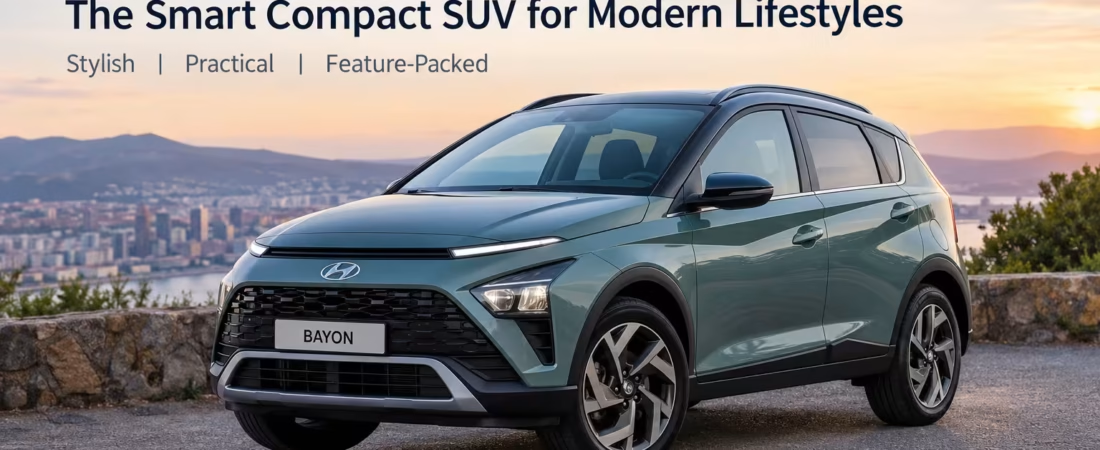
The compact SUV segment continues to attract buyers who want the elevated driving position of an SUV without the bulk, parking difficulties, and running costs associated with larger vehicles. Within this competitive category, the Hyundai Bayon stands out as a small crossover designed primarily for urban driving, practical everyday use, and European buyers looking for an efficient alternative to a conventional hatchback.
If you are searching for the Hyundai Bayon around its anticipated October 15, 2026, update or launch window, you probably want answers to several important questions: What does the SUV offer? How does its design compare with other compact crossovers? Which engine options and technology features are available? Could it arrive in India? And is it worth waiting for?
This guide explores the Hyundai Bayon’s design, interior, performance, safety considerations, expected market positioning, ownership factors, and possible future developments. It also separates established information about the existing model from details that need confirmation for any new 2026 version.
One important distinction before we begin: October 15 is a date to watch, not a confirmed launch date established by the information available here. Likewise, specifications, prices, and availability for a new model year or market should not be treated as official until Hyundai publishes them.
For prospective buyers, this distinction matters. A vehicle can be an established product in one country while remaining unavailable in another. Understanding the Bayon’s actual market position is the first step toward deciding whether it belongs on your shortlist.
Hyundai Bayon 2026: What Is New?
The Hyundai Bayon name now covers two closely related but market-specific stories: the established European compact crossover and the new India-focused SUV announced by Hyundai Motor India in September 2026 and unveiled on October 12, 2026.
Hyundai’s official European presentation introduces a larger, more spacious next-generation Bayon, with a planned hybrid powertrain and an available N Line version. In India, Hyundai has presented the Bayon as a technology-focused SUV built around connected features, a digital cockpit, and an intelligent voice assistant. These market-specific details should not be mixed together when comparing specifications.
For Indian buyers, the most relevant development is that the India-spec Bayon has moved beyond speculation. Hyundai has announced the vehicle and opened bookings, while the company’s published launch schedule and pricing should be checked separately before making a purchase decision.
SEO Information at a Glance

Hyundai Bayon 2026
Compact SUV / crossover
A practical, technology-oriented SUV with distinct European and Indian market specifications.
European model dimensions
4,245 mm
Overall length
European ICE luggage capacity
440 litres
Published specification
European specifications are not necessarily applicable to the India-spec SUV. Figures are based on Hyundai’s official European information.
1. Hyundai Bayon Design: A Compact SUV With a Distinctive Identity
Design plays a major role in the compact SUV market. Buyers often want a vehicle that feels practical enough for everyday travel but looks more substantial and expressive than a conventional hatchback.
The Hyundai Bayon has been developed around that balance. The European model uses a crossover-inspired shape, while Hyundai’s Indian reveal emphasizes a bolder SUV identity and its evolving Art of Steel design philosophy.


6
Front-end styling
The front of the European Bayon features a modern lighting arrangement and a wide, visually distinctive design. Its proportions are intended to make the vehicle look confident without giving it the footprint of a larger family SUV.
For the Indian model, Hyundai’s initial design sketches highlighted angular forms, sharp character lines and a stronger road presence. The final production vehicle’s actual equipment and styling should be assessed using official Indian-market images rather than relying solely on early sketches.
Side profile and proportions
A compact crossover needs to balance visual height with everyday usability. A relatively short body can make parking easier, while a higher seating position can help drivers see surrounding traffic.
The new European Bayon measures 4,245 mm long and has a 2,600 mm wheelbase. These dimensions suggest a vehicle designed to make efficient use of its footprint while improving cabin space over a smaller car.
For Indian buyers, however, the European dimensions should not automatically be assumed to describe the India-spec version. Confirm the local vehicle’s dimensions, turning radius and ground clearance before comparing it with competing SUVs.
Rear design and everyday practicality
The rear of an SUV is more than a styling feature. Its shape affects the opening of the boot, the height at which luggage must be lifted, and how easily bulky items can be loaded.
When inspecting the Bayon, check:
- Whether the boot opening is wide enough for suitcases and shopping bags.
- Whether the loading lip makes heavy luggage difficult to lift.
- Whether the rear glass provides useful visibility.
- Whether the reversing camera and parking sensors are included on your chosen trim.
- Whether the rear bumper is likely to be exposed to scrapes on steep ramps.
These practical details can have a greater effect on daily satisfaction than an attractive exterior alone.
2. Hyundai Bayon Interior: Technology and Passenger Comfort
The cabin is one of the most important areas to evaluate when buying a compact SUV. A vehicle may look impressive in photographs, but the quality of its seating, storage, controls and visibility determines how comfortable it feels after months of ownership.
The European Bayon and the India-spec model have different equipment stories. European materials describe an updated interior and increased rear-seat room. Hyundai’s Indian presentation places particular emphasis on connected technology and a digital cockpit.


5
Dashboard and digital displays
A modern infotainment system should make essential functions easier to use rather than adding unnecessary complexity.
Hyundai’s Indian Bayon presentation highlights a dual 12.3-inch display setup and an NVIDIA-accelerated Connected Car Navigation Cockpit, referred to as ccNC. The company has also announced software-oriented vehicle features and over-the-air controller updates.
For prospective buyers, the screen size is only one part of the story. During a showroom visit, check whether:
- Navigation responds quickly.
- Smartphone connectivity is easy to establish.
- The display remains readable in bright sunlight.
- Frequently used functions are accessible without navigating several menus.
- The driver can adjust climate and audio settings without becoming distracted.
- Software updates are supported for the specific Indian variant.
A large display is useful only if its interface remains straightforward during real driving.
Generative AI voice assistant
One of the headline features announced for the Indian Bayon is an in-built generative AI voice assistant. Hyundai describes this as part of its broader approach to intelligent mobility.
Voice control could help drivers interact with selected vehicle functions while keeping their hands on the steering wheel. The actual benefits depend on the assistant’s supported commands, language capabilities, internet requirements and ability to understand speech in noisy conditions.
Before paying extra for a technology package, ask the dealer to demonstrate it. Try ordinary requests rather than memorized promotional examples, and check which functions remain available if mobile connectivity is weak.
Also clarify whether the system requires a subscription, how personal data is handled, and whether its functions will receive updates over the ownership period.
Connected-car technology
Hyundai has announced more than 70 Bluelink connected features for the India-spec Bayon. The precise functions available to each owner depend on the final equipment and service terms.
Connected features can potentially help with vehicle monitoring, remote functions, navigation and convenience. However, buyers should distinguish between features built into the car, features accessed through a mobile application, and services that require a paid subscription.
Ask the dealership for a written feature list covering:
- Which services are included when the vehicle is purchased.
- Whether any introductory subscription expires after a fixed period.
- Which features need an active data connection.
- Whether the car can receive software updates remotely.
- What happens if the connected-services subscription is not renewed.
This is especially important for buyers who expect to keep their vehicles for five years or longer.
Seats, storage and cabin ergonomics
A good cabin should work for the people who will actually use it. Tall drivers need adequate steering and seat adjustment, while families may need generous rear-seat legroom and accessible storage.
The European model’s longer wheelbase is intended to improve rear-seat room. The official European information also identifies additional luggage-space practicality as a feature of the new generation.
When examining the Indian version, check the front-seat cushion length, under-thigh support, rear-seat backrest angle, headroom and ease of entering and exiting the cabin.
If children regularly travel in the car, bring the child seat you normally use and check its fit. Families should also confirm the number and placement of child-seat anchor points in the exact variant.
Cabin comfort on long journeys
Comfort depends on more than the materials used on the dashboard. Seat support, suspension tuning, tyre noise, ventilation and rear-seat space can make a substantial difference during highway travel.
A useful test drive should include at least some rough road surfaces and a stretch of faster traffic, if available. Listen for tyre noise, check how the suspension handles sharp bumps, and see whether the seats remain comfortable after 20–30 minutes.
Do not assume the European model’s ride quality will be identical to that of the India-spec version. Different tyres, suspension tuning and local specifications can change the driving experience.
3. Hyundai Bayon Engine Options and Performance
Engine choice affects acceleration, fuel expenses, overtaking ability and the overall driving experience. Buyers should evaluate the powertrain according to their daily routes rather than choosing an engine based only on its advertised output.
The European and Indian Bayon specifications differ, so the two should be considered separately.
European Hyundai Bayon engine options
Hyundai’s official European information lists the new Bayon with initial petrol engine options and a hybrid powertrain planned for a later stage. The published specifications include the following configurations.
| Powertrain | Published output | Transmission |
|---|---|---|
| 1.0-litre T-GDi petrol | 90 PS | 6-speed manual or 7-speed DCT |
| 1.0-litre T-GDi petrol | 115 PS | 6-speed manual or 7-speed DCT |
| 1.6-litre hybrid | 138 PS combined | 6-speed DCT |
These are European-market specifications announced for the new-generation model. Availability and final homologated figures may vary by market and trim.
The 90 PS configuration is intended for buyers who prioritize everyday mobility, while the 115 PS version offers greater power for drivers who regularly carry passengers or travel on faster roads. Actual acceleration and fuel economy depend on the selected transmission, vehicle load, driving conditions and final specifications.
The hybrid version is planned to combine a petrol engine with an electric motor. Its stated combined output is 138 PS, although final performance and consumption figures remain subject to confirmation in the official European specifications.
India-spec Hyundai Bayon engine expectations
Hyundai Motor India has announced that the Indian Bayon will use a petrol powertrain with manual and IVT transmission options.
An IVT, or intelligent variable transmission, is a type of continuously variable automatic transmission. It is generally designed to provide smooth acceleration without conventional fixed gear changes.
For urban commuters, an automatic transmission may reduce the effort associated with stop-and-go traffic. A manual transmission may appeal to drivers who prefer greater direct control or want to compare the purchase price of different variants.
The exact Indian engine capacity, output, torque, fuel-efficiency figures and availability of individual gearbox combinations should be confirmed against the final variant specifications before purchase.
Which transmission should you choose?

Manual transmission
Consider it if you enjoy changing gears yourself, drive regularly on less congested routes or find that the manual variant better fits your budget. Test the clutch effort and gear engagement in traffic before deciding.

IVT automatic
Consider it if you spend significant time in traffic, share the car with multiple drivers or value smooth low-speed operation. Check the exact transmission specification and test its response during overtaking and hill starts.
Is the Bayon suitable for highway driving?
A compact SUV can be a practical highway car if it has adequate power, stable handling, comfortable seats and appropriate safety equipment.
Before deciding, assess four things:
- Overtaking response: Does the engine accelerate confidently when joining faster traffic?
- High-speed stability: Does the car feel settled on open roads?
- Cabin noise: Are engine and tyre noise acceptable at cruising speeds?
- Braking confidence: Does the vehicle stop predictably without excessive pedal effort?
A short urban test drive may not reveal these characteristics. If highway use is important, request a longer test drive or ask the dealership about an approved extended demonstration.
4. Fuel Efficiency and Running Costs
Fuel efficiency is a major consideration for buyers who commute daily or use their cars for frequent family trips. However, an official laboratory figure and actual fuel consumption are not the same thing.
Traffic density, average speed, tyre pressure, air-conditioning use, driving style and vehicle load can all affect fuel economy.
What should buyers expect?
For the European model, Hyundai has published preliminary CO₂ targets for its new-generation petrol and hybrid configurations. These figures are not a substitute for a final, market-specific fuel-consumption rating.
For the India-spec model, wait for the final certified fuel-efficiency figures applicable to the exact engine and transmission.
The most useful approach is to compare vehicles under the same test conditions. If one manufacturer quotes a laboratory rating and another provides a different testing standard, the numbers may not be directly comparable.
How to estimate your monthly petrol budget
You can calculate an approximate fuel budget using your own driving distance and a conservative estimate of real-world mileage.
For example, suppose you drive 1,200 km per month, your car averages 14 km per litre in your normal conditions, and petrol costs ₹105 per litre. These are illustrative assumptions, not a claim about the Bayon’s actual mileage or your local fuel price.
The calculation is:
\[ \text{Monthly fuel cost} = \frac{1,200}{14}\times ₹105 \]
The estimated result is approximately ₹9,000 per month.
Use your own commute distance, local fuel price and realistic mileage estimate to calculate the figure for your situation.
Other running costs to consider
Petrol is only one part of ownership expenditure. Budget for:
- Periodic servicing and consumables.
- Insurance renewals.
- Tyres, wheel alignment and balancing.
- Brake-pad replacement.
- Battery replacement when required.
- Parking, tolls and other travel expenses.
- Potential subscription charges for connected services.
A car with a slightly lower purchase price may not be cheaper over five years if its insurance, tyres or financing costs are substantially higher.
5. Exterior Dimensions, Boot Space and Practicality
Dimensions affect how easily a car fits into a parking space, how comfortable it feels with five occupants and how much luggage it can carry.
The new European Bayon measures 4,245 mm in length, 1,810 mm in width and up to 1,570 mm in height with 18-inch wheels and roof rails. Its wheelbase is 2,600 mm. Hyundai lists a projected 440-litre luggage capacity for the internal-combustion version and 397 litres for the hybrid.
| Measurement | New European Bayon |
|---|---|
| Length | 4,245 mm |
| Width | 1,810 mm |
| Height | Up to 1,570 mm |
| Wheelbase | 2,600 mm |
| Luggage capacity, petrol versions | 440 litres |
| Luggage capacity, hybrid | 397 litres |
European manufacturer figures. The Indian vehicle may have different dimensions and luggage capacity.
Is 440 litres of boot space enough?
For many households, a 440-litre boot should provide useful room for regular shopping, backpacks and holiday luggage. Whether it is sufficient depends on the shape of the luggage compartment, not simply the advertised volume.
A family planning longer holidays should test the boot with its usual luggage. Check whether the space accommodates a large suitcase alongside smaller bags, and whether the rear seats can be folded to transport bulky items.
Also ask whether a spare wheel is provided, whether the boot floor can be adjusted, and how much usable space remains underneath it.
Is the Bayon easy to park?
Exterior length is only one factor in parking convenience. Width, turning radius, steering effort, visibility and the position of the front corners also matter.
If you park in a narrow apartment garage, measure the available space before buying. Check the clearance needed to open the doors, access the boot and walk around the car.
A reversing camera and parking sensors can be helpful, but they do not eliminate blind spots or replace careful observation.
Ground clearance and Indian roads
Ground clearance is especially relevant to Indian buyers who encounter uneven streets, tall speed breakers, potholes or steep driveway entrances.
Do not assume that a vehicle marketed as an SUV can handle every rough-road condition. Compare the officially stated ground clearance of the India-spec Bayon with your current car, and pay attention to its front overhang and underbody layout.
During a test drive, use normal, legal driving speeds and observe how the suspension deals with the types of road surfaces you regularly encounter. Avoid deliberately driving over obstacles that could damage the vehicle.
6. Hyundai Bayon Safety Features: What to Check Before Buying
Safety should be evaluated independently of exterior styling, screen size and convenience features.
Hyundai’s European Bayon information describes a modern compact SUV, while the Indian model’s announced positioning emphasizes advanced safety alongside technology. Buyers should nevertheless confirm the actual equipment and crash-test information applicable to the vehicle they intend to purchase.
Active safety systems
Depending on the market and trim, contemporary vehicles may offer systems such as:
- Autonomous emergency braking.
- Lane-departure warning and lane-keeping assistance.
- Driver attention monitoring.
- Electronic stability control.
- Hill-start assistance.
- Rear parking sensors and a reversing camera.
- Blind-spot monitoring or rear cross-traffic alerts.
This is a checklist of systems to verify, not a claim that every feature is standard on every Bayon variant.
Ask the dealer to identify which features are fitted to each trim and whether any systems are restricted to a higher-priced package.
Passive safety and crash protection
Passive safety includes the vehicle’s structural protection, airbags, seat belts, head restraints and child-seat attachment provisions.
When comparing the Bayon with another SUV, confirm:
- The number and locations of airbags in the exact variant.
- The availability of ISOFIX child-seat anchors and top-tether points.
- Whether rear-seat occupants receive three-point seat belts.
- Whether the vehicle has a published crash-test rating for the relevant model and market.
- Whether the rating applies to the same generation and specification.
A rating awarded to an older vehicle or a differently equipped international version should not automatically be applied to the Indian model.
How to assess safety claims
Terms such as “advanced safety,” “five-star standards” and “driver assistance” can sound reassuring, but they do not all mean the same thing.
A manufacturer’s engineering target is not necessarily the same as a published independent crash-test result. Likewise, a vehicle can have many electronic assistance features without offering the highest level of occupant protection in every crash scenario.
For a meaningful comparison, look for independent test results that explicitly identify the model year, market, tested configuration and assessment protocol.
7. Hyundai Bayon Technology: What Makes It Different?
The Indian Bayon’s technology package is a major part of Hyundai’s product positioning. The company has announced a generative AI voice assistant, NVIDIA-accelerated ccNC technology, over-the-air controller updates and more than 70 Bluelink connected features.
These systems may appeal to buyers who want their car to work more like a connected digital device. However, the most valuable features are those that improve convenience without distracting the driver.
What is a connected car?
A connected car uses communication technology to exchange information with compatible services or devices. Depending on the system, this can enable functions such as remote vehicle monitoring, connected navigation, vehicle-status checks and selected remote controls.
The practical value depends on coverage, compatibility, service availability and ongoing subscription terms.
What are over-the-air updates?
Over-the-air, or OTA, updates allow supported software to be delivered to a vehicle without requiring every update to be installed manually at a workshop.
Hyundai has announced controller OTA updates for the Indian Bayon. The exact controllers, update types and installation conditions should be confirmed in the owner’s documentation.
An OTA capability does not mean that every mechanical issue can be fixed remotely or that every future feature will be provided free of charge.
Will the AI voice assistant be useful?
The answer depends on how reliably it understands ordinary requests and which tasks it can perform.
A useful voice assistant should reduce the need to look away from the road to adjust settings or search through menus. Buyers should test common commands and check whether the system understands the languages and speech patterns they use.
It is also worth checking how the system handles poor connectivity, background noise and misunderstood commands.
Is advanced technology worth paying more for?
That depends on your priorities.
If you frequently use navigation, connected services and voice control, the technology package may provide meaningful everyday benefits. If you mainly drive short distances and prefer physical controls, a lower trim with fewer connected features could be a better value.
Compare the complete cost of ownership rather than assuming the highest trim is automatically the best choice.
8. Hyundai Bayon India Launch Date and Expected Price
For Indian readers, the Bayon’s market status is particularly important because the name was historically associated with Hyundai’s European crossover range.
Hyundai Motor India announced the Indian Bayon on September 14, 2026, and subsequently released design and technology information. The company announced that bookings were open from an initial amount of ₹11,000. Its Indian press release dated October 12, 2026, introduced the India-spec vehicle and outlined its technology-focused positioning.
India launch and booking details
Announced launch schedule
October 26, 2026
Listed by Autocar India; verify the final schedule with Hyundai.
Booking amount
₹11,000 initial amount
Announced by Hyundai India. Confirm the refund and cancellation terms before paying.
Expected price
Published estimates vary by source.
The final ex-showroom price, variant structure and on-road costs should be confirmed with Hyundai before purchase.
Official manufacturer information: Hyundai India press releases.
What will the Hyundai Bayon cost?
Before the official price is confirmed for a particular variant, online estimates should be treated as provisional.
A quoted starting price is not necessarily the price of the automatic variant, a higher trim or a vehicle registered in your city. The final on-road amount can include registration charges, insurance, applicable taxes and optional accessories.
To compare dealer quotations fairly, request the following in writing:
- Ex-showroom price of the exact variant.
- Registration and road-tax charges.
- Insurance premium and coverage.
- Extended warranty and service-package costs.
- Optional accessories and other dealer charges.
- Applicable discounts or exchange offers.
- Final on-road price.
This makes it easier to compare the Bayon with competing SUVs without being misled by different assumptions in advertised prices.
Should you book before the price announcement?
Early booking may help buyers express interest in the vehicle, but it should not replace a careful assessment of the final product.
Before paying, confirm the booking terms, cancellation policy, refund timeline and whether the amount is adjusted against the final invoice. Ask whether the booking secures a specific variant or colour, and whether delivery timing is guaranteed or only estimated.
If the final price, safety equipment or transmission availability is central to your decision, waiting for the full price list may be the more sensible option.
9. Hyundai Bayon vs Its Main Competitors
The Bayon should be compared with vehicles that meet the same budget, size and usage requirements. For Indian buyers, the relevant comparison set may include compact crossovers and larger family-oriented SUVs, depending on the final positioning and price.

Maruti Suzuki Fronx
A useful benchmark for buyers seeking a crossover with compact dimensions and a city-friendly footprint. Compare the Bayon’s price, equipment, transmission options, rear-seat comfort and ownership costs.

Maruti Suzuki Victoris
Worth considering if you want to compare a more family-focused SUV with the Bayon. Pay particular attention to space, powertrain options, safety equipment and total price.

Hyundai Venue
A natural comparison for existing Hyundai customers who want a compact SUV. Check how the Bayon’s equipment, cabin layout, engine options and price compare with the Venue’s actual variants.

Hyundai Creta
Relevant for buyers who prioritize a larger family-SUV experience. Compare cabin space, engine performance, comfort, features and running costs before choosing between the two.
Use two fingers to move the map
Use ctrl + scroll to zoom the map
Hyundai IndiaCorporate officeOpen
Maruti Suzuki India5.0•Suzuki dealerOpen
These are comparison candidates, not a definitive ranking. Their prices, dimensions, equipment and powertrains differ, and the right choice depends on your budget and requirements.
Hyundai Bayon vs Maruti Suzuki Fronx
The Fronx is a useful comparison for buyers who prefer a crossover that is easy to drive in the city. The Bayon may appeal to those who value Hyundai’s announced digital cockpit and connected technology, but the value proposition depends on the final Indian specifications and price.
Compare the actual variants rather than the nameplates. A well-equipped lower-priced competitor may offer better value than a base Bayon, while a higher Bayon trim could be more attractive if its extra features are useful to you.
Hyundai Bayon vs Hyundai Venue
The Venue comparison is particularly relevant to customers already familiar with Hyundai’s compact SUV range.
Consider whether the Bayon offers enough additional space, technology or comfort to justify its price relative to the Venue. Also compare the warranty, service package, delivery availability and insurance quotation for both vehicles.
If the two SUVs overlap significantly in price, a back-to-back test drive will be more informative than comparing their brochures alone.
Hyundai Bayon vs Hyundai Creta
The Creta is a relevant alternative for families who need more room or want to explore a broader range of powertrain and trim choices.
The Bayon could suit buyers whose priorities centre on everyday usability and connected technology. The Creta may be preferable if its cabin, luggage capacity or available features better suit your needs.
Do not assume that a compact SUV is always cheaper to own or that a larger SUV is always less efficient. Calculate costs using the specific variants you are considering.
10. Who Should Consider Buying the Hyundai Bayon?
The Bayon may suit a range of buyers, but the strongest reason to choose it will depend on the final Indian model’s price, equipment and driving characteristics.
Urban commuters
If most of your driving takes place in city traffic, focus on visibility, steering effort, transmission behaviour, parking assistance and fuel consumption.
The automatic version may be especially attractive to drivers who spend long periods in stop-and-go traffic. However, check how the car responds at low speeds and how easy it is to manoeuvre in tight spaces.
Small families
A compact SUV can work well for a small family if the rear seats are comfortable, the boot is sufficiently practical and child-seat installation is straightforward.
Take the whole family on the test drive if possible. Sit in the back, check access to the seat belt buckles and test the boot with the luggage you normally carry.
Technology-focused buyers
The India-spec Bayon’s announced digital cockpit and AI voice assistant may interest buyers who want advanced connected features.
Before choosing a technology-heavy trim, test the systems in person and confirm which features are included in the purchase price. Make sure you are comfortable with the interface and any associated service requirements.
First-time car buyers
First-time buyers should prioritize predictable driving behaviour, visibility, safety, ease of parking and affordable ownership.
Avoid spending more on features you may rarely use. A lower trim with the right safety equipment and transmission can be a better long-term purchase than a top-end model chosen primarily for its screen size or styling.
Buyers upgrading from a hatchback
A compact SUV can provide a higher seating position and a different driving experience, but the improvement depends on the actual vehicle.
If you are upgrading from a hatchback, compare the Bayon’s rear-seat comfort, boot access, ground clearance and turning radius with your current car. These are the areas most likely to influence your everyday satisfaction.
11. How to Buy the Hyundai Bayon: A Practical Step-by-Step Guide
Use this checklist when the final Indian specifications and prices are available.
Buyer checklist
0 of 6
Confirm the exact variant
Check the engine, transmission, safety equipment and included technology.
Compare the final price
Get a written, itemized on-road quotation from the dealer.
Test the vehicle
Drive it in city traffic and on representative road surfaces.
Check family practicality
Test the rear seats, child-seat fit and boot with your own luggage.
Verify ownership terms
Review the warranty, service schedule, insurance and connected-service conditions.
Review booking and delivery
Confirm cancellation terms, refund conditions, colour and expected delivery.
Copy checklist
Step 1: Set your total budget
Decide how much you can spend upfront and what monthly payment you can comfortably afford.
Remember that the cost of owning a car includes more than the loan instalment. Fuel, insurance, maintenance, parking and unexpected repairs also affect the household budget.
Step 2: Choose your powertrain
Decide whether a manual or automatic transmission suits your daily driving. Use the final Indian specification sheet rather than assuming that the European engine lineup will be offered in India.
If you frequently drive in heavy traffic, test the automatic. If you spend more time on open roads, evaluate both transmissions if available.
Step 3: Compare the variants
Create a simple table comparing the features that matter most to you. Include safety equipment, climate control, parking aids, infotainment, seat comfort and connected-service costs.
Do not pay for a higher trim solely because it has more features. Pay for the features you will genuinely use.
Step 4: Take a proper test drive
A useful test drive should include low-speed turns, parking, speed breakers, braking and a section of road where you can assess acceleration safely.
Check the driver’s seating position, rear visibility and whether the controls are easy to reach. If you regularly carry passengers, ask them to evaluate rear-seat comfort as well.
Step 5: Compare the full ownership package
Ask the dealership for the warranty details, service intervals, estimated maintenance charges and available service packages.
Check whether connected services are included for a limited period, and ask what happens after the introductory period ends.
Step 6: Read the paperwork before paying
Read the booking form, cancellation conditions, delivery estimate and payment terms. Keep copies of the quotation and any written promises about accessories or delivery.
If a dealer offers a discount, confirm whether it applies to the variant you want and whether it depends on financing, exchange or insurance through a particular provider.
12. Best Practices for Getting the Most From Your Bayon
Choosing the right vehicle is only the beginning. Good driving habits and regular maintenance help preserve reliability, safety and resale value.
Follow the manufacturer’s maintenance schedule
Use the service intervals specified in the owner’s manual for your particular model and powertrain. Do not assume that the European servicing schedule will be identical to the Indian schedule.
Keep records of scheduled maintenance, repairs and replacement parts. Complete documentation can help when making warranty claims or selling the vehicle.
Monitor tyre pressure
Incorrect tyre pressure can affect ride comfort, handling, tyre wear and fuel consumption.
Check the recommended pressures on the vehicle’s tyre-pressure label or in the owner’s manual. Adjust them according to the manufacturer’s guidance and the vehicle’s load.
Use driver-assistance systems responsibly
Electronic assistance systems can support the driver, but they do not replace attention or safe driving practices.
Learn how each system operates, what warnings it provides and under which conditions it may not function as intended. Keep your attention on the road even when adaptive or automated assistance is active.
Protect connected accounts
If you use connected-car applications, secure your account with a strong password and any available additional authentication. Review who has access to remote functions, especially if the vehicle is shared with family members.
Before selling the car, follow the manufacturer’s instructions for removing personal information, unlinking your account and transferring vehicle access.
Plan for long-term ownership
Think about how your needs might change during the next five years. A vehicle that works well for a single commuter may feel less practical when a family grows or regular long-distance travel becomes necessary.
Choose a variant that meets your present needs without stretching your budget for features that may not improve your daily experience.
13. Common Mistakes to Avoid When Considering the Hyundai Bayon
Mistake 1: Treating the European model as identical to the Indian version
The two markets have different product requirements and announced specifications. European engine options, dimensions, luggage capacity and hybrid availability should not be automatically applied to the India-spec car.
Better approach: Use the Indian specification sheet and price list when making a purchase decision.
Mistake 2: Assuming a launch date from a calendar listing
A tentative date, event date or media report does not always represent the date when customer deliveries begin.
Better approach: Confirm the announced launch schedule, booking terms and delivery estimate directly with Hyundai or an authorized dealership.
Mistake 3: Relying on an estimated price
Online price estimates can change when the manufacturer announces variants, taxes and equipment.
Better approach: Compare written, variant-specific on-road quotations.
Mistake 4: Choosing a vehicle based on technology alone
A large screen or AI voice assistant can be appealing, but neither determines how comfortable the car is on a rough road or how effectively it protects occupants in a crash.
Better approach: Give safety, comfort, reliability, running costs and practical usability equal consideration.
Mistake 5: Ignoring subscription charges
Some connected services may require subscriptions or depend on ongoing connectivity.
Better approach: Ask for the initial subscription period, renewal cost and a list of functions that stop working when the subscription expires.
Mistake 6: Comparing mileage figures without checking the test method
Fuel-efficiency numbers may come from different test cycles or reflect different vehicle configurations.
Better approach: Compare figures measured using the same standard, then use realistic estimates based on your driving conditions.
Mistake 7: Paying a deposit without reading the conditions
A booking amount does not automatically guarantee a particular delivery date, variant or refund arrangement.
Better approach: Read the booking terms and retain the confirmation receipt.
14. Future Outlook: What Could Shape the Hyundai Bayon’s Success?
The compact SUV market is changing as buyers demand more equipment, better efficiency and increasingly connected cabin experiences. Several factors are likely to influence the Bayon’s appeal.
More emphasis on software
Hyundai’s announced Indian Bayon technology package illustrates the growing role of software in vehicle design. Digital displays, connected services, remote functions and software updates are becoming part of the ownership experience rather than optional extras in every market.
The long-term question is whether these features remain reliable, intuitive and useful throughout the vehicle’s life. A good system should continue to serve the driver without requiring excessive subscriptions or complicated interactions.
Hybrid technology in Europe
Hyundai has announced plans for a hybrid powertrain in the new European Bayon after the initial petrol versions. The published specification identifies a 1.6-litre hybrid with a planned combined output of 138 PS.
A hybrid can reduce fuel consumption in suitable driving conditions by combining an engine with electric assistance. Actual savings depend on the system design, traffic patterns, driving style and vehicle price.
The European hybrid announcement should not be interpreted as confirmation of an Indian hybrid launch.
Increasing competition
Compact SUVs compete on price, cabin space, performance, safety, service access and resale value. Buyers can often find several vehicles with similar headline features, so the differences between specific variants become especially important.
The Bayon’s success will depend on whether its final price and equipment make sense against established alternatives, not simply on how many technologies it advertises.
Ownership experience will matter
Connected features may attract buyers initially, but long-term satisfaction also depends on after-sales support, spare-parts availability, service quality and warranty handling.
Prospective buyers should check service access in their area and ask the dealer about routine maintenance costs. These factors are particularly relevant for anyone planning to keep the vehicle for many years.
15. Is the Hyundai Bayon Worth Waiting For?
The Hyundai Bayon deserves consideration if you want a modern compact SUV with a strong technology focus and practical everyday usability.
For European buyers, the new-generation model’s announced dimensions, luggage capacity, petrol engine choices and planned hybrid option provide a useful picture of its intended role. For Indian buyers, Hyundai’s announced digital cockpit, generative AI voice assistant, connected features and petrol transmission options are the most relevant early details.
However, the best buying decision depends on details beyond the headline features. The final Indian price, variant-wise safety equipment, actual fuel efficiency, rear-seat comfort, driving behaviour and ownership costs all need to be assessed.
If you are considering the Bayon, shortlist two or three similarly priced SUVs and compare them using the same checklist. Test-drive the exact variant you intend to purchase, obtain a complete on-road quotation and read the warranty and booking terms carefully.
That approach will help you determine whether the Bayon offers genuine value for your needs rather than simply being the newest vehicle in the showroom.
Frequently Asked Questions About the Hyundai Bayon
1. What is the Hyundai Bayon?
The Hyundai Bayon is a compact crossover SUV developed by Hyundai. The established model is associated with European markets, while Hyundai Motor India announced an India-focused Bayon in September 2026 and unveiled its Indian specification in October 2026. The specifications and features differ by market.
2. What is the Hyundai Bayon launch date in India?
Hyundai announced the Indian Bayon and opened bookings in September 2026. Autocar India listed October 26, 2026, as the launch date. Buyers should confirm the final schedule and delivery timing with an authorized Hyundai dealership.
3. What is the expected price of the Hyundai Bayon in India?
Online estimates vary, and a final price should be confirmed for the exact variant. Do not confuse an estimated ex-showroom price with the on-road price, which includes registration, insurance and other applicable costs. Request an itemized quotation before booking.
4. Which engine will the Indian Hyundai Bayon use?
Hyundai India has announced a petrol powertrain with manual and IVT transmission options. Confirm the final engine capacity, power output, torque and variant-wise availability from the official Indian specification sheet. The European model’s 1.0-litre turbo-petrol and planned hybrid options should not be assumed to apply to India.
5. Will the Hyundai Bayon have an automatic transmission?
Hyundai India has announced IVT automatic and manual transmission options. The exact availability of each transmission across the final Indian variants should be checked with the manufacturer or dealership.
6. What are the key features of the Hyundai Bayon?
For India, announced highlights include a dual 12.3-inch display setup, an NVIDIA-accelerated ccNC cockpit, a generative AI voice assistant, controller OTA updates and more than 70 Bluelink connected features. Actual equipment and service availability may differ by variant.
7. Is the Hyundai Bayon a good family car?
It could be a good option for a small family if its final cabin space, rear-seat comfort, boot capacity, safety equipment and price suit your needs. Test the actual Indian vehicle with your usual passengers and luggage before making a decision.
8. Should I buy the Hyundai Bayon or a competing SUV?
Compare the Bayon with alternatives such as the Hyundai Venue, Hyundai Creta and Maruti Suzuki Fronx, as well as other SUVs within your budget. Choose based on the final on-road price, safety, comfort, fuel costs, transmission, warranty and local service access—not simply on the number of features.
The Future of Electric Vehicles: A Deep Dive into Harrier.ev!