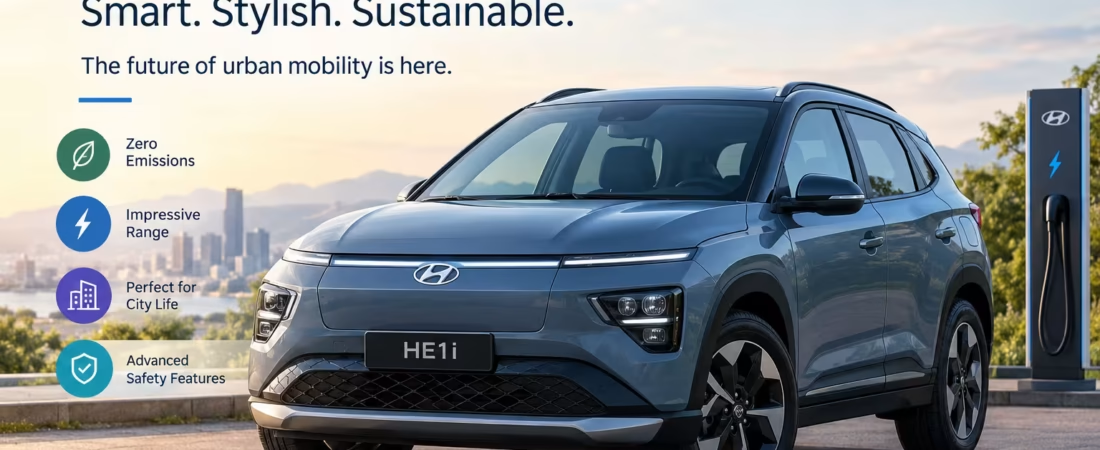
The Hyundai HE1i Compact EV is shaping up to be an important addition to India’s growing electric vehicle market. Designed specifically for the Indian market, this upcoming compact electric SUV is expected to bring Hyundai’s electric mobility technology to a more accessible price segment, giving buyers another option beyond conventional petrol cars and larger, more expensive electric SUVs.
For people considering their first electric car, the questions are practical: How much will it cost? What driving range can buyers expect? Will it be suitable for daily commuting? How long will charging take? And should you wait for Hyundai’s new EV or choose an electric SUV that is already available?
As of October 23, 2026, Hyundai has confirmed plans for a locally designed and manufactured compact electric SUV for India. The vehicle is known by its development codename, HE1i, but its final production name, official price, detailed battery specifications and certified driving range have not yet been announced. Recent automotive reporting points to a debut in the first quarter of 2027, although the final launch schedule remains subject to official confirmation.
This guide examines the Hyundai HE1i Compact EV’s expected launch timeline, reported platform, possible battery options, anticipated features, ownership considerations and competition. It also explains what prospective buyers should verify before making a booking decision.
The goal is to separate confirmed information from industry reports and reasonable expectations, helping you decide whether this upcoming Hyundai electric SUV deserves a place on your shortlist.
What Is the Hyundai HE1i Compact EV?
The Hyundai HE1i Compact EV is the development name for an upcoming small electric SUV planned for the Indian market by Hyundai Motor India. It is expected to sit below the Creta Electric in Hyundai’s electric vehicle lineup and target customers who want an urban-friendly SUV without moving into a higher-priced EV category.
Unlike a conventional petrol SUV adapted to use an electric motor, the HE1i is reported to be a dedicated electric vehicle based on Hyundai’s E-GMP (K) platform. This platform is also used by the international-market Hyundai Inster. The Indian model, however, is expected to receive market-specific design and localisation rather than simply being an unchanged import.
Hyundai has publicly outlined plans for a compact electric SUV designed and localised for India. The company has also confirmed a next-generation infotainment system and Level 2 assisted-driving technology for the new vehicle.
These announcements matter because the affordable EV segment needs more than a low purchase price. Buyers need dependable charging, useful everyday range, a practical cabin, good safety equipment and manageable long-term ownership costs.
The HE1i could become an appealing option if Hyundai manages to combine those elements at a competitive price.
Why Is the HE1i Generating Interest?
There are several reasons this upcoming electric SUV deserves attention.
- A new price segment: It is expected to target buyers who find larger electric SUVs too expensive.
- India-focused development: Local design, manufacturing and localisation could help Hyundai tailor the vehicle to domestic driving conditions and customer preferences.
- Dedicated EV architecture: The reported E-GMP (K) foundation suggests that the vehicle is being developed around electric propulsion.
- Two reported range versions: Automotive reports indicate that Standard Range and Long Range configurations are planned.
- Modern technology: Hyundai has confirmed Level 2 assisted-driving technology and a next-generation infotainment system.
These points make the HE1i promising, but they do not establish its final value. Its success will depend on specifications, pricing, safety performance, charging capability and the actual experience customers receive.
Hyundai HE1i Compact EV Launch Date in India
The launch timeline has changed as Hyundai’s plans have developed. Earlier announcements and industry reports referred to a debut by the end of 2026 or by March 2027. A report published by Autocar India on October 17, 2026, subsequently indicated that the compact EV was now scheduled to debut in the first quarter of 2027, with January mentioned as the expected timing.
Launch timeline at a glance
Project announced
Hyundai outlined plans for an India-focused compact electric SUV.
Latest reported debut window
Q1 2027
January 2027 has been reported as a possible debut month, not a confirmed customer-delivery date.
Official launch date and bookings
The final public launch schedule, booking opening and delivery timetable still require confirmation.
When Will Bookings Open?
Hyundai has not established a confirmed booking date in the information available as of October 23, 2026. Customers should therefore be cautious about websites displaying precise dates without linking them to a company announcement.
The usual launch process for a new car may include a reveal, a specification announcement, price disclosure, booking commencement and customer deliveries. These events do not necessarily happen on the same day.
If you plan to purchase the HE1i, monitor Hyundai India’s official website and authorised dealerships for announcements about:
- Booking commencement and the initial booking amount.
- Available variants and colour choices.
- Test-drive availability.
- Price and delivery estimates.
- Finance offers and applicable incentives.
Buying tip: Do not make a purchase decision based only on an estimated launch date from a third-party car listing. A reported debut is not a guarantee that customer deliveries will begin immediately.
Hyundai HE1i Compact EV Expected Price in India
Price will be one of the most important factors determining whether the Hyundai HE1i becomes a serious alternative to existing electric SUVs.
Several automotive listings and reports have placed the upcoming model in an estimated ₹10 lakh to ₹15 lakh ex-showroom price bracket, depending on the configuration. These figures are expectations, not confirmed Hyundai prices.
The final price could depend on battery capacity, equipment levels, safety technology, charging hardware and the extent of local manufacturing.
Expected Price Range
| Pricing detail | Current position |
|---|---|
| Expected starting price | Around ₹10 lakh, based on industry estimates |
| Potential upper price | Could approach ₹15 lakh, depending on variant |
| Official ex-showroom price | Not announced |
| On-road price | Not available as a confirmed figure |
| Booking amount | Not announced |
| Finance and EMI offers | Awaiting official details |
These estimates should be treated as a preliminary shopping guide rather than a price commitment.
What Could Affect the Final Price?
1. Battery size
A larger battery generally adds cost because it requires more cells and supporting components. If the HE1i launches in Standard Range and Long Range versions, the latter may command a premium.
2. Feature package
Equipment such as advanced driver assistance, a sophisticated infotainment system, automatic climate control, a surround-view camera and powered seats can affect variant pricing. Which of these features will be offered on the HE1i remains to be confirmed.
3. Manufacturing localisation
Local production and domestic component sourcing can help a manufacturer manage costs and supply chains. Hyundai has said the new compact EV will be designed and localised for India. However, localisation alone does not guarantee a particular retail price.
4. Battery sourcing
Reports indicate that the HE1i will initially use battery cells from Svolt, with Hyundai planning to move towards locally sourced cells through its association with Exide when the supply arrangements allow. The timing and precise effect of any such transition on the vehicle’s price have not been confirmed.
5. Competition
Hyundai will need to consider alternatives such as the Tata Punch EV, Tata Nexon EV and Mahindra XUV 3XO EV when positioning its new model. Competitive equipment and pricing may be crucial to attracting customers.
How Much Could the On-Road Price Be?
The on-road price is the amount a buyer pays after adding applicable registration charges, insurance, taxes and other dealer or statutory costs.
For example, if Hyundai were to price a hypothetical base variant at ₹11 lakh ex-showroom, the final on-road amount would be higher. The difference would depend on the buyer’s state, insurance selection, applicable EV policies and the dealership’s itemised charges.
Do not use this hypothetical example as a prediction of the HE1i’s final price. Wait for an official quotation before comparing loan offers or planning a down payment.
How to Evaluate an EV Quote
When dealerships begin accepting bookings, request a written quotation that separates:
- Ex-showroom price.
- Registration and applicable road charges.
- Insurance premium and add-ons.
- Home-charger hardware and installation.
- Extended warranty and maintenance packages.
- Optional accessories.
- Any verified incentive or discount.
This makes it easier to compare the HE1i with rival EVs on a like-for-like basis.
Hyundai HE1i Compact EV Battery and Driving Range
Battery capacity and usable range will strongly influence the HE1i’s suitability for daily life.
Industry reports indicate that Hyundai intends to offer the compact EV in Standard Range and Long Range versions. The exact battery capacities, certified range figures and power outputs have not yet been officially disclosed.
This distinction matters because a model’s expected range should not be confused with a manufacturer’s certified figure or an independently measured real-world result.
What Do We Know About the Battery?
The reported E-GMP (K) platform underpins the overseas Hyundai Inster. International Inster versions provide a useful technical reference, but they are not a specification sheet for the India-focused HE1i.
For context, the overseas Inster has been offered with 42 kWh and 49 kWh battery options, with claimed WLTP driving ranges of up to approximately 300 km and 355 km, respectively. Those figures belong to the Inster and must not be presented as confirmed HE1i specifications.
The HE1i’s final battery chemistry, pack size, usable capacity, warranty conditions and range certification will need to be checked when Hyundai releases the full technical details.
Standard Range vs Long Range: Which Is Better?
The following comparison explains the trade-offs a buyer should consider. It is a general EV buying guide, not a confirmed list of HE1i variant specifications.
| Consideration | Standard Range version | Long Range version |
|---|---|---|
| Purchase cost | Usually lower | Usually higher |
| Daily city use | May be sufficient for shorter commutes | Provides more flexibility |
| Highway travel | Requires more careful planning | Typically offers a larger range buffer |
| Battery size | Generally smaller | Generally larger |
| Charging frequency | May be higher for the same distance | May be lower for the same distance |
| Best suited to | Buyers with predictable local travel | Buyers with longer or less predictable journeys |
A larger battery is not automatically the best purchase for everyone. If most trips are short and charging is convenient, a smaller battery may meet your needs at a lower initial cost.
On the other hand, a household that frequently travels between cities may value additional range because it provides greater flexibility when charging stations are unavailable, occupied or out of service.
What Is Real-World EV Range?
A certified range is measured under a defined test procedure. Real-world range depends on conditions such as:
- Average speed.
- Traffic congestion.
- Outside temperature.
- Air-conditioning use.
- Passenger and luggage load.
- Road gradient and surface.
- Tyre pressure.
- Driving style.
- Battery age and condition.
Highway driving at sustained speeds can consume more energy per kilometre than slower urban travel in some circumstances. Cold or very hot weather can also affect efficiency, while heavy air-conditioning use may increase consumption.
Regenerative braking can recover some energy when slowing down, particularly in stop-and-go traffic. It does not create free energy or eliminate the losses involved in driving.
How to Estimate Your Daily Range Requirement
Use your normal travel pattern rather than choosing a battery solely from a headline range figure.
- Record your average daily distance for a typical working week.
- Add occasional errands and detours.
- Consider the distance you travel on your longest regular trip.
- Check whether charging is available at home or work.
- Allow a practical buffer instead of planning to use the battery down to zero every day.
For example, a commuter who drives 35 km per day and can charge at home has different requirements from someone who regularly covers 140 km between towns.
The first driver may prioritise affordability and convenient charging. The second may place more value on a larger battery, efficient highway performance and reliable rapid-charging access.
Expert tip: Once the HE1i’s official range is published, look for independent road tests that include city and highway driving. A measured result under conditions similar to your own is more useful than relying on a single maximum-range number.
Hyundai HE1i Compact EV Motor, Performance and Driving Experience
An electric vehicle’s driving character is shaped by more than its maximum power output. Motor response, torque delivery, vehicle weight, suspension tuning, tyres and battery management all influence how it feels on the road.
The HE1i’s final motor specifications have not been announced. Buyers should wait for Hyundai to disclose the motor’s power, torque, drivetrain configuration and performance figures before comparing it directly with rival vehicles.
Nevertheless, its electric architecture provides a useful starting point for understanding what to look for.
Instant Torque and City Driving
Electric motors can deliver strong torque from low speeds, allowing an EV to move away from traffic lights smoothly and respond promptly to accelerator inputs.
For urban drivers, that can make everyday journeys easier. Joining moving traffic, negotiating gaps and moving through stop-and-go congestion can feel less demanding than driving a conventional car that needs repeated gear changes.
However, the exact acceleration and throttle response of the HE1i will depend on its final motor calibration and power output.
Automatic Driving Convenience
The HE1i is expected to use an electric powertrain with automatic-style operation rather than a conventional multi-gear manual transmission.
This should make it appealing to drivers who spend considerable time in congested Indian cities. There is no conventional engine clutch to operate, and the absence of routine gear changes can simplify driving.
Regenerative braking may also allow some slowing to be managed through the accelerator pedal, depending on the final system settings. Hyundai has not yet disclosed the HE1i’s exact regeneration modes or whether it will offer a full one-pedal driving function.
What About Highway Performance?
Highway suitability depends on more than acceleration from a standstill.
Before purchasing the HE1i, buyers should check:
- Whether power delivery remains adequate at highway speeds.
- How comfortably the car overtakes slower vehicles.
- Whether the cabin remains quiet at higher speeds.
- How the suspension handles uneven roads and expansion joints.
- Whether steering feels stable and predictable.
- How quickly the battery depletes during sustained highway driving.
A compact EV can be perfectly suitable for occasional highway journeys, but route planning becomes more important when charging infrastructure is limited.
The ideal test drive should include a mixture of low-speed traffic, rough surfaces, open roads and parking manoeuvres.
Hyundai HE1i Compact EV Design and Exterior Styling
Hyundai has not yet released a complete official exterior specification for the HE1i. Its final name, dimensions, production design details, wheel sizes and colour options remain unconfirmed.
The vehicle is expected to be a compact SUV intended for the Indian market. That positioning suggests that dimensions, visibility, ease of parking and useful cabin space will be important to its appeal.
It would be premature, however, to assume that the India-specific model will look exactly like the international Inster.
Why Compact Dimensions Matter
In cities such as Pune, Mumbai, Bengaluru and Delhi, a compact vehicle can be easier to park in apartment complexes, shopping centres and crowded residential streets.
Smaller external dimensions may also help drivers negotiate narrow lanes and congested junctions.
But a compact body should not mean sacrificing practical interior space. The final vehicle’s wheelbase, seating layout, door openings and luggage compartment will determine how effectively it accommodates passengers.
Exterior Features Worth Checking
When official images and the production model become available, examine the following details:
- Lighting: Headlamp visibility, indicator placement and rear-light visibility.
- Ground clearance: Whether the underbody has sufficient clearance for your normal routes.
- Wheels and tyres: Replacement costs, ride comfort and tyre availability.
- Visibility: Rear-window size, mirrors, blind spots and camera coverage.
- Door access: How easily passengers enter and exit in tight parking spaces.
- Charging-port placement: Whether the location is convenient for your home parking arrangement.
- Body protection: The availability of practical protection for bumpers and lower bodywork.
These everyday details can matter more than decorative exterior elements when the car is used for years.
Hyundai HE1i Compact EV Interior and Cabin Practicality
The cabin will be one of the most important areas to inspect once Hyundai reveals the production interior.
A compact electric SUV needs to balance modern technology with the practical requirements of Indian families. A stylish dashboard is useful, but comfortable seating, accessible controls and sufficient storage will have a greater effect on daily ownership.
Space for Passengers
Buyers should check front-seat adjustment, rear-seat legroom, headroom and seat cushioning in person.
A compact SUV may have adequate space for four adults while feeling less comfortable with five occupants, especially on longer trips. The exact experience depends on the body dimensions and seat design.
Families with child seats should test the fit before committing to a purchase. They should also verify the availability and accessibility of the required child-seat anchorages.
Boot Space and Everyday Storage
Boot capacity has not been officially confirmed for the HE1i.
Rather than relying only on a litre figure, consider the objects you regularly carry:
- Grocery bags.
- Office backpacks.
- A cabin-size suitcase.
- School bags.
- A folded stroller.
- Sports equipment.
Check whether the boot opening is wide enough and whether the rear seats fold in a useful configuration.
In a family car, small storage spaces for bottles, phones, charging cables and everyday essentials can make a noticeable difference.
Interior Quality and Climate Control
The Indian climate makes effective air-conditioning especially important.
When the vehicle is available for test drives, check how quickly the cabin cools, whether rear passengers receive sufficient ventilation and whether the controls are easy to operate while driving.
Also examine the quality of frequently touched surfaces, seat fabric or upholstery, door handles and centre-console storage. These are practical ownership considerations that photographs cannot fully communicate.
Hyundai HE1i Compact EV Features and Technology
Hyundai has confirmed two important technology areas for the upcoming compact electric SUV: a next-generation infotainment system and Level 2 assisted-driving technology.
The full equipment list has not been released, so the availability of individual convenience features must remain unconfirmed.
Next-Generation Infotainment System
Modern infotainment systems can bring navigation, media, smartphone connectivity, vehicle settings and energy information together in one interface.
For an EV, useful software should do more than display music and maps. Ideally, it should help drivers understand battery consumption, locate suitable charging stations and estimate arrival charge levels on longer journeys.
The final HE1i system’s precise capabilities, screen sizes, connected services and smartphone integration arrangements have not yet been fully detailed.
When evaluating it, look for:
- A clear and responsive touchscreen.
- Readable battery and range information.
- Straightforward climate controls.
- Reliable phone connectivity.
- Useful navigation and charging information.
- Over-the-air update support, if offered.
- Sensible operation without requiring excessive screen interaction.
A large display is not automatically a better system. Clear menus and dependable everyday performance matter more than screen size alone.
Level 2 Assisted-Driving Technology
Hyundai has confirmed Level 2 assisted-driving technology for the model. This is a meaningful technology commitment, but it should not be interpreted as fully autonomous driving.
Depending on the systems fitted, Level 2 assistance can combine functions such as adaptive cruise control and lane-centering or lane-keeping assistance. The exact feature set, operating conditions and limitations of the HE1i’s system are not yet confirmed.
Drivers must remain attentive, supervise the system and be ready to take control at all times.
Before relying on any assistance feature, read the owner’s manual and understand where the system works reliably. Road markings, weather, traffic behaviour and sensor limitations can affect performance.
Other Features: What Is Confirmed and What Is Not?
| Feature | Current status |
|---|---|
| Next-generation infotainment | Confirmed by Hyundai |
| Level 2 assisted-driving technology | Confirmed by Hyundai |
| Touchscreen size | Not confirmed |
| 360-degree camera | Not confirmed |
| Ventilated seats | Not confirmed |
| Panoramic sunroof | Not confirmed |
| Wireless smartphone integration | Not confirmed |
| Wireless phone charging | Not confirmed |
| Vehicle-to-load power output | Not confirmed |
| Over-the-air updates | Full details not confirmed |
This distinction is useful because speculative feature lists can make an upcoming vehicle appear more fully specified than it actually is.
How to Judge Technology Value
Prioritise features according to how you drive.
For someone who commutes daily, a reliable reversing camera, useful parking sensors and effective climate control may be more valuable than a panoramic sunroof.
For someone who regularly travels on highways, properly calibrated driver assistance, good headlights and a clear navigation system may be more useful.
Technology should improve safety, comfort or convenience rather than simply increase the number of features on a brochure.
Hyundai HE1i Compact EV Safety: What Buyers Should Check
Safety should be a core part of the purchasing decision, particularly for a family vehicle.
Although Level 2 assisted-driving technology has been confirmed, the HE1i’s complete safety equipment list, crash-test results and final ratings have not yet been announced. A confirmed driver-assistance feature does not, by itself, establish how well a vehicle protects occupants in a collision.
Active Safety and Driver Assistance
Active safety features are designed to help prevent or reduce the severity of certain incidents.
Depending on the final variant, buyers should check whether the vehicle offers functions such as:
- Automatic emergency braking.
- Forward collision warning.
- Lane departure warning.
- Lane-keeping assistance.
- Adaptive cruise control.
- Blind-spot monitoring.
- Rear cross-traffic alert.
- Parking sensors and a reversing camera.
These are items to verify, not a claim that every feature will be available on the HE1i.
Passive Safety and Crash Protection
Passive safety helps protect occupants when a collision occurs. The final equipment list should be checked for airbags, seat-belt pretensioners, stability control, child-seat anchorages and other relevant systems.
Buyers should also look for an independently published crash-test result for the exact model and applicable specification, if one becomes available.
Do not assume that a rating awarded to a different Hyundai vehicle or an overseas version applies automatically to the India-specific HE1i.
EV-Specific Safety Considerations
Electric vehicles use high-voltage electrical systems and traction batteries. Their safety engineering must address battery protection, electrical isolation, thermal management and charging faults.
When purchasing the HE1i, review Hyundai’s battery warranty, roadside assistance terms and procedures for dealing with damage to the underbody or battery enclosure.
If the vehicle is involved in a serious collision or the battery area is visibly damaged, it should be assessed by an authorised EV service facility rather than treated as an ordinary minor bodywork repair.
Practical advice: Compare the HE1i’s actual safety equipment and independent crash-test evidence with competing vehicles once the relevant information is published. Do not choose a family car on the strength of an advanced-safety label alone.
Hyundai HE1i Compact EV Charging: Home Charging, Public Chargers and Costs
Charging convenience can determine whether an electric car fits comfortably into everyday life.
For many owners, the most convenient arrangement is to charge at home overnight and use public charging stations for longer journeys. The HE1i’s exact charging power, connector details, charging times and supported rapid-charging standards have not yet been confirmed, so precise charging-time claims would be premature.
Nevertheless, understanding the available charging options will help prospective buyers prepare.
1. Home Charging
Home charging is particularly convenient for drivers who have a dedicated parking space.
Depending on the final vehicle specifications and the charging equipment selected, owners may be able to use an appropriate domestic charging solution or a dedicated AC wall charger.
Before installation, consider the following:
- Whether you have a private parking space.
- Whether your electricity connection can support the charger.
- Whether your apartment society permits EV charging installation.
- Whether the wiring, earthing and protective equipment meet applicable requirements.
- Whether the installation requires approval from the electricity distribution company or property management.
- Whether the charger is compatible with the final HE1i specification.
Do not assume that an ordinary household socket is suitable for every charging arrangement. A qualified electrician or authorised charging installer should assess the installation.
2. Public AC Charging
Public AC chargers can be useful when a vehicle is parked at an office, shopping centre, hotel or other destination for an extended period.
Charging speed depends on the station’s output, the vehicle’s onboard charger and the battery’s current state of charge.
For example, a charger capable of supplying more power than a car’s onboard AC charger can accept will not necessarily make the car charge faster. The vehicle’s own charging limit matters.
3. DC Fast Charging
DC fast charging can be useful for long-distance travel because it can replenish the battery more quickly than many AC charging arrangements.
However, maximum charging power alone does not tell the entire story. The charging curve, battery temperature, starting charge level and power-sharing arrangements at a station all influence the time required.
A vehicle may accept high power only during part of a charging session. Charging usually slows as the battery approaches a high state of charge to help manage battery conditions.
Once Hyundai releases the HE1i’s charging specifications, buyers should compare its expected charging time over a useful battery interval rather than relying only on a peak-power number.
How to Plan Charging for a Road Trip
A sensible approach is to:
- Charge before leaving, especially if the route has limited charging facilities.
- Identify compatible chargers along the route.
- Check recent charger availability and operating status.
- Keep a reserve for detours, traffic and unexpected delays.
- Have a backup charging option for important stops.
- Allow more time than the theoretical minimum charging estimate.
This approach reduces the risk of arriving at a station that is unavailable or discovering that the journey requires more energy than expected.
Hyundai HE1i Compact EV Running Cost and Ownership Expenses
Electric cars can offer lower energy costs than petrol vehicles, particularly when owners charge at home and drive regularly. But the savings depend on the purchase price, electricity tariff, vehicle efficiency, charging mix, insurance and maintenance requirements.
Because the HE1i has not yet received an official efficiency rating, the following examples are illustrative calculations, not predictions of its performance.
Example: Calculating the Cost of Home Charging
Suppose a hypothetical EV consumes 15 kWh of electricity per 100 km at the vehicle level.
If electricity costs ₹8 per kWh, the simple energy cost would be:
\[ 15 \times ₹8 = ₹120 \]
That works out to ₹1.20 per kilometre before accounting for charging losses or other ownership expenses.
Actual electricity consumption from the meter will be higher than the energy delivered to the battery because charging is not perfectly efficient. Your tariff may also include different slabs, fixed charges or time-based rates.
Example: Monthly Energy Costs
Assume the same illustrative vehicle travels 1,000 km in a month.
| Item | Illustrative calculation |
|---|---|
| Monthly distance | 1,000 km |
| Vehicle energy consumption | 15 kWh/100 km |
| Energy delivered to the battery | 150 kWh |
| Assumed home electricity tariff | ₹8/kWh |
| Energy cost before charging losses | ₹1,200 |
This is a simplified estimate. It excludes charging losses, fixed electricity charges, public charging fees and any tariff variations.
If you frequently use paid DC fast chargers, your average cost per kilometre may be higher than this home-charging example.
How Does It Compare With a Petrol Car?
Consider a hypothetical petrol car that delivers 15 km per litre, with petrol priced at ₹105 per litre.
The fuel cost per kilometre would be:
\[ ₹105 \div 15 = ₹7 \]
For 1,000 km, the petrol cost would be ₹7,000. Compared with the simplified ₹1,200 EV energy calculation, the apparent difference is ₹5,800 per month.
This is only an illustration based on assumed values. It is not a guaranteed saving for the HE1i. The comparison does not include charging losses, differences in vehicle prices, financing, maintenance, insurance, depreciation or charging infrastructure costs.
A fair comparison uses the real efficiency and fuel costs of the cars you are considering, along with your own travel pattern.
Total Cost of Ownership Matters More Than Energy Cost Alone
Before deciding that an EV is cheaper, consider the following expenses over your expected ownership period:
- Purchase price and financing interest.
- Home-charger equipment and installation.
- Electricity or public charging fees.
- Insurance and renewal costs.
- Tyres and routine maintenance.
- Battery warranty and out-of-warranty repair exposure.
- Resale value and depreciation.
- Any applicable government incentives.
A car with a lower purchase price may not always have the lowest lifetime cost. Conversely, a more expensive EV may offer enough savings to justify its premium for a high-mileage driver who can charge cheaply at home.
Does an EV Require Less Maintenance?
An electric vehicle generally has fewer routine powertrain service requirements than a comparable petrol car because it does not need engine oil changes, spark plugs or conventional engine-related maintenance.
However, it still needs regular inspection and servicing.
Tyres, brakes, suspension, cabin filters, coolant systems where fitted, electrical components, software and the 12-volt battery may all require attention.
Regenerative braking can reduce friction-brake use in some driving conditions, but brake components still need inspection. Tyres can also wear quickly if a driver frequently uses strong acceleration or if alignment and pressures are neglected.
Check the HE1i’s official service schedule and warranty conditions rather than assuming that all EV maintenance is negligible.
Hyundai HE1i Compact EV vs Tata Punch EV, Tata Nexon EV and Mahindra XUV 3XO EV
The HE1i will enter a market with established electric models and buyers who already have alternatives to consider.
Automotive reports identify the Tata Nexon EV, Mahindra XUV 3XO EV and Kia Syros EV among the expected competitors. Depending on its eventual price and dimensions, buyers may also compare it with smaller EVs such as the Tata Punch EV.

Hyundai HE1i Compact EV
Upcoming model
The reported India-focused electric SUV to watch if you want a new Hyundai EV in a compact format. Its official specifications and price remain unconfirmed.

Tata Punch EV
A compact electric SUV worth considering if you want to compare available features, urban practicality, charging support and the cost of ownership without waiting for the HE1i.

Tata Nexon EV
An established electric SUV alternative for buyers who want to compare cabin space, variant choices, charging capability and the ownership experience of an existing model.

Mahindra XUV 3XO EV
Another model to assess against the upcoming Hyundai, especially for buyers comparing electric SUVs on equipment, practicality, driving range and price.
Which Model Should You Choose?
The best choice depends on whether you want to buy now or can wait.
| Buyer priority | Sensible approach |
|---|---|
| Need a car immediately | Compare currently available EVs and test-drive them |
| Want to consider Hyundai’s new EV technology | Wait for the HE1i’s final specification and price |
| Lowest possible purchase price | Compare entry-level variants and the complete on-road quote |
| Frequent highway travel | Prioritise real-world range and rapid-charging performance |
| Daily city commuting | Consider parking, home charging and daily energy costs |
| Family use | Inspect rear-seat comfort, boot space and safety equipment |
It is not possible to declare a definitive winner before Hyundai publishes the HE1i’s full specifications and independent reviews become available.
Why You Should Compare Variants, Not Just Models
An entry-level HE1i could be priced competitively but offer fewer convenience or safety features than a higher variant of a rival.
Similarly, a higher-priced competitor might provide a larger battery, faster charging or more equipment. The difference may justify the extra cost for some households but not for others.
Compare equivalent equipment levels wherever possible. Include the battery warranty, home-charger package and the actual on-road price rather than relying on the headline starting price.
Is the Hyundai HE1i Compact EV Suitable for Indian Roads?
A vehicle designed for India needs to work across a wide range of conditions, from smooth urban roads to broken surfaces, monsoon waterlogging and heavily congested highways.
Hyundai’s decision to design and localise the HE1i for the Indian market is relevant, but its suitability for specific road conditions will depend on the final engineering and equipment.
City Driving and Congestion
Compact dimensions and electric propulsion could make the HE1i a practical option for urban commuting.
Potential advantages include smooth low-speed response, quiet operation and the convenience of charging at home. However, parking sensors, visibility, turning radius and suspension comfort should be assessed on the actual production vehicle.
Monsoon Conditions
Heavy rain presents challenges for all vehicles, including EVs.
An electric car should never be assumed safe to drive through deep water simply because its battery and high-voltage components are designed with protective measures. Water depth, road damage, hidden obstacles and water intrusion can create serious risks.
During the monsoon:
- Avoid flooded roads whenever possible.
- Do not attempt to drive through water of unknown depth.
- Follow the manufacturer’s guidance for wet conditions and charging.
- Arrange an authorised inspection if the vehicle has experienced significant flooding or underbody impact.
Rough Roads and Speed Breakers
Ground clearance, suspension travel, tyre sidewalls and wheel design all influence how a compact SUV handles rough roads.
When the HE1i becomes available, test it over the types of speed breakers and uneven surfaces you encounter regularly. Pay attention to underbody clearance and the comfort of rear passengers.
Long-Distance Travel
The HE1i may be capable of highway journeys, but the practicality of a particular route will depend on its confirmed range and charging performance.
Before planning a long trip, check the charging network along the route and identify alternatives at major stops. A route with several dependable charging options is preferable to one that relies on a single station.
How to Decide Whether You Should Wait for the Hyundai HE1i
Waiting for an upcoming vehicle can be worthwhile, but it also carries uncertainty.
The HE1i’s final specifications, equipment, pricing and delivery schedule remain to be established. Meanwhile, currently available electric cars can be test-driven and evaluated using real ownership experiences.
Wait for the HE1i If…
- You specifically want to consider Hyundai’s upcoming compact EV.
- Your existing vehicle can comfortably meet your needs until the launch.
- You want to compare its confirmed price and features with existing rivals.
- You can wait for independent reviews before committing.
- Your expected budget appears compatible with the preliminary price estimates.
Consider Buying an Existing EV If…
- You need a vehicle immediately.
- You have already identified a model that meets your range and charging needs.
- You can access a suitable home or workplace charger.
- A current offer makes an available model attractive.
- You prefer to assess an established product rather than wait for an untested model.
A Practical Decision-Making Checklist
Before placing an order for any electric SUV, answer these questions:
- Can I charge at home or at a dependable nearby location?
- Does the usable range suit my normal journeys?
- Can I complete my regular highway trips with practical charging stops?
- Is the on-road price within my budget?
- Have I compared the warranty and service schedule?
- Have I checked safety equipment and independent test results?
- Is there sufficient space for my family and luggage?
- Have I compared insurance and financing costs?
- Am I comfortable with the expected delivery timeline?
If several important questions remain unanswered, waiting for more information may be wiser than paying a deposit immediately.
Future Outlook: What the HE1i Could Mean for Hyundai’s EV Strategy
The HE1i is relevant beyond its individual specifications because it represents Hyundai’s effort to expand its electric vehicle offering into a more accessible segment.
Hyundai’s 2026 investor-day announcements described plans for an India-focused electric SUV, localised development and a next-generation infotainment system with Level 2 assisted-driving technology. The company’s wider India strategy also includes investment in local supply chains and manufacturing.
More Choice in the Compact EV Segment
As more manufacturers introduce smaller electric SUVs, customers should have a wider range of options across price points, battery capacities and equipment levels.
Competition can encourage manufacturers to improve efficiency, charging convenience, software and after-sales support.
For consumers, the benefit will depend on whether those improvements reach the variants they can actually afford.
Local Manufacturing and Battery Supply
Local production may help manufacturers respond to domestic requirements and develop a more resilient supply chain.
Battery sourcing remains an important consideration because batteries represent a major component of an EV’s cost. The transition between imported and locally sourced cells, where planned, can involve supplier readiness, quality validation and manufacturing scale.
Customers should focus on the final product’s warranty, reliability, efficiency and repair support rather than assuming that any particular sourcing arrangement automatically makes the vehicle cheaper or better.
Software and Connected Features
Software is becoming increasingly important to the ownership experience of electric cars.
Useful features may include charging information, energy-consumption analysis, navigation support, vehicle diagnostics and software updates. Their value depends on reliability, ease of use and how long the manufacturer supports the system.
Hyundai’s confirmation of a next-generation infotainment system makes this an area worth watching, but the HE1i’s exact software features remain to be disclosed.
What Will Determine Its Success?
The HE1i’s commercial prospects will depend on a combination of factors:
- Competitive pricing across the variant range.
- Practical real-world driving range.
- Convenient charging performance.
- Good cabin space and ride comfort.
- A credible safety package.
- Dependable after-sales service.
- Clear battery warranty terms.
- An ownership experience that justifies the purchase price.
A compelling launch announcement is only the beginning. The vehicle will ultimately need to deliver consistent value in daily use.
Frequently Asked Questions About the Hyundai HE1i Compact EV
1. What is the Hyundai HE1i Compact EV?
The Hyundai HE1i is the development codename for an upcoming compact electric SUV planned for India. It is expected to use Hyundai’s E-GMP (K) electric vehicle platform and will be designed and localised for the Indian market. Its final production name has not yet been announced.
2. What is the expected launch date of the Hyundai HE1i Compact EV?
Recent automotive reporting points to a debut in the first quarter of 2027, with January 2027 reported as a possible launch month. This is not a confirmed booking or delivery date. Buyers should follow official Hyundai announcements for the final schedule.
3. What will be the expected price of the Hyundai HE1i Compact EV?
Industry estimates place the expected price broadly around ₹10 lakh to ₹15 lakh ex-showroom, depending on the variant. Hyundai has not announced the official price, so the final starting price and top-variant cost may differ.
4. What will be the driving range of the Hyundai HE1i?
The official driving range has not been disclosed. Reports indicate that the vehicle is planned in Standard Range and Long Range versions, but the battery capacities and certified range figures remain unconfirmed. Do not treat the international Hyundai Inster’s range figures as the HE1i’s specifications.
5. Will the Hyundai HE1i Compact EV support fast charging?
The vehicle’s final charging specifications have not yet been published. Buyers should check the supported DC charging standard, maximum charging power and official charging-time estimates when Hyundai releases the full specification sheet.
6. What features will the Hyundai HE1i offer?
Hyundai has confirmed a next-generation infotainment system and Level 2 assisted-driving technology. Other equipment, including camera systems, sunroof options, seat ventilation and smartphone connectivity, needs official confirmation.
7. Which cars will compete with the Hyundai HE1i?
Expected rivals include the Tata Nexon EV, Mahindra XUV 3XO EV and Kia Syros EV. Depending on the HE1i’s final pricing and positioning, the Tata Punch EV may also be a relevant alternative for buyers looking for a compact electric SUV.
8. Should I wait for the Hyundai HE1i or buy an electric car now?
Wait if your current vehicle meets your needs and you want to evaluate Hyundai’s new offering before deciding. If you need a car immediately, compare available EVs based on real-world range, charging access, safety, warranty and total ownership cost. The HE1i should be judged on its final specifications and independent reviews rather than preliminary estimates.
Conclusion: Is the Hyundai HE1i Compact EV Worth Waiting For?
The Hyundai HE1i Compact EV is an upcoming electric SUV worth watching for buyers interested in moving to electric mobility without stepping into a larger, more expensive vehicle category.
Its India-focused development, reported E-GMP (K) platform, planned Standard Range and Long Range versions, and Hyundai’s confirmation of next-generation infotainment and Level 2 assisted-driving technology give prospective buyers several reasons to follow its progress.
However, the most important purchasing details remain unresolved. The official price, battery capacity, certified driving range, charging performance, complete safety equipment and final variant lineup have yet to be disclosed.
For now, the sensible approach is to use the reported ₹10 lakh to ₹15 lakh price bracket as a preliminary budgeting reference, not a confirmed offer. Start by calculating your daily driving distance, identifying your charging options and comparing currently available electric SUVs.
Once Hyundai publishes the production specifications, compare the HE1i against its rivals using the actual on-road price, real-world range, warranty, safety equipment and charging convenience.
Ready to make the switch to electric? Keep an eye on Hyundai India’s official announcements, arrange a test drive when bookings open, and compare the HE1i with available EVs before making your final decision. A well-chosen electric car should suit your everyday life, not just look attractive on a specification sheet.
Mahindra Thar.e: Expected Design, Electric SUV Features, Range, Price and Launch Outlook