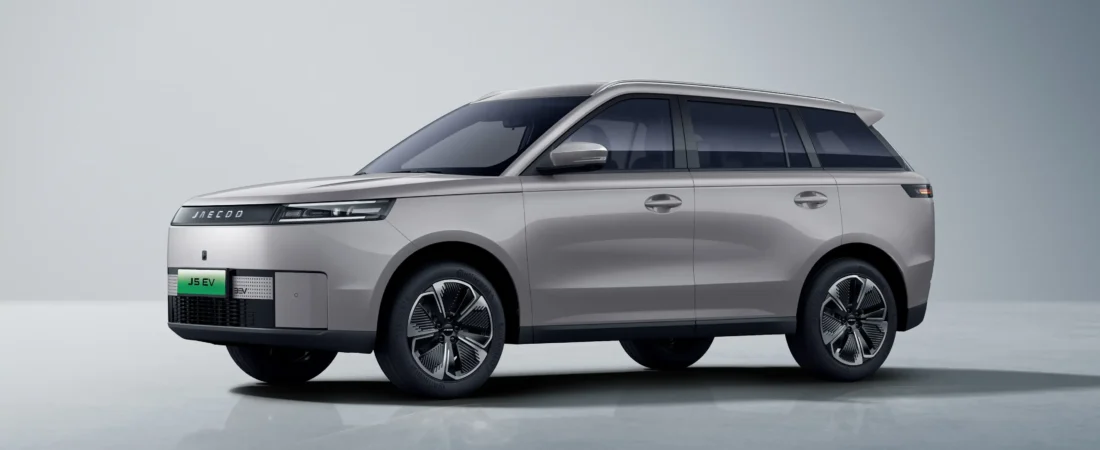
The electric SUV market in India is becoming increasingly competitive, with buyers looking for vehicles that combine modern styling, practical driving range, advanced technology and reasonable ownership costs. One upcoming model attracting attention is the JSW Jaecoo J5 EV, a compact electric SUV expected to bring an international design and technology package to the Indian market.
Based on the globally available Jaecoo J5 EV, the upcoming India-focused model could offer a battery pack of around 59–61 kWh, approximately 210 PS of power, front-wheel drive and DC fast-charging capability. Its upright SUV styling, five-seat layout and technology-focused cabin could make it an interesting alternative to established electric SUVs.
However, there is an important distinction for prospective buyers: JSW Motors has not yet officially confirmed the Indian model’s final specifications, price, variant lineup or launch date. Overseas specifications provide a useful preview, but they should not be treated as guaranteed specifications for India. Automotive publications have also reported differing launch timelines.
So, is the JSW Jaecoo J5 EV worth waiting for? What range might it offer, how practical could it be for Indian families, and how will it compare with electric SUVs already available in the market?
This detailed guide examines the expected design, battery, performance, charging, interior, safety features, ownership costs, potential competitors and important factors buyers should consider before making a purchase decision.
What Is the JSW Jaecoo J5 EV?
The JSW Jaecoo J5 EV is an upcoming electric SUV associated with JSW Motors’ plans to introduce vehicles based on models developed by China’s Chery Automobile group.
The international Jaecoo J5 is a compact SUV offered in different powertrain configurations in overseas markets, including a fully electric version. The Indian electric SUV being developed around this model has been spotted testing, indicating that JSW Motors is evaluating it for the local market.
The vehicle is designed around a familiar SUV formula: a relatively upright body, substantial-looking front styling, a five-seat cabin and a modern dashboard dominated by a touchscreen.
Unlike a conventional petrol SUV, the electric version uses a battery-powered motor. It does not require petrol, engine oil changes or a traditional multi-speed gearbox, although it still needs regular maintenance for tyres, brakes, suspension, air conditioning and other vehicle systems.
For Indian buyers, the J5 EV could be particularly relevant if they want an electric vehicle that is suitable for everyday commuting while retaining the elevated driving position and flexible cargo space associated with compact SUVs.
Why Is JSW Motors Entering the Electric SUV Market?
The electric vehicle market is attracting established carmakers and new entrants because consumers are increasingly evaluating alternatives to petrol and diesel vehicles.
JSW Motors’ planned product portfolio has been reported to include vehicles based on models from Chery’s related automotive brands, including Jaecoo and iCAUR. The Jaecoo J5-based SUV is one of the models reported to be under consideration for India.
For JSW Motors, the J5 EV could serve several purposes:
- Establish a presence in the compact electric SUV category.
- Appeal to buyers seeking a modern alternative to petrol-powered SUVs.
- Offer a technology-focused cabin with contemporary convenience features.
- Build a product range that can eventually include additional electric and electrified vehicles.
The success of the vehicle will depend on more than its international specifications. Pricing, local assembly, spare-parts availability, charging compatibility, service coverage and long-term reliability will all influence its appeal.
Who Should Consider the JSW Jaecoo J5 EV?
If the Indian version remains close to the overseas model, it could suit several types of buyers.
Urban commuters: People who drive regularly in cities and have access to home or workplace charging may benefit from lower routine energy costs.
Small families: A five-seat configuration and compact SUV dimensions could make it suitable for everyday family travel.
Technology-focused buyers: The international model’s large touchscreen, connected features and available driver-assistance systems may appeal to buyers who prioritise cabin technology.
Existing petrol SUV owners: Drivers considering their first EV may find the J5 EV interesting if it delivers sufficient range for their daily travel and occasional longer journeys.
Buyers who frequently undertake long, remote road trips, lack access to dependable charging or need extensive service coverage should wait for confirmed Indian specifications and ownership information before making a decision.
JSW Jaecoo J5 EV Expected Price in India
Price will be one of the most important factors determining whether the JSW Jaecoo J5 EV can compete effectively in India.
Some automotive listings have indicated an expected price of around ₹20 lakh, while other reports have discussed a broader potential positioning around ₹18 lakh to ₹22 lakh. These are estimates, not an officially announced price list.
Expected price positioning
₹18 lakh–₹22 lakh
Indicative ex-showroom estimate only; final Indian pricing has not been confirmed.
Ex-showroom price
The advertised vehicle price before applicable registration, insurance and other on-road charges.
On-road price
Will depend on the final variant, location, insurance, registration charges and applicable taxes or incentives.
What Could Affect the Final Price?
Several factors will determine how JSW Motors positions the J5 EV.
1. Battery capacity: Battery packs account for a substantial portion of an electric vehicle’s manufacturing cost. A larger battery or a higher-range variant may cost more.
2. Equipment levels: Features such as a panoramic sunroof, ventilated seats, advanced driver assistance systems and a surround-view camera may be restricted to selected variants.
3. Local manufacturing: The extent of local assembly and component sourcing could influence manufacturing costs. Reports have discussed assembly from completely knocked-down kits at JSW Motors’ planned manufacturing facility, but the final production arrangement for the J5 EV needs official confirmation.
4. Warranty and after-sales package: Battery warranty, roadside assistance and complimentary maintenance may influence the overall ownership proposition.
5. Competition: JSW Motors will need to consider the prices, equipment and real-world capabilities of rival electric SUVs.
Will the JSW Jaecoo J5 EV Cost Less Than ₹20 Lakh?
That remains uncertain. Some reports have suggested positioning under ₹20 lakh, but there is no confirmed Indian price to establish whether this target will be achieved.
Buyers should also distinguish between the entry-level price and the price of a well-equipped version. A vehicle advertised at an attractive starting price may have a smaller feature list than the variant most buyers actually want.
When bookings open, compare the price of the exact variant you intend to purchase rather than relying only on the headline starting price.
JSW Jaecoo J5 EV Specifications: What We Know So Far
The most useful reference point is the international Jaecoo J5 EV. Its specifications differ slightly by market, so the Indian model’s final configuration could change.
The following table combines reported international specifications with the current status of the Indian version.
| Specification | International reference | Indian version |
|---|---|---|
| Body style | Compact electric SUV | Expected SUV |
| Seating capacity | 5 seats | Expected 5 seats |
| Length | Approximately 4,380 mm | Not officially confirmed |
| Width | Approximately 1,860 mm | Not officially confirmed |
| Height | Approximately 1,650 mm | Not officially confirmed |
| Wheelbase | Approximately 2,620 mm | Not officially confirmed |
| Battery | Around 58.9–60.9 kWh, depending on specification | Unconfirmed |
| Motor power | Around 155 kW / 210 PS | Unconfirmed |
| Maximum torque | Around 288 Nm | Unconfirmed |
| Drivetrain | Front-wheel drive | Unconfirmed |
| Claimed range | Around 402 km WLTP or 461 km NEDC in different specifications | Unconfirmed |
| DC fast charging | Up to 130 kW in overseas specifications | Unconfirmed |
| 0–100 km/h | Approximately 7.3–7.7 seconds, depending on specification | Unconfirmed |
Sources: international Jaecoo specification sheets and reporting on the India-bound SUV. Figures from different markets and test cycles are not directly interchangeable.
These figures suggest that the J5 EV belongs in the mainstream compact electric SUV category rather than the entry-level, small-battery EV segment.
Nevertheless, the final Indian specification sheet will be essential. Buyers should verify the battery chemistry, usable battery capacity, charging standards, certified range and equipment list before comparing the J5 EV with another vehicle.
Exterior Design: A Boxy SUV With Modern Details
The international Jaecoo J5 EV uses an upright design that gives it a traditional SUV silhouette without relying on an excessively large body.
Its shape is likely to appeal to buyers who prefer a strong road presence over the flowing, coupe-like styling of some electric crossovers.
Front Design
The electric version features a closed-off front grille treatment, slim lighting elements and a sculpted bumper. Because an EV does not need the same front cooling arrangement as a combustion-engine vehicle, the design can use a more enclosed appearance.
The lighting design helps establish a modern identity, while the upright front section reinforces the SUV character.
The Indian model has been spotted testing under camouflage, and the extent of market-specific styling changes remains uncertain.
Side Profile and Proportions
The overseas J5 measures approximately 4.38 metres in length, making it comparable in overall size to several compact SUVs sold in India.
Its relatively upright roofline should help preserve rear-seat headroom, while the wheelbase of approximately 2.62 metres provides a useful starting point for packaging a five-seat cabin.
Other visible design characteristics include:
- A relatively flat roofline.
- Pronounced wheel arches.
- Modern alloy-wheel designs.
- A substantial-looking rear section.
- Body proportions that emphasise practicality.
These styling choices can appeal to drivers who want an SUV that looks substantial without moving into a larger, more expensive vehicle category.
Rear Design
The international model uses contemporary rear lighting and a broad tailgate design. The overall appearance is clean, with horizontal visual elements that help emphasise the vehicle’s width.
For family buyers, however, the more important questions concern rear visibility, tailgate opening height, loading convenience and the shape of the boot opening.
These are best evaluated in person when the Indian vehicle becomes available.
Expected Colour Options
International promotional material has shown colours such as Forest Green, Jet Black, Pristine White and Ivory Grey.
The final Indian colour palette may be different. Buyers should also check whether selected colours carry an additional charge or are restricted to particular variants.
Interior and Cabin Features
ราคาข้อมูลขนาดสเปกและรายละเอียดทั้งหมดของ JAECOO 5 EV Long Range Max 2025ที่นี่
Jaecoo J5 EV review: Stylish small electric SUV takes on BYD’s Atto 2
8
A modern cabin can be a major selling point for an electric SUV, particularly when buyers expect digital controls, connected services and comfortable seating as part of the package.
The international Jaecoo J5 EV provides a useful indication of what the India-bound vehicle could offer, although the exact trim and equipment list have not been confirmed for India.
Dashboard and Infotainment System
Overseas specifications include a large central touchscreen, with some market versions listing a 13.2-inch display. Other reports have described different screen sizes depending on the version being discussed.
A large display can make navigation, media and vehicle settings easier to access, but screen size alone does not determine usability.
Before buying, check whether the Indian model offers:
- Wireless or wired Android Auto and Apple CarPlay.
- Reliable smartphone pairing.
- Clear navigation instructions.
- Physical controls for commonly used functions.
- Fast and responsive touchscreen operation.
- Over-the-air software updates, if supported.
- A straightforward interface for climate and charging settings.
A touchscreen that looks impressive in photographs may still be inconvenient if essential functions require several taps.
Digital Driver Display
The international equipment list includes a digital instrument display. jaecoo.
A well-designed driver display should show the information needed to operate an EV efficiently, including:
- Remaining battery charge.
- Estimated driving range.
- Current energy consumption.
- Regenerative braking information.
- Speed and driving mode.
- Navigation prompts, where supported.
The accuracy and clarity of the remaining-range estimate will be especially important during long trips.
Seating Comfort
The international model is configured for five occupants. Higher-specification overseas versions list features such as electrically adjustable and ventilated front seats, although availability varies by market and trim.
For Indian driving conditions, ventilated seats could be useful during hot weather, especially in cities with long periods of slow-moving traffic.
However, buyers should evaluate comfort rather than simply count features. Seat cushioning, under-thigh support, lumbar support and the ability to find a comfortable driving position matter more during a two-hour journey than a long list of electronic adjustments.
Rear-Seat Space
A five-seat layout and the vehicle’s dimensions suggest a family-oriented cabin. The relatively upright roofline may help create a less cramped feeling for rear passengers.
Before deciding whether the J5 EV is suitable for your family, inspect:
- Knee room with the front seat adjusted for a tall driver.
- Headroom for adults.
- Rear-seat cushioning and backrest angle.
- Space for a child seat.
- The presence of rear air-conditioning vents.
- USB charging ports and storage spaces.
- The width of the rear bench for three passengers.
Three adults sitting across a compact SUV’s rear bench may experience a different level of comfort from two adults travelling with a child. A physical seating test is the most reliable way to assess this.
Storage and Practicality
The international J5’s boot capacity has been reported at approximately 384 litres measured to the cargo cover, or around 480 litres when measured to the roof in certain specifications.
These measurements should not be assumed to apply unchanged to the Indian model.
For practical use, inspect the boot with the parcel shelf in place. Consider whether it can accommodate everyday shopping, cabin luggage, a stroller or the bags you normally carry on a family holiday.
Also check whether the rear seats fold easily and whether the resulting cargo area is reasonably flat.
Panoramic Sunroof and Ambient Lighting
Some international variants offer a panoramic sunroof, power sunshade and multi-colour ambient lighting. The Indonesian specification sheet lists 64-colour ambient lighting on the equipped version.
These features can improve the perceived quality of the cabin, but they should be secondary to comfort, safety, charging performance and after-sales support.
For buyers living in hot regions, it is worth checking the sunshade’s coverage, cabin heat management and air-conditioning performance.
Battery, Range and Real-World Driving
Battery range is one of the most important considerations when purchasing an electric vehicle.
The international Jaecoo J5 EV has been listed with battery capacities of 58.9 kWh and 60.9 kWh, depending on market and specification. Published range figures include approximately 402 km under the WLTP test cycle and 461 km under the NEDC cycle.
These figures are not contradictory in themselves: different test procedures can produce different certified range estimates for the same vehicle.
What Does a 400 km Claimed Range Mean?
A certified range figure is useful for comparing vehicles tested under the same procedure. It is not a promise that every driver will travel that distance in everyday conditions.
Actual range depends on several factors:
- Driving speed.
- Traffic conditions.
- Outside temperature.
- Air-conditioning use.
- Road gradients.
- Passenger and luggage weight.
- Tyre pressure.
- Battery condition.
- Driving style.
Highway driving at sustained speeds generally uses more energy per kilometre than steady, moderate-speed driving. Heavy acceleration, strong headwinds and frequent elevation changes can also reduce efficiency.
Consequently, a buyer should not assume that a vehicle advertised with a 400 km WLTP range will always cover 400 km between charges.
Understanding Range in Indian Conditions
Consider a hypothetical Indian version with a usable battery capacity of 58.9 kWh. This is an illustration based on an overseas specification, not a confirmed Indian configuration.
Suppose your average energy consumption is 17 kWh per 100 km. The simple calculation would be:
\[ \text{Estimated range} = \frac{58.9}{17}\times100 \]
That gives approximately 346 km.
If consumption rises to 20 kWh per 100 km, the estimate falls to about 295 km.
These calculations assume the full usable battery capacity is available for driving. Real trips may cover less because drivers normally keep a reserve rather than running the battery down to zero.
The example illustrates why efficiency matters as much as battery size.
Is the J5 EV Suitable for Daily Commuting?
For a driver travelling 40 km each working day, a vehicle delivering 300 km of usable real-world range would provide several days of driving between charges, depending on the starting battery level and the amount of reserve maintained.
A driver covering 100 km per day would need to recharge more frequently.
The right range therefore depends on your routine, not simply the largest number printed in a brochure.
Before purchasing, calculate your typical daily distance and identify the longest journey you regularly make. Then allow a reasonable margin for traffic, detours, weather and charging availability.
How to Improve Electric SUV Range
You can improve efficiency with a few straightforward habits:
- Maintain the recommended tyre pressure.
- Accelerate smoothly rather than repeatedly using maximum power.
- Avoid unnecessary high speeds.
- Use regenerative braking appropriately.
- Pre-cool or pre-heat the cabin while the vehicle is plugged in, if supported.
- Remove unnecessary heavy items.
- Plan highway charging stops before leaving.
- Use the vehicle’s energy-consumption display to understand which routes and speeds are most efficient.
These practices are useful for almost any EV and do not depend on a particular brand.
Motor Performance and Driving Experience
The overseas Jaecoo J5 EV uses a front-mounted electric motor producing approximately 155 kW, equivalent to around 210 PS, with maximum torque of 288 Nm. Published acceleration figures indicate a 0–100 km/h time of roughly 7.3–7.7 seconds, depending on the specification.
If the Indian model retains similar hardware, its performance should be adequate for everyday commuting, overtaking and highway merging. However, the Indian version’s output and acceleration figures remain unconfirmed.
Instant Torque and City Driving
Electric motors deliver useful torque without the need to build engine speed in the same way as a conventional petrol engine.
For the driver, this can mean:
- Smooth acceleration from traffic lights.
- Predictable responses in stop-and-go traffic.
- Convenient low-speed manoeuvring.
- Quiet operation during ordinary driving.
- Less need to manage gear changes.
The driving experience will still depend on throttle calibration. A well-tuned electric SUV should respond progressively rather than delivering an abrupt surge every time the accelerator is pressed.
Front-Wheel Drive
The international model is listed with front-wheel drive, meaning the front wheels provide the driving force.
Front-wheel drive is a practical arrangement for an everyday family SUV. It can offer predictable handling in normal conditions and avoids the additional hardware required by a dual-motor all-wheel-drive setup.
However, the J5 EV should not automatically be treated as a serious off-road vehicle just because it has an SUV body.
Buyers should verify ground clearance, underbody protection, water-wading guidance and the manufacturer’s intended use before taking it onto rough tracks or flooded roads.
Ride Quality and Handling
The international specification lists MacPherson strut front suspension and independent multi-link rear suspension.
That hardware provides a useful starting point, but suspension design alone cannot establish ride comfort.
The vehicle’s actual behaviour will depend on spring and damper tuning, tyre dimensions, wheel weight and how the suspension handles uneven surfaces.
For Indian roads, a proper test drive should include broken tarmac, speed breakers, sharp road joints and uneven city streets. Listen for rattles and check whether the car remains comfortable over repeated bumps.
Also assess steering weight, visibility, turning radius and how easily the vehicle can be positioned in narrow parking spaces.
Charging the JSW Jaecoo J5 EV
Charging convenience can make the difference between an enjoyable EV ownership experience and a frustrating one.
International specifications list DC fast charging of up to 130 kW. Some market-specific documents also list AC charging options, including 11 kW charging equipment. The final Indian charging limits and connector configuration have not been confirmed.
Home Charging
Home charging is usually the most convenient arrangement for drivers who have a dedicated parking space and permission to install an appropriate charging point.
The process generally involves:
- Confirming that the parking space has suitable electrical infrastructure.
- Having a qualified professional assess the supply, wiring, earthing and protective equipment.
- Choosing a compatible charger approved for the vehicle.
- Checking the building’s permissions if you live in an apartment.
- Establishing a routine that keeps sufficient charge available for the next day’s travel.
Charging overnight can reduce the need for frequent visits to public charging stations.
However, installation costs, electricity tariffs, apartment rules and the availability of dedicated parking vary significantly. Obtain a proper installation quotation rather than assuming a charger will be included free of charge.
Public AC Charging
AC chargers are useful when a vehicle remains parked for an extended period, such as at a workplace, hotel or shopping destination.
The charging rate depends on the vehicle’s onboard AC charger, the station’s power rating and the electrical supply.
A 22 kW public AC charger, for example, will not necessarily charge a vehicle at 22 kW if the vehicle’s onboard equipment accepts less power.
For this reason, buyers should confirm both the maximum AC charging rate and connector compatibility.
DC Fast Charging
DC fast charging is designed for situations in which the driver needs to add energy relatively quickly.
International Jaecoo J5 EV specifications quote charging capability of up to 130 kW, with one overseas specification sheet estimating approximately 28 minutes for a 30%–80% charge under suitable conditions.
This is a reference figure, not a guaranteed Indian charging time.
Actual charging speed depends on battery temperature, starting state of charge, charger output, charging-curve behaviour and other conditions. A vehicle’s peak charging rate is not maintained throughout the entire session.
How Much Time Could Charging Take?
The following examples are simplified illustrations, not official J5 EV charging times.
| Charging arrangement | Main consideration |
|---|---|
| Standard household socket | Usually slow; use only if the vehicle and electrical installation support it safely |
| 7.4 kW AC charger | Charging time depends on usable battery capacity and the vehicle’s AC acceptance limit |
| 11 kW AC charger | Potentially convenient for overnight or extended parking, if supported |
| High-power DC charger | Can add substantial charge during a road-trip stop, subject to the vehicle’s charging curve |
To estimate charging time, divide the energy that needs to be added by the actual average charging power. Then allow for charging losses and any reduction in power during the session.
Charging on Long Road Trips
Before a long journey, use a charging map to identify stations along the route. Confirm that the stations are compatible, operational and accessible during your planned travel time.
Keep an alternative charging location in mind, particularly on routes where public charging options are limited.
For a more reliable trip, plan around a conservative range estimate instead of assuming the advertised maximum will always be available.
Features and Technology to Look For
The overseas Jaecoo J5 EV is advertised with a range of comfort, connectivity and driver-assistance equipment, although the availability of each feature varies by specification.
For the Indian model, these are the features worth checking when the final brochure is released.
Connected-Car Technology
Connected features can allow drivers to check selected vehicle information through a smartphone application, depending on the manufacturer’s system and local support.
Useful functions may include vehicle-status information, charging status, remote climate controls and navigation-related services.
Do not assume that every overseas connected service will work in India. Check mobile-network compatibility, subscription charges, software support and the availability of the relevant application.
Wireless Charging and Smartphone Connectivity
The international equipment list includes a 50W wireless charging feature on an equipped version.
A high-output wireless charging pad can be useful for compatible phones, but performance depends on the device, heat management and alignment.
For everyday convenience, reliable smartphone mirroring and well-placed USB ports may matter just as much.
Driver Assistance
Some overseas versions list advanced driver-assistance features. Their availability and functionality should be confirmed for the Indian model.
Depending on the final equipment package, relevant features could include:
- Adaptive cruise control.
- Lane-departure warning.
- Lane-keeping assistance.
- Autonomous emergency braking.
- Blind-spot monitoring.
- Rear cross-traffic alerts.
- Traffic-sign recognition.
These technologies can support the driver, but they do not replace attentive driving.
Indian traffic conditions can be challenging for camera- and radar-based systems, particularly around poorly marked roads, two-wheelers, pedestrians and unexpected obstacles. A test drive should establish how clearly the systems communicate warnings and whether their settings can be adjusted appropriately.
Cameras and Parking Assistance
Some overseas versions feature a 540-degree camera system.
The terminology describes a camera-based view designed to improve visibility around the vehicle; it does not mean the driver literally sees through every surface of the car.
Before buying, check image quality in daylight and at night, the clarity of parking guidelines and how quickly the camera activates.
Safety: What Buyers Should Verify
Safety should be evaluated separately from styling, power and infotainment.
Some international Jaecoo J5 EV specifications list six airbags and advanced driver-assistance equipment, but the final Indian safety package has not been confirmed.
Active Safety
Active safety systems aim to help drivers avoid or reduce the severity of certain collisions.
Features worth checking include electronic stability control, anti-lock braking, traction control, emergency braking assistance and any available collision-avoidance technologies.
The standard equipment list matters. A feature that is optional overseas may not be included in every Indian variant.
Passive Safety
Passive safety features help protect occupants during a collision.
Review the number and placement of airbags, seat-belt equipment, head restraints, child-seat anchorages and the availability of rear-seat reminders.
Also look for independently verified crash-test results applicable to the exact model and specification being sold.
A crash-test rating from another market should not automatically be assumed to cover every regional version.
EV-Specific Safety
Electric vehicles require careful management of their high-voltage battery systems.
Before purchasing, ask about:
- Battery protection and monitoring systems.
- High-voltage isolation and emergency procedures.
- Battery warranty terms.
- Inspection and repair procedures after an underbody impact.
- Assistance arrangements following a charging or electrical fault.
- Approved repair facilities and technician training.
For drivers in areas prone to heavy monsoon rain, follow the manufacturer’s water-crossing guidance. An electric powertrain does not make a vehicle safe to drive through floodwater.
Expected Rivals of the JSW Jaecoo J5 EV in India
The J5 EV is likely to enter a market where consumers can choose from electric SUVs with different priorities, including range, cabin space, performance and value.
The most useful comparisons will depend on the J5 EV’s final Indian price and specifications.
Hyundai Creta Electric Resmi Meluncur, Dibanderol Rp 340 Jutaan
Hyundai Creta Electric
A relevant benchmark for buyers who want a mainstream electric SUV with an established Indian automotive brand behind it. Compare real-world range, charging, rear-seat comfort and service support.
Mahindra BE 6 Price (2026) – Images, Colours, Range & Reviews
Mahindra BE 6
Worth considering for buyers prioritising distinctive styling, electric performance and a technology-focused driving experience. Compare its dimensions, equipment and price with the final J5 EV variant.
The Real Deal. MG Windsor EV. Special Feature – Overdrive
MG Windsor EV
A useful alternative for buyers who prioritise cabin comfort and everyday practicality. Compare the seating layout, luggage space, charging arrangements and ownership terms.
Vinfast VF6 to Get 6 Colours, 2 Variants – CarWale
VinFast VF 6
Another model to investigate when comparing compact electric SUVs. Local availability, pricing, service coverage and warranty terms will be especially important.
The Hyundai Creta Electric, Mahindra BE 6 and VinFast VF 6 have been identified in reporting as potential competitors for the India-bound Jaecoo-based electric SUV. Autocar India+1
The MG Windsor EV is also worth considering as a broader practical alternative, although its body style, packaging and pricing structure differ from those of a conventional compact SUV.
How to Compare These Vehicles Properly
Do not compare cars using only their advertised range or motor power.
Instead, evaluate the following factors using confirmed information:
| Buying factor | What to compare |
|---|---|
| Price | On-road cost of the exact variant |
| Range | Certified figures under the same test cycle, plus independent real-world results |
| Battery | Usable capacity, chemistry and warranty |
| Charging | AC charging limit, DC peak power and charging curve |
| Space | Rear-seat comfort, boot capacity and child-seat compatibility |
| Safety | Standard equipment and applicable crash-test results |
| Ownership | Service access, roadside assistance and repair support |
| Resale | Brand presence, demand and available resale evidence |
Until the Indian J5 EV’s final specifications are published, any ranking of these vehicles would be premature.
Estimated Running Cost of the JSW Jaecoo J5 EV
One of the strongest reasons to consider an electric SUV is the potential to reduce everyday energy costs.
However, the actual savings depend on how much you drive, where you charge, the price of electricity and the efficiency of the vehicle.
Because the Indian J5 EV’s final specifications and efficiency figures are not confirmed, the following calculations are illustrative rather than official ownership estimates.
Example: Electricity Cost Per 100 km
Assume the vehicle consumes 17 kWh of electricity per 100 km and your effective charging cost is ₹8 per kWh.
\[ 17 \times ₹8 = ₹136 \]
Under these assumptions, driving 100 km would cost approximately ₹136 in electricity.
If you drive 1,500 km per month, the estimated energy requirement would be 255 kWh, giving an electricity cost of ₹2,040 per month.
Your actual bill could be higher because of charging losses, different electricity tariffs, public charging fees and variations in driving efficiency.
Calculate Your Estimated EV Running Cost
Use this simple calculator to estimate electricity expenses for a hypothetical J5 EV.Monthly driving distance
1,500 km
300 km
3,000 kmEnergy consumption
17 kWh/100 km
12
25Electricity tariff
₹8/kWh
₹4
₹25Estimated charging losses
10%
0%
20%
Estimated monthly electricity expense
₹2,244
Estimated annual expense
₹26,928
Illustrative energy-cost calculation only. Excludes insurance, maintenance, tyres, financing, charger installation and other ownership expenses.
How Does It Compare With a Petrol SUV?
Suppose a petrol SUV delivers 15 km per litre and petrol costs ₹105 per litre. Its fuel cost would be ₹700 per 100 km.
Compared with the illustrative EV cost of ₹136 per 100 km, the difference would be ₹564 per 100 km.
That comparison is not a forecast of actual J5 EV savings. It demonstrates how charging tariffs and vehicle efficiency can affect the economics of switching to electric driving.
To make a meaningful purchase decision, calculate both vehicles’ expected costs over your annual distance and include their respective purchase prices, insurance, financing, maintenance and resale values.
Maintenance, Warranty and Long-Term Ownership
Electric vehicles have fewer conventional powertrain components than petrol vehicles, but they are not maintenance-free.
The J5 EV’s ownership experience will depend on the final warranty package and the quality of JSW Motors’ service network.
What Maintenance Could Be Required?
Routine maintenance may include:
- Tyre inspection, rotation and replacement.
- Brake inspection and servicing.
- Suspension and steering checks.
- Cabin air-filter replacement.
- Air-conditioning maintenance.
- Coolant checks where specified.
- Software updates and diagnostic inspections.
- Periodic battery-system checks.
Regenerative braking may reduce conventional brake-pad usage under some driving conditions, but the brakes still require inspection.
Tyres also deserve attention because electric vehicles can place significant demands on them through their weight and immediate torque delivery.
Battery Warranty
Before purchasing, obtain the written battery warranty rather than relying on general industry assumptions.
Check the warranty duration, kilometre limit, coverage conditions, capacity-retention provisions and exclusions. Confirm whether the traction battery, electric motor and other high-voltage components have separate terms.
Also ask whether repairs are performed at component level or whether certain failures require replacement of a larger assembly.
Service Network and Spare Parts
An attractive vehicle price is less valuable if servicing is difficult or replacement parts take a long time to arrive.
Before booking the J5 EV, verify:
- The location of authorised service centres near your home.
- Whether the nearest facility has trained EV technicians.
- The availability of towing and roadside assistance.
- Typical waiting times for commonly needed parts.
- How warranty claims are handled.
- Whether software and battery diagnostics can be performed locally.
This is particularly important for buyers outside major cities.
How to Prepare for the JSW Jaecoo J5 EV Launch
With the Indian model’s final launch details still awaiting official confirmation, prospective buyers should focus on gathering reliable information instead of making decisions based on speculative listings.
Step 1: Follow Official Announcements
Check JSW Motors’ official communications for the confirmed model name, launch date, price, variants and specifications.
Third-party automotive websites can provide useful updates, but their expected prices and dates are not equivalent to a manufacturer’s announcement.
Step 2: Compare the Variants
When the brochure becomes available, compare the battery capacity, range, charging equipment, safety systems, cabin features and warranty for each variant.
A lower-priced model may be perfectly suitable if it includes the essentials you need. Conversely, a more expensive variant may be worthwhile if it provides a feature you will use regularly.
Step 3: Assess Home Charging
Determine whether you can install a compatible charger at home or access reliable charging at work.
If you live in an apartment, speak to the building management before committing to the vehicle. Do not assume that a parking space automatically includes permission or electrical capacity for charging.
Step 4: Book a Test Drive
Evaluate low-speed control, ride comfort, steering, braking, visibility and cabin ergonomics.
If possible, test the car on roads similar to your daily commute. Check whether the rear seats and boot suit your family.
Step 5: Calculate the Total Ownership Cost
Compare the complete on-road price with your budget. Add financing costs, insurance, home-charger installation, expected electricity expenses and maintenance.
Consider the resale uncertainty associated with a newly introduced model and a developing service network.
Step 6: Check Booking Terms
Before paying a booking amount, read the refund policy, delivery conditions and any written promises regarding price or delivery timing.
If the vehicle has not been officially launched, ask the dealer to identify which details are confirmed and which remain provisional.
Common Mistakes to Avoid Before Buying an Electric SUV
Mistake 1: Treating the Advertised Range as Guaranteed
A certified range figure is a comparison tool, not a promise of the distance you will cover in every condition.
Better approach: Plan around realistic consumption and retain a battery reserve for unexpected delays.
Mistake 2: Comparing Different Test Cycles
A range figure measured under NEDC cannot be directly compared with a WLTP figure as though both were generated under identical conditions.
Better approach: Identify the test cycle behind every published range number.
Mistake 3: Focusing Only on the Purchase Price
An EV with a lower sticker price may not offer the best value if it has less range, slower charging or weaker service support.
Better approach: Compare the exact variants and total ownership costs.
Mistake 4: Ignoring Charging Access
Relying entirely on public chargers can be inconvenient if stations are distant, busy or unavailable when needed.
Better approach: Establish a dependable charging routine before purchasing.
Mistake 5: Assuming Overseas Features Will Be Standard in India
International brochures may describe equipment that is unavailable or optional in another market.
Better approach: Verify every important feature against the final Indian variant brochure.
Mistake 6: Booking Before Checking Warranty and Service
A new brand or model can introduce uncertainty around repairs, parts and resale.
Better approach: Obtain written warranty details and identify your nearest authorised service facility.
Future Outlook: What Could Determine the J5 EV’s Success?
The JSW Jaecoo J5 EV enters a segment where buyers increasingly expect a balanced package rather than a single headline feature.
A competitive battery range will matter, but so will charging performance, cabin quality, safety equipment and ownership support.
Local Assembly and Manufacturing
Automotive reporting has discussed the possibility of assembling the J5-based SUV from imported kits before increasing local sourcing at a later stage. The actual manufacturing plan and its timing need official confirmation. Autocar India+1
Greater localisation can potentially support supply-chain resilience and cost management, although its effect on retail pricing depends on production volumes, component sourcing and other business decisions.
Charging Infrastructure
As public charging networks expand, more drivers may find electric SUVs suitable for longer journeys.
However, infrastructure quality matters as much as the number of charging points. Drivers need stations that are compatible, operational, accessible and capable of delivering the advertised power.
Software and Connected Services
Vehicle software is becoming an increasingly important part of the ownership experience.
Navigation, charging information, connected applications and driver-assistance calibration can influence day-to-day satisfaction. The availability of ongoing software support will therefore be worth examining when the J5 EV launches.
Brand Confidence
For a newly introduced vehicle, buyers will also evaluate the manufacturer’s ability to provide dependable service, replacement parts and warranty support over several years.
A well-equipped product can attract attention, but consistent ownership support is essential for building long-term customer confidence.
Frequently Asked Questions About the JSW Jaecoo J5 EV
1. What is the expected price of the JSW Jaecoo J5 EV in India?
Current automotive listings and reports suggest a potential price around ₹18 lakh–₹22 lakh, with some estimates near ₹20 lakh. These figures are provisional, and the official Indian price has not been confirmed.
2. When will the JSW Jaecoo J5 EV launch in India?
The launch timeline remains uncertain. Some automotive listings have indicated November 2026, while other reporting has suggested a later launch. As of 28 October 2026, buyers should treat these dates as estimates rather than an official launch announcement.
3. What is the expected range of the JSW Jaecoo J5 EV?
Overseas specifications quote approximately 402 km under WLTP and 461 km under NEDC for different versions. The certified range of the Indian model has not been announced. Actual driving distance will depend on speed, traffic, weather, air-conditioning and other factors.
4. What battery capacity will the J5 EV have?
International versions are listed with battery capacities of approximately 58.9 kWh and 60.9 kWh, depending on market and specification. The battery capacity and usable energy of the Indian model remain unconfirmed.
5. How powerful is the Jaecoo J5 EV?
The overseas electric model produces approximately 155 kW, or 210 PS, and 288 Nm of torque. These figures provide a reference for the expected vehicle, but JSW Motors has not confirmed the final Indian powertrain specifications.
6. How long does it take to charge the Jaecoo J5 EV?
International specifications quote up to 130 kW DC fast charging, with an estimated 30%–80% charging time of around 28 minutes under suitable conditions. Actual charging time depends on the vehicle’s final specification, charger output, battery temperature and charging curve.
7. Is the JSW Jaecoo J5 EV suitable for families?
It could be worth considering for small families because the international model has five seats and compact SUV dimensions. However, buyers should test rear-seat comfort, child-seat compatibility, luggage space and the Indian model’s safety equipment before making a decision.
8. Should I wait for the JSW Jaecoo J5 EV or buy another electric SUV?
Waiting may make sense if you are interested in its design and can postpone your purchase until official prices, specifications and warranty terms are announced. If you need a vehicle immediately, compare available alternatives based on real-world range, charging access, total cost and service coverage rather than buying solely on expected specifications.
Conclusion: Is the JSW Jaecoo J5 EV Worth Waiting For?
The JSW Jaecoo J5 EV is an interesting upcoming electric SUV because the international model combines compact SUV dimensions, a modern cabin, a battery capacity of around 59–61 kWh and motor output of approximately 210 PS.
If JSW Motors brings a similarly equipped version to India at a competitive price, it could become a worthwhile option for families and urban commuters exploring electric mobility.
Nevertheless, the vehicle’s actual value will depend on details that buyers still need: the confirmed Indian price, certified range, charging specifications, standard safety equipment, warranty coverage and service network.
For prospective buyers, the best next step is to monitor official announcements, evaluate home-charging options and compare the final variant against established electric SUVs in the same budget.
Thinking about buying the JSW Jaecoo J5 EV? Save this guide, check the official specifications when they are announced and book a test drive before making your final decision.
JSW Chery iCar V23: Expected Price in India, Range, Features, Design and Launch Updates