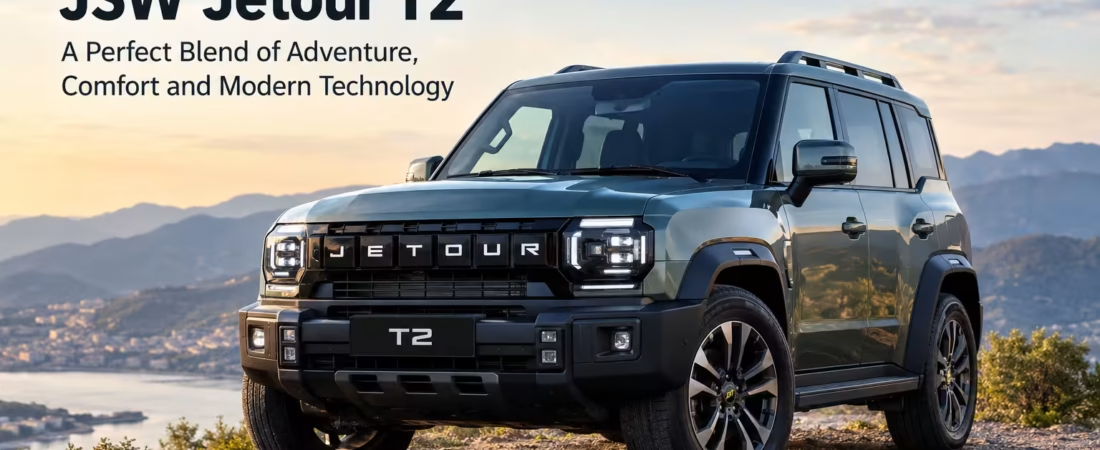
The JSW Jetour T2 is an SUV that stands out for its rugged, boxy styling, adventure-focused design and modern technology. Unlike conventional urban SUVs that prioritize sleek curves and a road-oriented appearance, the Jetour T2 follows a more muscular design philosophy, with an upright stance, squared-off proportions and styling inspired by traditional off-road vehicles.
For Indian buyers, the SUV is particularly interesting because JSW Group has been exploring opportunities in the passenger vehicle market through its automotive ventures. A vehicle like the Jetour T2 could attract customers who want the commanding presence of a lifestyle SUV without giving up the comfort, connectivity and convenience expected from a modern family vehicle.
However, there is an important distinction between an international vehicle and a confirmed Indian-market product. The Jetour T2 is an established model in certain international markets, but its Indian launch date, final specifications, price, variants and equipment must be verified through official announcements before being treated as confirmed.
This comprehensive guide examines the Jetour T2’s design, powertrain, interior, technology, safety considerations, off-road potential, ownership factors and suitability for Indian roads. It also explains what prospective buyers should check before considering the SUV and how it could compare with established lifestyle SUVs in India.
What Is the JSW Jetour T2?
The Jetour T2 is an adventure-oriented SUV developed by Jetour. The model combines rugged exterior styling with a monocoque body structure, a modern cabin and available four-wheel-drive technology.
Jetour belongs to China’s broader automotive industry, where manufacturers have been expanding internationally with SUVs that offer substantial equipment, distinctive styling and multiple powertrain choices. The T2 reflects this approach: it is designed to appeal to buyers who want an SUV suitable for everyday driving as well as weekend trips beyond paved roads.
For Indian readers, the name JSW Jetour T2 needs some context. The international Jetour T2 is the reference vehicle, while reports about its potential Indian introduction have connected it with JSW’s automotive plans. Recent Indian media reporting has also described a locally assembled, plug-in hybrid SUV based on the T2 under the name JSW Combat, with a reported launch planned for December 4, 2026. The reported date, specifications and price should not be treated as final confirmation until JSW makes an official announcement.
This distinction matters because a vehicle sold overseas can differ significantly from an India-bound version. The engine, battery, safety equipment, software, suspension tuning and even the model name may change between markets.
Why Is the Jetour T2 attracting attention?
Several characteristics make the SUV worth following:
- Rugged design: Its upright body, squared-off proportions and distinctive lighting give it a recognisable adventure-SUV appearance.
- Large dimensions: The international specification lists a wheelbase of 2,800 mm and a body width of approximately 2,006 mm.
- Multiple powertrain options: International versions are available with turbocharged petrol engines, while plug-in hybrid versions are offered in selected markets.
- Modern technology: Depending on the market and variant, equipment can include a large touchscreen, digital instrument display, cameras and driver-assistance systems.
- All-wheel-drive capability: Selected petrol versions offer an automatic four-wheel-drive system with terrain-specific driving modes.
Jetour Global+2
These features make the Jetour T2 relevant to buyers researching premium lifestyle SUVs, upcoming hybrid vehicles and alternatives to conventional family crossovers.
JSW Jetour T2 India Launch Date and Expected Price
One of the most common questions prospective buyers ask is when the SUV will reach Indian showrooms and how much it might cost.
The answer depends on the final Indian product, rather than the price or specifications of an overseas Jetour T2.
As of October 16, 2026, Indian media reporting points to a JSW-branded plug-in hybrid SUV based on the Jetour T2 platform, reportedly called the JSW Combat. A report published in October places its planned launch on December 4, 2026, and estimates its ex-showroom price at ₹40 lakh to ₹50 lakh. These are reported details, not a substitute for an official price announcement.
India launch and price at a glance
Reported India model
JSW Combat
Based on the Jetour T2
Reported launch plan
December 4, 2026
Subject to official confirmation
Reported price estimate
₹40–50 lakh
Indicative ex-showroom estimate
Powertrain reported
Plug-in hybrid
Final Indian specifications awaited
Source: Indian media reporting published in October 2026. Confirm the final model name, launch date, variant list and pricing with JSW before making a purchase decision.
Is the India launch date confirmed?
A reported launch date is not the same as a completed launch or an official booking announcement. Before visiting a showroom or paying a deposit, check whether JSW has published an official launch notice, opened bookings and identified authorised dealerships.
The following milestones are worth tracking:
- Official announcement of the Indian model and its final name.
- Publication of the India-specific specification sheet.
- Confirmation of the launch date and booking process.
- Announcement of ex-showroom prices and available variants.
- Disclosure of warranty, service coverage and delivery timelines.
What could the expected price mean for buyers?
At a reported price of ₹40 lakh to ₹50 lakh ex-showroom, the proposed JSW model would sit in a premium SUV segment rather than compete directly with entry-level compact SUVs.
The final on-road price would depend on the selected variant, registration charges, insurance, applicable taxes and accessories. Buyers should also account for any home-charging installation costs if the Indian version is a plug-in hybrid.
For example, someone comparing a ₹42 lakh ex-showroom SUV with another vehicle priced at ₹40 lakh should not automatically assume that the second one is cheaper to own. Insurance premiums, fuel consumption, maintenance, financing costs and resale value can alter the overall calculation.
Buying tip: Do not rely on a launch article’s estimated price when arranging a car loan. Ask for a written dealer quotation showing the exact variant, insurance, registration, accessories and all additional charges.
Exterior Design: A Bold and Boxy Adventure SUV


6
The Jetour T2’s most distinctive characteristic is its design. It uses a boxy silhouette, an upright front end and broad body surfaces to create the appearance of a vehicle built for exploration.
This styling differs from the rounded profiles of many urban crossovers. Instead of hiding its dimensions behind flowing bodywork, the T2 makes its size and squared-off shape central to its identity.
Front profile and lighting
The front end features a prominent grille design, a relatively upright bonnet and distinctive headlamp elements. The combination gives the SUV a strong visual presence, particularly when viewed from the front three-quarter angle.
Depending on the market and trim, the international model includes LED lighting and matrix-style headlamps. However, equipment can vary between versions, so buyers should not assume that every international feature will appear on the Indian model.
For everyday use, good headlights matter for more than appearance. Their beam pattern, high-beam performance and glare control affect night driving on poorly illuminated highways and rural roads.
When the Indian version is revealed, buyers should check the actual lighting specification rather than judging it only from promotional photographs.
Side profile and proportions
The SUV’s tall roofline, squared wheel arches and substantial body panels contribute to its rugged appearance. Roof rails add to the adventure-oriented look, although their actual load rating and suitability for accessories should be verified before carrying luggage or mounting equipment.
International specifications list the vehicle at approximately 4,612 mm long without the spare-wheel cover, or 4,785 mm with it. The width is about 2,006 mm, and the wheelbase is 2,800 mm. Height varies slightly by configuration, with figures around 1,870–1,880 mm.
These are substantial dimensions for an SUV that seats five.
The longer body can help create a spacious cabin, but the width may present challenges in narrow Indian streets, crowded parking areas and older multi-level car parks. Buyers should assess the vehicle’s actual width with mirrors extended and folded.
Rear design and spare-wheel styling
The rear styling continues the square-bodied theme. International versions use a distinctive tailgate arrangement, prominent lighting and a spare-wheel cover that reinforces the traditional off-road appearance.
A rear-mounted spare wheel can be visually appealing and useful on longer trips, but it also changes the vehicle’s overall length and can affect parking clearance. Drivers should check rear visibility, camera coverage and the tailgate’s opening mechanism during a test drive.
Is the design practical for Indian roads?
The styling has several practical advantages. The relatively upright body can make the SUV easier to judge from the driver’s seat than some heavily tapered crossovers, while the tall stance supports the adventure-oriented positioning.
There are trade-offs, too:
- The wide body can make tight parking manoeuvres more demanding.
- The large exterior surfaces may be more vulnerable to scratches in narrow lanes.
- The upright front end makes a front camera or effective parking sensors particularly useful.
- Roof accessories can increase overall height and affect access to parking structures.
- Large wheels may look attractive but can make replacement tyres more expensive.
The best approach is to evaluate the SUV in the environments where it will actually be used. A spacious showroom does not reveal how comfortably a vehicle fits into a narrow apartment parking bay.
Dimensions, Ground Clearance and Space
Vehicle dimensions are useful because they affect cabin packaging, road presence, manoeuvrability and off-road geometry.
The following figures come from international Jetour T2 specifications. They are reference specifications, not confirmed measurements for a final Indian-market vehicle.
| Specification | International Jetour T2 reference |
|---|---|
| Length without spare-wheel cover | 4,612 mm |
| Length with spare-wheel cover | 4,785 mm |
| Width | 2,006 mm |
| Height | Approximately 1,870–1,880 mm |
| Wheelbase | 2,800 mm |
| Published minimum ground clearance | 220 mm |
| Seating capacity | 5 |
| Fuel tank | 70 litres on listed petrol versions |
What does the 2,800 mm wheelbase mean?
The wheelbase is the distance between the front and rear axles. A longer wheelbase can provide more room for passengers and help the vehicle feel settled on highways.
However, it does not guarantee generous rear-seat legroom. Seat design, floor height, front-seat positioning and the shape of the cabin all matter.
During a test drive, rear passengers should sit in their normal positions and check:
- Knee clearance behind the driver’s preferred seating position.
- Space beneath the front seats for their feet.
- Headroom with the seatback in a comfortable position.
- Ease of entering and leaving the rear cabin.
- Comfort over broken roads and longer journeys.
Is 220 mm of ground clearance enough?
The international specification lists 220 mm of minimum ground clearance for the relevant versions. That figure is useful when assessing the vehicle’s potential to handle uneven surfaces, but ground clearance alone does not determine off-road capability.
Approach angle, departure angle, breakover angle, tyre choice, suspension articulation, drivetrain calibration and underbody protection also affect performance.
Ground clearance can also change with passengers, luggage and other loads. Buyers should ask how the figure is measured and whether it applies to the precise variant being considered.
For Indian driving, higher clearance may help with rough rural roads, broken pavement and some steep approaches. It does not make a vehicle immune to damage from deep potholes, large rocks or poorly judged water crossings.
Can it accommodate a family?
The international T2 is a five-seat SUV, not a seven-seat family vehicle. That may suit a household that values a large cabin and luggage space over an additional row.
A five-seat layout can also make the rear cabin easier to access and allow more space to be allocated to passenger comfort.
Nevertheless, boot capacity, rear-seat folding arrangements and the shape of the luggage compartment should be checked on the specific version. A large exterior does not automatically guarantee that every suitcase, stroller or outdoor accessory will fit conveniently.
For families with child seats, test the actual child-seat installation points, door opening and access to buckles before buying.
Engine and Performance: What Powers the Jetour T2?
The international Jetour T2 is offered with different powertrains depending on the country and variant. Its conventional petrol range includes turbocharged 1.5-litre and 2.0-litre engines, while the T2 family also includes plug-in hybrid versions in selected markets. These configurations should not be confused with the specifications of the proposed Indian model.
1.5-litre turbo-petrol engine
The international 1.5-litre turbo-petrol version is listed with a maximum output of 135 kW and peak torque of 290 Nm, paired with a seven-speed dual-clutch transmission.
That translates to approximately 184 PS, although the output figures and units should always be checked against the specification sheet for the relevant market.
A turbocharged petrol engine uses exhaust energy to compress incoming air, helping it produce more power than a naturally aspirated engine of similar displacement. This can be useful in a relatively large SUV, particularly when accelerating onto a highway or carrying passengers and luggage.
The transmission also matters. A dual-clutch gearbox can provide quick gear changes, but its behaviour at low speeds varies with calibration, temperature and driving conditions.
For Indian city traffic, buyers should pay attention to how smoothly the vehicle crawls in congestion, climbs a parking ramp and moves off on an incline. A gearbox that feels responsive on an empty road may behave differently in stop-start traffic.
2.0-litre turbo-petrol engine
Selected international 2.0-litre versions are listed with 187 kW of maximum power and 390 Nm of torque. The specification sheet pairs these engines with a seven-speed dual-clutch transmission and an automatic all-wheel-drive system.
The additional torque can help when accelerating, climbing hills or driving with a full load. However, engine output alone does not establish how quick or economical the vehicle will be.
Real-world performance also depends on vehicle weight, transmission ratios, tyre choice, traction, throttle calibration and the conditions in which the vehicle is driven.
For buyers who regularly travel on highways or visit hilly areas, the 2.0-litre engine may be attractive if it is offered in the Indian lineup. Its suitability will ultimately depend on the final powertrain, price and fuel consumption.
Plug-in hybrid powertrain: The Indian-market angle
A plug-in hybrid electric vehicle, commonly called a PHEV, combines an internal-combustion engine with an electric drive system and a rechargeable battery.
This technology is especially relevant to the reported JSW-branded, T2-based Indian SUV. Media reporting has described the planned model as a plug-in hybrid, but the final Indian battery capacity, motor configuration, charging rate, electric range and combined power output require official confirmation.
A PHEV can offer three main advantages:
- Electric driving for shorter journeys: If the battery is charged and the journey fits within the vehicle’s usable electric range, some trips can be completed without starting the petrol engine.
- Petrol-powered long-distance flexibility: The engine can extend the vehicle’s usability on journeys where charging opportunities are limited.
- Regenerative braking: The electric motor can recover some energy during deceleration and braking, storing it in the battery for later use.
The benefits depend heavily on charging habits. A plug-in hybrid driven with a charged battery can have a very different fuel-consumption pattern from the same vehicle driven for weeks without plugging it in.
Which powertrain is better for you?
| Your driving pattern | What to consider |
|---|---|
| Mostly short city journeys | A PHEV may reduce petrol use if you charge regularly. |
| Frequent long highway trips | Compare fuel economy with the battery depleted, not just the advertised electric range. |
| Regular mountain travel | Evaluate sustained engine performance, cooling and the behaviour of the AWD system. |
| Limited access to charging | Calculate whether a PHEV still makes financial sense without daily charging. |
| High annual mileage | Compare total energy costs, servicing, insurance and purchase price over several years. |
The best choice is not necessarily the engine with the highest power figure. It is the powertrain that fits your driving habits without creating inconvenient charging requirements or unexpectedly high running costs.
Transmission and Four-Wheel-Drive Technology
The Jetour T2’s drivetrain is an important part of its identity. However, not every version offers the same hardware.
International specifications show a front-wheel-drive 1.5-litre petrol configuration and all-wheel-drive versions of the 2.0-litre petrol model. Jetour also promotes an automatic XWD system, which can intelligently distribute drive between the wheels according to operating conditions.
What is XWD?
XWD stands for X Wheel Drive in Jetour’s terminology. It describes an electronically controlled system designed to adjust drive distribution automatically rather than requiring the driver to operate a conventional transfer-case lever.
Depending on the configuration, the system works with different driving modes and traction-control functions to help the vehicle maintain movement on surfaces with varying grip.
This can be helpful on wet roads, loose gravel, sand or muddy tracks. The system’s actual performance depends on the tyres, available traction, software calibration and the particular version of the vehicle.
What are terrain modes?
The international specification lists driving modes that can include Sport, Economy, Standard, Snow, Sediment, Rock and X Smart. Availability varies by variant.
Terrain modes adjust aspects of vehicle behaviour, such as throttle response, transmission strategy and traction control.
- Snow mode: Designed to support controlled acceleration on slippery surfaces.
- Sediment mode: Intended for loose terrain, where maintaining momentum can be important.
- Rock mode: Designed for certain uneven surfaces that require careful traction management.
- Sport mode: Prioritises a more responsive driving feel.
- Economy mode: Adjusts vehicle responses to support more restrained driving.
- Standard mode: Provides a general-purpose setting for ordinary driving.
The exact behaviour depends on the system’s calibration. Selecting a mode cannot compensate for unsuitable tyres, excessive speed or a route that exceeds the vehicle’s capabilities.
Is the Jetour T2 a hardcore off-roader?
Not necessarily. The T2 uses a monocoque body rather than the traditional separate ladder-frame construction associated with many dedicated off-road vehicles.
A monocoque structure integrates the body and main load-bearing structure. It can support better road manners and packaging, but the vehicle’s overall off-road capability still depends on its complete engineering.
The T2’s automatic AWD and terrain modes can make it suitable for many light-to-moderate adventure routes. However, buyers who regularly tackle deep ruts, steep rock steps or demanding recovery situations should compare its hardware with dedicated off-roaders equipped with low-range gearing and appropriate mechanical locking systems.
For most owners, the more useful question is whether the vehicle can handle the roads they actually encounter: broken rural stretches, gravel approaches, muddy farm tracks and occasional mountain routes.
Interior and Cabin Comfort

![[Jetour T2]-Volante-Immagini | BitAuto Italy](https://images.openai.com/static-rsc-4/r4aNFJYV7oXNhLQWpoRTOv4ueYLivbGD2OigwHB_4u3YdqLCvAuqnHGKPuVLZuKgMKbhRNEb9kI5Sbl2w3lALg4rv5HXvRcnEDetrHRwgpDDJI_wzwTJyhhv9FwGq0lhCz6EjT-nBVSDuDJumStLLaNaGtHvQJy6goxfEW-aL2A?purpose=inline)

8
The Jetour T2’s cabin follows a modern SUV design approach, combining a prominent central screen with a digital instrument display and practical storage areas.
The international model’s published equipment includes a 15.6-inch infotainment display and a 10.25-inch digital instrument cluster. The precise equipment depends on the trim and market.
Dashboard and infotainment
A large touchscreen provides space for navigation, media, vehicle settings and compatible smartphone functions. The international specification lists Apple CarPlay, Bluetooth and voice-control functions on the relevant configurations.
Screen size alone does not guarantee a good user experience. Buyers should check:
- Whether the interface responds quickly.
- Whether commonly used functions require too many taps.
- Whether the navigation system supports local roads and reliable map updates.
- Whether smartphone connectivity works consistently.
- Whether the air-conditioning controls remain easy to access while driving.
- Whether the display is readable in direct sunlight.
A good infotainment system should make daily driving easier rather than forcing the driver to navigate multiple menus for basic tasks.
Digital instrument cluster
The digital instrument display can present information such as speed, driving mode and other vehicle data. Depending on the market and variant, it may also display energy flow, driver-assistance status or off-road information.
For a hybrid version, the clarity of the energy display becomes particularly important. Drivers should be able to understand battery charge, electric operation and fuel consumption without needing to interpret confusing graphics.
The Indian software package and language support should be verified when the final model is announced.
Seating comfort and cabin materials
International T2 specifications list different seat materials and adjustment features across the range, with higher configurations offering additional electric adjustment and ventilation features.
For Indian conditions, ventilated seats can be useful during hot weather, but their effectiveness depends on the seat design and ventilation system.
Before buying, check the firmness of the seat cushion, lumbar support, headrest position and thigh support. Spend enough time in the seat to identify pressure points rather than judging comfort after a brief showroom visit.
The same applies to rear passengers. A spacious-looking cabin can still feel uncomfortable if the seatback angle is unsuitable or the cushion is too short.
Air-conditioning and storage
A large SUV used in India needs effective cooling, especially during summer and in regions with high daytime temperatures.
The international specification includes automatic climate control and rear air vents on the listed configurations. Exact climate-control arrangements for the Indian version remain to be confirmed.
Check how quickly the cabin cools after being parked outdoors. Also examine the rear air vents, fan-speed control and the ability of the system to maintain a comfortable temperature when all seats are occupied.
Storage is another practical consideration. Look for useful cup holders, door pockets, charging ports and a secure place for smaller belongings. A family vehicle should accommodate everyday items without forcing passengers to leave them loose in the cabin.
Technology and Connected Features
Modern SUVs increasingly rely on electronic systems to improve convenience, visibility and driver awareness. The Jetour T2’s international equipment list includes several such technologies, although the precise package varies by trim.
Cameras and parking assistance
A surround-view camera system can help drivers understand the position of the vehicle in tight spaces. Certain international versions also advertise a transparent-underbody view, designed to provide a camera-based perspective of the terrain beneath the vehicle.
These features can be useful when manoeuvring near walls, navigating narrow trails or positioning the vehicle around obstacles.
However, camera views have limitations. Image distortion, dirt, low light and blind spots can affect what the driver sees. Cameras should supplement direct observation and careful manoeuvring, not replace them.
Driver-assistance systems
Selected international versions list features such as adaptive cruise control, lane-departure warning, lane-keeping assistance, forward-collision warning and automatic emergency braking. These are not necessarily standard on every version.
The term Level 2 driver assistance refers to systems that can support steering and speed control under specific conditions. It does not mean the car drives itself.
Drivers remain responsible for observing the road, supervising the system and intervening when required. Performance can vary in heavy rain, faded lane markings, construction zones and irregular traffic conditions.
For an Indian-market model, buyers should verify the exact systems available, their operating limits and whether they have been calibrated for local traffic patterns.
Safety: What Buyers Should Check
Safety should be evaluated through verified equipment and test results rather than promotional language.
The international Jetour T2 specification lists equipment such as airbags, electronic stability control, anti-lock braking, traction control, tyre-pressure monitoring and child-seat mounting points, with additional systems on selected variants.
These are useful reference points, but they do not establish the safety rating of a future Indian version.
Passive safety features
Passive safety systems are designed to help protect occupants when a collision occurs. They include the vehicle’s structural design, seat belts, airbags, head restraints and child-seat attachment provisions.
When evaluating the Indian SUV, ask for the final airbag count and configuration. Check whether rear passengers receive the same level of protection and whether child-seat mounting points are provided in the positions your family needs.
A high airbag count is valuable, but it should be considered alongside structural performance, seat-belt design and independent crash-test evidence.
Active safety features
Active safety systems aim to help prevent or reduce the severity of collisions. These can include electronic stability control, automatic emergency braking, blind-spot monitoring and lane-support functions.
Their availability and performance vary by trim. Buyers should establish which features are standard, which are optional and which are absent.
It is also useful to test the warnings during a supervised demonstration. Alerts should be understandable without being unnecessarily distracting.
What about the crash-test rating?
Do not assume that a rating awarded to a vehicle in one market automatically applies to a differently specified version in another market.
Before buying the Indian model, look for a published crash-test result from a recognised independent assessment programme that explicitly identifies the relevant vehicle and specification. If no applicable result is available, treat the rating as unverified rather than repeating an unofficial claim.
Fuel Efficiency and Running Costs
Fuel economy is one of the most important ownership questions, but there is no single mileage figure that accurately describes every Jetour T2 variant.
Engine type, transmission, traffic, road speed, climate control, tyre pressure and driving style all influence consumption. A plug-in hybrid introduces another variable: how frequently the battery is charged and how much of each journey is completed electrically.
What affects petrol consumption?
A large SUV must move a substantial amount of mass, and its upright body can create more aerodynamic resistance than a lower, sleeker vehicle. Repeated acceleration in traffic can further increase fuel consumption.
For a realistic estimate, buyers should seek independent road tests or verified owner reports for the exact powertrain and market.
Avoid treating a claimed test-cycle figure as a guaranteed real-world result. Test-cycle conditions may differ considerably from Indian traffic, road surfaces, temperature and driving habits.
How to calculate fuel cost
Use this simple formula:
\[ \text{Fuel cost per km} = \frac{\text{Fuel price per litre}}{\text{Mileage in km/litre}} \]
For example, if petrol costs ₹105 per litre and the vehicle returns 10 km/litre under your actual driving conditions, the petrol cost is ₹10.50 per kilometre.
For 1,000 kilometres, that would be approximately ₹10,500 in petrol. This is an illustration, not a claimed Jetour T2 mileage figure.
The same calculation can be used with your local fuel price and a realistic consumption estimate from a comparable vehicle.
How to evaluate a plug-in hybrid’s running cost
For a PHEV, calculate electric and petrol use separately.
- Estimate the kilometres you drive on electric power each month.
- Find the vehicle’s verified electricity consumption per kilometre.
- Multiply that consumption by your home electricity tariff.
- Estimate the remaining distance driven using petrol.
- Add fuel, charging losses and any relevant public-charging fees.
- Compare the result with a petrol SUV over the same distance.
This approach is more useful than relying on a single combined range figure. The cost advantage of a plug-in hybrid depends on electricity prices, charging frequency and how the vehicle is used.
Maintenance and ownership expenses
Before purchasing an unfamiliar model, request a written maintenance schedule and estimate the costs of routine servicing.
Pay particular attention to:
- Scheduled service intervals and labour charges.
- Engine oil, filters and other consumables.
- Tyre replacement costs and availability.
- Warranty coverage for the engine, transmission and hybrid battery.
- Hybrid-system diagnostic support.
- Roadside assistance and recovery coverage.
- Insurance renewal premiums and parts availability.
A vehicle can be attractive to purchase yet expensive to maintain if replacement parts take a long time to arrive or specialist repairs are available only in a few cities.
Charging Requirements for a Plug-In Hybrid Version
If the Indian model arrives as a plug-in hybrid, charging access will be an important part of the buying decision.
Unlike a conventional hybrid that generally recharges its battery through the engine and regenerative braking, a PHEV is designed to accept an external electrical charge. This allows the driver to use electricity for suitable journeys and retain petrol-powered flexibility for longer trips.
Can you charge it at home?
Home charging is often the most convenient arrangement for a plug-in hybrid owner. Before delivery, confirm the vehicle’s supported charging connector, AC charging capacity, electrical requirements and compatibility with the charging equipment available at your home.
Apartment residents should obtain permission for a dedicated charging point where necessary. They should also ask the housing society or property manager about installation, electrical load, metering and parking arrangements.
Do not assume that every charging station is compatible with every PHEV. Connector standards and charging capabilities differ between vehicles and markets.
Does a PHEV need public fast charging?
That depends on the vehicle’s supported charging hardware and your routine. Some plug-in hybrids are primarily designed around AC charging, while others support additional charging options.
Before purchasing, confirm the maximum supported charging rate, estimated charging time and whether the battery can be charged using the public charging equipment you expect to use.
Do not calculate charging time simply by dividing battery capacity by a charger’s advertised power. Actual charging rates can be limited by the vehicle, battery temperature, charge level and electrical supply.
How to decide whether a PHEV suits your lifestyle
A plug-in hybrid may be a good fit if you:
- Have a dependable place to charge at home or work.
- Regularly drive predictable daily distances.
- Want electric driving for some urban journeys.
- Frequently travel longer distances where petrol flexibility is useful.
It may be less attractive if you cannot charge conveniently and most of your journeys are long enough to require regular engine operation.
The most useful question is not how impressive the advertised electric range sounds. It is how many kilometres you can realistically drive on electricity each week and how much that saves after accounting for charging costs.
Ride Quality and Handling
The Jetour T2’s monocoque architecture distinguishes it from many traditional ladder-frame off-roaders. Its international specification lists MacPherson-strut front suspension and multi-link rear suspension on the versions covered by the specification sheet.
This arrangement can support a balance between cabin comfort and handling, but the hardware alone does not establish the quality of the ride. Spring rates, dampers, wheel size, tyre construction and suspension tuning all influence the final result.
What to expect on highways
The SUV’s substantial wheelbase may help it feel stable on long, straight roads, but buyers should assess body movement, steering response and cabin noise during a proper test drive.
Pay attention to:
- How the suspension handles expansion joints.
- Whether the vehicle feels unsettled over repeated bumps.
- Wind noise around the mirrors and doors.
- Road noise from the tyres.
- Steering effort at parking speeds and highway speeds.
- Braking stability when the vehicle is carrying passengers.
Large wheels and low-profile tyres can sharpen steering responses but may transmit more impact over broken surfaces. The actual Indian specification will determine the balance.
What about city driving?
The T2’s width is a practical consideration in congested areas. Drivers should assess how easily they can judge the front corners, use parking sensors and manoeuvre around two-wheelers.
A vehicle with a strong road presence may be appealing, but it must also suit the driver’s daily environment. If most journeys involve crowded streets and narrow parking spaces, a smaller SUV may prove more convenient.
Boot Space and Everyday Practicality
Adventure-oriented styling often suggests plenty of room for equipment, but actual luggage capacity needs to be assessed separately from exterior dimensions.
The international T2 is a five-seat SUV, which means its cabin is arranged around two rows rather than a third row of passengers.
For a family, the practical question is whether the boot can accommodate the items normally carried on a weekend trip.
Before buying, test the luggage compartment with representative items such as:
- Two or three medium suitcases.
- A folded stroller, if needed.
- Sports or camping equipment.
- Grocery bags and daily-use items.
- A small travel cooler or charging accessories.
Also check whether the rear seats fold easily, whether the resulting loading floor is practical and whether the tailgate can open fully in your parking space.
If the Indian version uses a plug-in hybrid powertrain, ask whether the battery installation changes luggage space or underfloor storage compared with the conventional petrol model.
JSW Jetour T2 vs Other SUVs in India
The proposed JSW-branded SUV could attract buyers who are considering a premium family vehicle with more adventurous styling than a typical crossover.
However, it would be premature to rank the Indian model against rivals before its final price, dimensions, drivetrain and equipment are confirmed.
The most relevant comparison is based on what you need from an SUV rather than which vehicle looks the most rugged.

Mahindra Thar Roxx
A relevant option for buyers who prioritise off-road-oriented engineering alongside the practicality of a five-door cabin. Compare its available four-wheel-drive hardware, powertrains and ride quality with the final JSW model.

Maruti Suzuki Jimny
Worth considering for buyers who frequently encounter narrow trails and want a compact, manoeuvrable four-wheel-drive vehicle. Its smaller footprint makes it a different proposition from the larger T2.

Mahindra XUV700
A useful comparison for families who value everyday comfort, highway travel and family-oriented equipment. Compare seating, luggage space, safety features and actual ownership costs.

MG Gloster
Relevant to buyers shopping for a larger premium SUV. Its size, seating configurations and traditional SUV positioning differ from the five-seat monocoque T2, so compare the vehicles according to actual family requirements.
Which SUV is better for off-road use?
The answer depends on the type of terrain.
A compact vehicle can be easier to manoeuvre on narrow mountain tracks, while a dedicated off-roader with low-range gearing may be better suited to difficult technical obstacles. A monocoque adventure SUV can make sense for someone who spends most of the time on paved roads but occasionally ventures onto rough tracks.
For the Jetour T2, check whether the specific version includes all-wheel drive, terrain modes and any differential-locking functions advertised for the international model. Do not assume that every trim has identical equipment.
Which is better for family use?
A family should compare rear-seat comfort, ease of entry, boot space, child-seat compatibility and ride quality.
The T2’s five-seat configuration may suit a family that prefers two spacious rows. Buyers who regularly transport six or seven people should look at vehicles with a suitable third row instead.
Which is better for long-term ownership?
An established service network can be more valuable than a longer feature list.
For a new or unfamiliar brand, ask how many authorised service locations will support the vehicle, where hybrid-system repairs can be performed and how quickly common replacement parts can be obtained.
The answer may vary considerably between metropolitan areas and smaller towns. Verify local support rather than relying on a national sales announcement.
Advantages and Disadvantages of the JSW Jetour T2
The SUV has several promising characteristics, but a balanced evaluation must also account for the uncertainties surrounding its Indian introduction.
Potential advantages
1. Distinctive design
The boxy bodywork and upright proportions give the vehicle a clear identity. Buyers who want something different from conventional crossovers may find this appealing.
2. Substantial dimensions
The international model’s 2,800 mm wheelbase and wide body suggest a spacious vehicle, although actual passenger and luggage space should be checked in person.
3. Available AWD technology
Selected international versions offer automatic AWD and terrain-oriented driving modes, potentially making the SUV more versatile than a front-wheel-drive urban crossover.
4. Modern cabin technology
The international range includes a large infotainment display, digital instruments and various convenience features, depending on specification.
5. Potential plug-in hybrid flexibility
If the Indian model adopts the reported PHEV configuration, it could combine electric driving for suitable journeys with petrol-powered long-distance capability. The actual financial benefit will depend on price, charging access and efficiency.
Potential disadvantages and concerns
1. Indian specifications remain a key uncertainty
International equipment and performance figures cannot be assumed to apply to the final Indian product.
2. Large exterior dimensions
A width of approximately two metres can make narrow roads and parking spaces more challenging.
3. Off-road capability has limits
Automatic AWD and terrain modes do not make a monocoque SUV equivalent to a specialist vehicle with low-range gearing and dedicated off-road hardware.
4. Ownership support needs verification
The quality of the Indian service network, spare-parts supply and hybrid repair capability will strongly influence the ownership experience.
5. Hybrid savings are not automatic
A PHEV that is rarely charged may not deliver the running-cost advantage expected by its owner.
6. Resale value is difficult to predict
For a new or unfamiliar model, used-car demand and resale values are uncertain until the market develops a meaningful ownership history.
The right decision depends on whether the final vehicle delivers the equipment, price and support that justify its purchase cost.
How to Buy the JSW Jetour T2 Wisely
When the Indian model becomes available for purchase, a structured evaluation will help you avoid paying for features that do not suit your needs.
Step 1: Verify the exact model and variant
Start by confirming the official name, model year and powertrain. If the vehicle is sold under a JSW-specific name rather than Jetour T2, ensure that you are reading the correct brochure.
Check whether the vehicle is a conventional petrol SUV or a plug-in hybrid. Their purchase costs, maintenance requirements and running costs can differ substantially.
Step 2: Obtain the final price in writing
Ask the dealer for a variant-specific quotation. It should include:
- Ex-showroom price.
- Registration and applicable taxes.
- Insurance.
- Optional accessories.
- Extended warranty, if offered.
- Home-charging equipment and installation, if applicable.
- Finance charges, if you are taking a loan.
Compare quotations on the same basis. An attractive headline price can become less competitive after compulsory packages and other charges are added.
Step 3: Test the SUV on familiar roads
A test drive should include ordinary city traffic, a rough road where permitted and a short highway section if available.
Pay attention to visibility, steering effort, suspension comfort, transmission response, braking and cabin noise.
For a PHEV, ask to experience both electric operation and hybrid operation. Confirm how the vehicle behaves when the battery charge is low.
Step 4: Assess charging feasibility
If you are considering a plug-in hybrid, establish where you will charge it regularly.
Check your parking arrangement, electrical connection, installation permissions and the cost of charging equipment. If you expect to use public chargers, verify connector compatibility and local availability.
Step 5: Check safety equipment and warranty
Ask for the final safety specification and confirm which features are standard on your selected variant.
Read the warranty documents carefully. Hybrid batteries, high-voltage components, consumables and accessories may have different terms and exclusions.
Step 6: Investigate the service network
Find the nearest authorised service facility and ask whether it can diagnose and repair the relevant powertrain.
Confirm roadside assistance coverage, parts availability and the expected process for accident repairs. This is particularly important if the nearest authorised workshop is far from your home.
Step 7: Calculate the total cost of ownership
Estimate the vehicle’s cost over at least three to five years. Include the purchase price, financing, fuel, electricity, scheduled servicing, insurance, tyres and likely resale value.
This calculation will help you compare the T2-based model with established alternatives fairly.
Common Mistakes to Avoid
Prospective buyers can easily become distracted by a new SUV’s styling or advertised technology. Avoid these common mistakes when evaluating the JSW Jetour T2.
Mistake 1: Treating the international specification as final
A global model can have different engines, safety features and equipment in each country. Use overseas figures as background information, not as a promise about the Indian version.
Mistake 2: Assuming an announced or reported date guarantees delivery
Launch plans can change. Before making travel or financing arrangements, confirm the current status with the manufacturer or an authorised dealer.
Mistake 3: Judging fuel economy from a PHEV’s best-case figure
A plug-in hybrid may achieve excellent efficiency on regularly charged short journeys but consume considerably more petrol when driven long distances with a depleted battery. Compare results under conditions similar to your own.
Mistake 4: Confusing high ground clearance with unlimited off-road ability
Ground clearance is only one factor. Tyres, angles, traction systems, underbody protection and driver judgement also matter.
Mistake 5: Ignoring service availability
A premium SUV may have attractive features, but long waits for parts or specialist repairs can become expensive and inconvenient.
Mistake 6: Paying a booking deposit without checking the terms
Ask whether the deposit is refundable, which variant it applies to and what happens if prices or delivery dates change. Keep all written confirmation and payment records.
Expert Tips for Prospective Buyers
- Follow official announcements: Prioritise manufacturer communications for final prices, specifications and booking details.
- Choose the powertrain based on your routine: A PHEV is most compelling when charging is convenient and daily journeys make meaningful use of electric driving.
- Test the vehicle with your family: Bring the people who will use the rear seats regularly and check luggage capacity.
- Evaluate the actual parking situation: Measure your parking space and consider the vehicle’s width, tailgate clearance and turning requirements.
- Check the tyre specification: Tyre size, replacement availability and cost can affect both comfort and long-term ownership expenses.
- Ask about software updates: Confirm how infotainment and vehicle-control software will be updated and whether updates require a workshop visit.
- Compare written service plans: A transparent service schedule can make it easier to estimate long-term costs.
- Avoid booking based on speculation: Wait for a confirmed variant and a clear delivery commitment before making a major financial decision.
Is the JSW Jetour T2 Suitable for Indian Driving Conditions?
India presents a demanding mix of driving environments. An SUV may spend one day navigating congested city streets, the next travelling on a motorway and the following weekend crossing a rough rural road.
The Jetour T2’s international design and available drivetrain options make it worth evaluating for these conditions, but suitability depends on the exact Indian specification.
City driving
For urban use, the key considerations are visibility, turning behaviour, transmission smoothness and parking convenience.
The SUV’s wide body could make tight lanes and older parking structures more challenging. Parking sensors and cameras may help, but drivers should still judge whether the vehicle fits their regular parking arrangements.
If the Indian version uses a plug-in hybrid powertrain, electric driving could be useful in slow-moving traffic when the battery is charged. However, buyers should test the transition between electric and engine operation rather than assuming it will always be imperceptible.
Highway driving
A substantial SUV can be appealing for long-distance journeys because of its seating position and cabin proportions. Nevertheless, highway comfort depends on seat support, suspension tuning, noise insulation and the stability of the vehicle at cruising speeds.
During a test drive, assess overtaking response, braking performance, lane changes and wind noise. Also check whether the driver-assistance systems operate appropriately on clearly marked roads.
Rural and monsoon driving
Ground clearance and suitable tyres can be useful on uneven rural roads, but no SUV should be driven through floodwater merely because it has an adventure-oriented design.
Water depth can be difficult to judge, and water may conceal damaged surfaces, open drains or strong currents. The vehicle’s published wading limit, if one is provided, must be respected.
For muddy tracks, tyre condition and traction control matter as much as drivetrain technology. If a route is beyond the vehicle’s capabilities, turning back is safer than attempting a difficult crossing.
Long-distance travel and charging
For a PHEV, route planning should account for both fuel availability and charging opportunities. The petrol engine can provide flexibility on long trips, but charging access still matters if the owner wants to maximise electric driving.
Do not assume that a public charging point will be available, operational or compatible with the vehicle when you arrive. Check the connector, supported charging rate and access arrangements before depending on a particular station.
The Future of Adventure SUVs and Plug-In Hybrids
The automotive market is gradually expanding beyond the traditional choice between petrol, diesel and fully electric vehicles. Hybrid powertrains give manufacturers another way to combine familiar refuelling convenience with some of the benefits of electric propulsion.
For an adventure-oriented SUV, this creates an interesting opportunity. Electric motors can provide responsive torque, while a combustion engine can support longer journeys when charging infrastructure is limited.
However, the benefits must be judged against the additional complexity of carrying two propulsion systems. A plug-in hybrid has an engine, electric drive components, a battery and charging hardware. Its long-term value depends on the quality of the engineering, battery warranty, service support and how frequently the owner charges it.
What will determine the success of a T2-based Indian SUV?
Several factors are likely to matter more than a long equipment list.
Competitive pricing: Buyers need to see a clear relationship between the vehicle’s purchase price, performance and equipment.
Reliable after-sales support: Hybrid vehicles require appropriate diagnostic tools, trained technicians and access to replacement components.
Practical charging arrangements: A PHEV should be convenient to charge at home or work, not just impressive in a launch presentation.
Local suitability: Suspension tuning, climate control, software, ground clearance and driver-assistance calibration should suit Indian conditions.
Long-term confidence: Warranty clarity, dependable repairs and a transparent ownership experience can help a new product establish itself.
The Jetour T2 provides a useful reference for understanding what an adventure-focused SUV can offer. Whether a JSW-branded version becomes a compelling purchase in India will depend on how effectively the final product addresses these real-world requirements.
Frequently Asked Questions About the JSW Jetour T2
1. What is the JSW Jetour T2?
The Jetour T2 is a rugged-styled, five-seat SUV developed by Jetour, a Chinese automotive brand. It is available internationally with different turbo-petrol powertrains and, in selected markets, plug-in hybrid technology. Indian media reports have linked a T2-based plug-in hybrid SUV to JSW’s plans, reportedly under the name JSW Combat.
2. What is the expected price of the JSW Jetour T2 in India?
An October 2026 media report estimates that the T2-based JSW Combat could cost between ₹40 lakh and ₹50 lakh ex-showroom. This is a reported estimate rather than a confirmed official price. The final cost will depend on the announced variants and applicable charges.
3. When will the JSW Jetour T2 launch in India?
An October 2026 report gives December 4, 2026, as the planned launch date for the JSW Combat, described as a plug-in hybrid SUV based on the Jetour T2. Buyers should verify the date through an official JSW announcement because launch plans can change.
4. Is the Jetour T2 a petrol SUV or a hybrid?
The international T2 range includes turbocharged petrol versions and plug-in hybrid variants in selected markets. The Indian vehicle described in recent media reports is expected to use a plug-in hybrid powertrain. Its final Indian specifications have to be confirmed by the manufacturer.
5. Does the Jetour T2 have four-wheel drive?
Selected international versions offer automatic all-wheel drive and terrain-specific driving modes. The listed 1.5-litre petrol configuration is front-wheel drive, while the specified 2.0-litre versions use an all-wheel-drive system. The drivetrain of the final Indian variant should be checked before purchase.
6. What is the ground clearance of the Jetour T2?
The international specification lists minimum ground clearance of 220 mm for the relevant versions. This is not confirmation of the final Indian model’s ground clearance. Buyers should also check approach and departure angles, underbody protection and any load-related changes to clearance.
7. Is the Jetour T2 a seven-seater?
The international Jetour T2 specifications describe a five-seat, two-row layout. Buyers who need space for six or seven occupants should compare it with SUVs that offer a third row.
8. Should I wait for the JSW Jetour T2 or buy an SUV already available in India?
If you need a vehicle immediately, compare currently available SUVs according to price, safety, service coverage and the type of driving you do. If you can wait, monitor official announcements and evaluate the T2-based model after its Indian specifications, price, warranty and dealer network are confirmed. Avoid paying a non-refundable deposit based solely on unofficial estimates.
Conclusion: Is the JSW Jetour T2 Worth Waiting For?
The JSW Jetour T2 is an interesting SUV prospect for Indian buyers who want a rugged appearance, a spacious five-seat layout, modern cabin technology and the potential benefits of hybrid driving.
The international Jetour T2 offers a useful starting point for understanding the vehicle. Its boxy design, substantial dimensions, available all-wheel-drive technology and range of powertrains distinguish it from many conventional urban SUVs. A plug-in hybrid version could be particularly appealing to buyers who want electric driving for everyday journeys without relying entirely on public charging infrastructure.
However, the final Indian product is what matters. Its confirmed price, powertrain, safety equipment, charging specifications, warranty and after-sales support will determine whether it offers genuine value. The reported JSW Combat name and December 2026 launch plan are worth following, but prospective buyers should verify these details through official announcements before making a financial commitment.
Our recommendation: If you are planning to buy a premium SUV, shortlist the T2-based JSW model alongside established alternatives, calculate your expected ownership costs and take a test drive when the Indian version becomes available. Prioritise safety, comfort, service support and suitability for your daily journeys over styling or headline specifications alone.
Keep checking official JSW announcements for the final launch date, booking details, variant-wise prices and delivery information. Those details will provide the clearest basis for deciding whether this adventure-oriented SUV deserves a place in your garage.