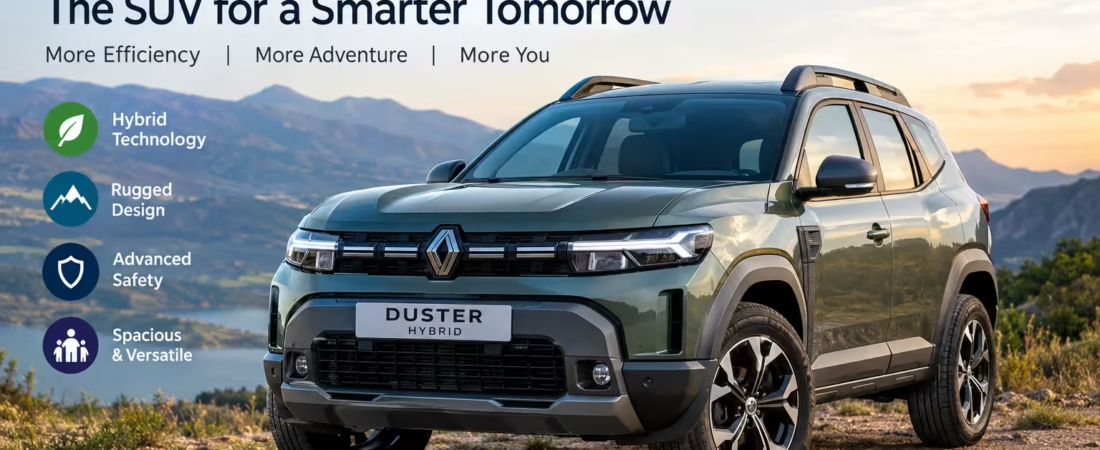
The Renault Duster Hybrid is shaping up to be one of the most interesting SUV launches in India in October 2026. Combining the Duster’s practical SUV character with Renault’s strong-hybrid E-Tech technology, the new model aims to offer a balance of fuel efficiency, everyday comfort and confident performance.
Renault India has confirmed a 1.8-litre petrol strong-hybrid powertrain, a 1.4 kWh battery and an ARAI-certified fuel efficiency figure of 29 km/l for the Duster Strong Hybrid E-Tech 160. Bookings opened on 9 October 2026, with a token amount of ₹21,000, and the official launch and price announcement are scheduled for 17 October 2026.
For buyers who want an SUV that can handle daily office commutes, congested city roads, weekend journeys and family travel without depending entirely on an external charging station, the Renault Duster Hybrid deserves attention.
However, fuel efficiency is only one part of the buying decision. Prospective owners should also understand how the hybrid system works, what features are confirmed, how it compares with rival hybrid SUVs, what remains unknown about pricing and whether the hybrid makes more financial sense than a conventional petrol model.
This comprehensive guide covers the Renault Duster Hybrid’s expected ownership experience, engine specifications, mileage, technology, comfort, safety considerations, rivals, buying advice and frequently asked questions. It focuses on the Indian-market model and distinguishes confirmed information from details that still require official confirmation.
Renault Duster Hybrid 2026: An Overview


6
The new Renault Duster Hybrid adds an electrified powertrain to the latest-generation Duster range in India. Instead of relying exclusively on a petrol engine, the strong-hybrid version combines a petrol engine with two electric motors and a compact battery.
This arrangement is designed to reduce petrol consumption, particularly in city driving, where repeated acceleration, braking and low-speed movement can make a conventional petrol SUV less efficient.
Renault’s Indian-market information identifies the powertrain as Strong Hybrid E-Tech 160. Its principal specifications include a 1.8-litre petrol engine, a 1.4 kWh battery, two electric motors and a claimed ARAI-certified efficiency of 29 km/l.
Here is a quick look at the information available as of 15 October 2026.
| Specification | Renault Duster Hybrid |
|---|---|
| Model year | 2026 |
| Vehicle category | Mid-size SUV |
| Hybrid technology | Strong hybrid / full hybrid |
| Powertrain name | E-Tech 160 |
| Petrol engine | 1.8-litre, four-cylinder |
| Electric motors | Two |
| Battery capacity | 1.4 kWh |
| Combined system output | 160 PS |
| Claimed fuel efficiency | 29 km/l, ARAI-certified |
| Transmission | 8-speed multimode hybrid transmission |
| Bookings opened | 9 October 2026 |
| Official launch | Scheduled for 17 October 2026 |
| Booking amount | ₹21,000 |
| Official hybrid price | Awaiting announcement as of 15 October 2026 |
Specifications are based on Renault India information and launch-period reporting. Equipment, variant availability, final pricing and other market-specific details should be confirmed with Renault before purchase.
The most important distinction is that the Duster Hybrid is a full hybrid rather than a mild hybrid. Its electric motor can help propel the vehicle, and the system can operate on electric power alone under suitable conditions. It does not need to be plugged into an external charger.
For buyers who want to reduce fuel consumption without changing their driving habits or installing a home charging point, this could be a meaningful advantage.
1. What Is the Renault Duster Hybrid, and Why Does It Matter?
The Renault Duster has long been associated with a practical approach to SUV ownership: useful ground clearance, a commanding driving position and a body style suited to varied road conditions. The latest generation brings that familiar identity into a market where buyers increasingly consider fuel costs, automatic transmissions, connected features and electrified powertrains.
The hybrid version represents a significant change in how the Duster uses energy.
A conventional petrol SUV depends primarily on its combustion engine to move the vehicle. A strong hybrid can use its electric motor at low speeds, assist the engine during acceleration and recover energy while slowing down. The petrol engine remains an important part of the system, but it does not have to do all the work.
This matters particularly in Indian cities, where drivers may spend considerable time in slow-moving traffic, stop frequently at signals and accelerate repeatedly over short distances.
How the Duster Hybrid fits into the Indian SUV market
Indian buyers have traditionally considered petrol and diesel engines when choosing an SUV. More recently, hybrid and electric vehicles have expanded the available choices.
Each powertrain has a different purpose:
- Conventional petrol: Suitable for buyers seeking a familiar engine and, depending on the model, a lower initial purchase price.
- Mild hybrid: Uses a small electric system to support the combustion engine but generally cannot drive the vehicle independently for meaningful distances.
- Strong hybrid: Combines a combustion engine with an electric drive system that can propel the vehicle under suitable conditions.
- Battery-electric vehicle: Runs on electric power stored in a rechargeable traction battery and requires access to charging infrastructure.
The Duster Hybrid sits between conventional petrol SUVs and fully electric vehicles in terms of everyday ownership. It retains petrol refuelling convenience while using electric assistance to improve efficiency.
For people living in apartments, parking on the street or travelling frequently between cities, avoiding the need for regular external charging may be particularly useful.
Why the Duster name matters
The Duster is an established name in India’s SUV market, and Renault’s return with a new-generation model creates an opportunity to attract existing Duster owners as well as customers considering competing mid-size SUVs.
The hybrid powertrain could appeal to people who like the idea of electric driving but are not ready to move to a fully electric vehicle.
It also gives Renault another way to differentiate the Duster. Rather than competing only on styling, space or conventional engine performance, the company can make fuel efficiency a central part of its proposition.
Whether that advantage translates into strong sales will depend on the final price, equipment, availability, real-world fuel economy and ownership costs.
2. Renault Duster Hybrid Engine and Performance

The heart of the Renault Duster Hybrid is its E-Tech 160 powertrain. Renault India lists a 1.8-litre petrol engine, a 1.4 kWh battery and a multimode automatic hybrid transmission. The complete system delivers a stated maximum output of 160 PS.
The 1.8-litre petrol engine
The hybrid system uses a naturally aspirated, four-cylinder petrol engine with a displacement of approximately 1,789 cc.
Unlike a turbocharged petrol engine that relies on forced induction, a naturally aspirated engine draws air into the cylinders without a turbocharger. Its role in the hybrid system is to provide combustion-engine power and support the overall energy requirements of the vehicle.
The engine works alongside the electric motors rather than operating in isolation. This coordinated arrangement can reduce the amount of time the petrol engine needs to work inefficiently at low loads.
For buyers, the important point is that the engine’s displacement alone does not tell the complete performance story. The electric motors, battery, transmission and control software all contribute to how the SUV accelerates and responds.
Two electric motors
The Duster Hybrid uses two electric machines with different functions.
According to launch-period technical reporting, one electric unit is rated at approximately 20 hp and acts primarily as a generator and high-voltage starter-generator. The second, rated at approximately 49 hp, can drive the wheels. These figures describe individual components, not separate power figures that should simply be added to the engine output.
The generator helps manage energy and engine operation, while the traction motor supplies electric drive and assists the petrol engine.
The combined system can respond to changing driving conditions without requiring the driver to select between petrol and electric modes manually.
What does 160 PS mean?
Renault identifies the hybrid system as E-Tech 160, with a maximum combined system output of 160 PS.
PS is a metric unit used to describe power. It should not be confused with torque, which describes rotational force.
In everyday driving, the power figure provides a broad indication of the system’s performance potential, but it does not independently establish acceleration times, top speed or overtaking ability.
Electric motors can deliver useful torque quickly, which can make a vehicle feel responsive when pulling away from a standstill. The actual experience also depends on battery charge, transmission behaviour, vehicle weight, road gradient and accelerator input.
What should buyers expect? The combination of petrol and electric propulsion is intended to balance responsive driving with fuel efficiency. A proper test drive will reveal how well the system manages acceleration, gear changes and engine noise in conditions that matter to the buyer.
The 8-speed multimode hybrid transmission
Renault India lists an eight-speed DHT, or dedicated hybrid transmission, for the strong-hybrid Duster.
A hybrid transmission coordinates power from the engine and electric motors. Unlike a conventional automatic gearbox that simply changes between fixed engine-driven gears, a dedicated hybrid arrangement must also manage when electric drive is used, how the engine contributes power and how energy is recovered.
The driver does not need to operate a clutch or select the energy source manually.
When evaluating the transmission, pay attention to:
- Smoothness when moving away from a stop.
- How naturally the vehicle accelerates in heavy traffic.
- Engine noise during strong acceleration.
- Response when overtaking on a highway.
- Behaviour on steep inclines and during low-speed manoeuvres.
These real-world observations are more useful than judging the transmission solely by the number of ratios advertised.
Is the Renault Duster Hybrid powerful enough for highway driving?
The system’s 160 PS combined output suggests that Renault has designed the hybrid to be more than a fuel-saving city vehicle. However, the headline figure should not be treated as a substitute for independent performance testing.
For highway buyers, the relevant questions include whether the SUV accelerates confidently with passengers and luggage, how much engine noise enters the cabin during overtaking and whether the transmission maintains predictable responses on inclines.
The electric motor’s contribution may make initial acceleration feel different from that of a conventional petrol SUV. At higher speeds, the engine and hybrid system must work together according to the vehicle’s operating conditions.
If most of your journeys involve highways, take a test drive on a road that allows safe acceleration and cruising at typical travel speeds. That will provide a more meaningful impression than a brief drive around a dealership.
3. Renault Duster Hybrid Mileage: Understanding the 29 km/l Claim

Fuel efficiency is one of the strongest headline features of the new model. Renault India advertises 29 km/l as the Duster Hybrid’s ARAI-certified fuel efficiency.
For an SUV intended to serve as a family vehicle, that figure may make the hybrid particularly attractive to buyers concerned about petrol expenses.
However, understanding the difference between a certified mileage figure and real-world fuel economy is essential.
What does 29 km/l mean?
At 29 km/l, a vehicle would theoretically travel 29 kilometres using one litre of fuel under the applicable certified test conditions.
It is a laboratory-derived benchmark, not a guarantee that every owner will achieve the same result on every journey.
Actual consumption changes with traffic, temperature, road gradients, vehicle load, tyre pressure, driving style, air-conditioning use and journey length.
A driver travelling at a steady speed on an open road may experience different fuel consumption from someone navigating congested urban traffic with frequent stops.
Why a strong hybrid can be efficient in city traffic
Conventional petrol engines often consume fuel while accelerating from low speeds and may operate inefficiently during repeated stop-start driving.
A strong hybrid can improve this situation in several ways.
Electric assistance during acceleration: The traction motor can provide additional propulsion, reducing the amount of work demanded from the petrol engine under suitable conditions.
Electric-only movement: The vehicle can operate using electric propulsion when system conditions permit, including some low-speed driving.
Regenerative braking: During deceleration, the electric motor can recover some of the vehicle’s kinetic energy and convert it into electricity stored in the battery.
Automatic energy management: The vehicle’s control system determines when to use electric drive, when to run the petrol engine and when to recover energy.
Together, these functions help explain why full hybrids can be particularly useful in urban conditions.
Can the Duster Hybrid drive on electricity alone?
Yes. Renault describes its strong-hybrid E-Tech system as capable of electric driving, including at the start of a journey. The company also advertises the ability to drive in electric mode for up to 80% of the time in city conditions.
That figure refers to a share of driving time under the relevant city-driving conditions. It does not mean that the SUV can travel 80% of a journey’s distance on electricity, nor does it establish an electric-only range of a particular number of kilometres.
The petrol engine may start automatically when the system needs additional power, when the battery’s available energy changes or when operating conditions require it.
This flexibility is central to the strong-hybrid concept: the vehicle can use electricity when useful without relying on the driver to find a charger.
What is the role of the 1.4 kWh battery?
The battery stores electrical energy for the hybrid system. At 1.4 kWh, it is much smaller than the large traction batteries commonly used in fully electric vehicles.
That smaller capacity is appropriate for a system that continually manages energy while driving rather than depending on long-distance electric-only operation.
The battery can receive energy through regenerative braking and through the vehicle’s engine-generator system when required. The driver does not normally need to plug the vehicle in.
Battery capacity alone cannot be used to calculate a reliable electric-only driving range because the answer depends on usable battery energy, vehicle efficiency, operating conditions and the hybrid system’s control strategy.
How much petrol could you save?
The most useful way to evaluate the Duster Hybrid is to compare its likely fuel consumption with that of the petrol vehicle you would otherwise purchase.
For illustration, consider a driver covering 15,000 kilometres annually.
At a hypothetical average of 15 km/l, the vehicle would consume 1,000 litres of petrol per year. At a hypothetical average of 20 km/l, it would consume 750 litres.
That is a difference of 250 litres annually.
These two mileage figures are examples for calculation only; they are not verified real-world figures for the Duster Hybrid or another specific Duster variant.
The actual saving depends on the mileage each vehicle achieves in the same driving conditions, annual distance travelled and the petrol price paid by the owner.
A buyer should therefore avoid estimating financial benefits from the certified 29 km/l figure alone.
How to calculate your own fuel budget
Use this simple formula:
\[ \text{Annual fuel cost}= \frac{\text{Annual kilometres}}{\text{Actual km/l}}\times \text{Petrol price per litre} \]
Suppose you travel 1,200 kilometres per month, your vehicle averages 20 km/l and petrol costs ₹105 per litre. Your approximate monthly petrol expenditure would be:
\[ \frac{1,200}{20}\times ₹105=₹6,300 \]
If a different vehicle achieved 25 km/l over the same distance at the same petrol price, the calculation would be:
\[ \frac{1,200}{25}\times ₹105=₹5,040 \]
The difference would be ₹1,260 per month, or ₹15,120 annually.
This example illustrates how to compare fuel expenses. It does not predict the Duster Hybrid’s actual mileage or the precise saving an owner will achieve.
Best practices for improving hybrid mileage
To get the most from a full hybrid, adopt a smooth driving style rather than trying to maximise electric-only operation at every opportunity.
- Accelerate progressively instead of repeatedly using full throttle.
- Look ahead and slow down smoothly when traffic permits.
- Maintain correct tyre pressure.
- Remove unnecessary heavy items from the vehicle.
- Use air-conditioning sensibly without compromising comfort.
- Keep up with scheduled servicing.
- Compare fuel consumption across several full tanks rather than judging it from a single short journey.
The hybrid system manages energy automatically, so aggressive attempts to force a particular operating mode may be less effective than consistent, relaxed driving.
4. Renault Duster Hybrid Design and Exterior Styling


10
A mid-size SUV must do more than look attractive in photographs. Buyers also consider visibility, ground clearance, ease of parking, door access, boot usability and how well the exterior stands up to daily use.
The latest Duster’s design retains a rugged SUV identity, with pronounced bodywork, an upright stance and styling intended to distinguish it from softer-looking urban crossovers.
The hybrid version’s principal difference is its powertrain. Buyers should not automatically assume that every exterior detail, colour, wheel design or trim element will be identical across all variants.
Front-end design
The front fascia plays an important role in establishing the Duster’s visual character. The grille, lighting elements, bonnet contours and bumper design contribute to its broad, upright appearance.
For buyers comparing several SUVs, the most useful question is not simply which design looks sportiest. It is whether the front end provides adequate visibility from the driver’s seat and whether the vehicle’s dimensions are manageable in narrow streets and crowded parking areas.
When inspecting the vehicle, check the view of the bonnet edges, the front corners and the space available for turning into a tight parking bay.
Side profile and SUV proportions
The side profile is important for both appearance and practicality.
Body cladding and substantial-looking wheel arches reinforce the Duster’s SUV character, while the roofline and door openings influence how easy it is to enter and exit.
Families should pay attention to rear-door access, the height of the door sill and the ease with which children or older passengers can get into the cabin.
Wheel and tyre specifications also matter. Larger wheels may change the vehicle’s appearance, but tyre replacement costs, ride comfort and susceptibility to damage on rough roads should be considered before choosing a variant.
Rear design
At the rear, the tailgate, lighting arrangement, bumper and loading opening determine much of the vehicle’s practical usability.
If you frequently carry suitcases, shopping bags, sports equipment or a child’s pushchair, inspect the boot opening rather than judging capacity from exterior photographs.
A reversing camera and parking sensors, if fitted to the selected variant, can make a noticeable difference when manoeuvring a mid-size SUV in a crowded residential area. Confirm the actual equipment on the variant you intend to buy.
Ground clearance and rough-road ability
Ground clearance is one of the specifications SUV buyers should examine closely, especially in India, where speed breakers, uneven village roads, potholes and steep driveway entrances are common.
However, clearance alone does not establish off-road ability. Tyre choice, approach and departure angles, suspension travel, traction management and the drivetrain all contribute to how well a vehicle handles difficult terrain.
Do not assume that the Duster Hybrid has the same off-road capabilities as every international Duster version. Renault offers different powertrain and drivetrain combinations in different markets, and equipment can vary.
For buyers who regularly travel on muddy farm roads or steep unpaved tracks, ask the dealership to confirm the Indian hybrid’s drivetrain configuration. A strong-hybrid badge does not automatically mean all-wheel drive.
5. Interior, Comfort and Cabin Practicality


8
A vehicle may have impressive mileage and attractive styling, but long-term satisfaction often depends on its interior. The Renault Duster Hybrid will be judged by how well it accommodates the driver, passengers and luggage during everyday use.
Because variant-level equipment can differ, buyers should confirm the final hybrid specification rather than assuming that all features shown in promotional images are standard.
Driver’s seat and driving position
A high seating position is one reason many people prefer SUVs. It can provide a commanding view of the road and make entry and exit easier for some passengers.
During a test drive, check whether the steering wheel and driver’s seat can be adjusted to your preferred position. Your knees should have sufficient clearance, and you should be able to reach the main controls without stretching.
Spend at least several minutes in the driving seat before starting the engine. A comfortable position during a short showroom visit may feel different after an hour on the road.
Dashboard and controls
Modern SUV interiors increasingly combine physical controls with touchscreen interfaces.
A touchscreen can make navigation, media and smartphone integration easier, but essential functions should remain straightforward to use while driving.
Check the location of the climate controls, volume adjustment, drive information and any hybrid-energy display. A clear display of energy flow and battery status can help drivers understand the powertrain without requiring constant attention.
Avoid assuming that a particular screen size, connected-car function or voice-control feature is included in every hybrid variant. Request a demonstration of the actual vehicle’s equipment.
Rear-seat comfort
For family buyers, the rear seat can be more important than headline engine output.
Check:
- Legroom with the front seats adjusted for the driver and front passenger.
- Headroom for taller adults.
- Seat-cushion support during longer journeys.
- Ease of fitting child seats, where required.
- Availability and position of rear air-conditioning vents.
- Charging ports and storage spaces, if fitted.
- Ease of entering and exiting through the rear doors.
If the SUV will regularly carry three adults in the rear, test that arrangement before booking. A cabin that comfortably seats two adults may feel restrictive with three, depending on seat width and floor design.
Boot space and luggage capacity
Hybrid systems can influence vehicle packaging because they require a battery and associated electrical components. However, the actual impact depends on how the manufacturer integrates those components into the platform.
Do not assume that the hybrid has the same boot volume as the petrol versions or that it necessarily sacrifices a particular amount of luggage space.
Ask the dealership for the official boot-capacity figure, and if possible, inspect the luggage compartment in person.
A useful practical test is to place your typical holiday bags, laptop cases, shopping containers or other frequently carried items in the boot. Check whether the loading lip is manageable and whether the rear seats fold in a way that suits your needs.
Ride comfort on Indian roads
Ride quality is influenced by suspension tuning, tyre size, wheel design, vehicle load and road surface.
The Duster’s SUV-oriented positioning makes comfort on uneven roads an important point to evaluate, but the hybrid’s precise ride behaviour should be judged through a test drive rather than inferred from the nameplate.
Try to drive over a representative mix of road surfaces. Listen for suspension noise, observe how the vehicle settles after bumps and check whether passengers experience excessive vertical movement over repeated undulations.
For regular highway travel, also assess seat support, cabin noise and stability at legal cruising speeds.
6. Technology and Features: What Should Buyers Check?

Technology can improve convenience, safety and everyday comfort, but a long feature list does not necessarily mean that a vehicle is easy to live with.
The Renault Duster Hybrid should be evaluated by its actual Indian-market variant specification. Some features may be available only on higher trims or as part of optional packages.
Infotainment and smartphone connectivity
For many buyers, smartphone connectivity is now an essential feature rather than a luxury.
Before purchasing, confirm whether the selected variant offers the connectivity functions you use, including compatible smartphone integration, Bluetooth audio, navigation and USB charging.
If you rely on your phone for directions, test how easily the system connects and whether navigation instructions remain clear when music or calls are active.
Also consider whether the touchscreen responds quickly and whether the interface remains usable in bright sunlight.
Digital instrument display
A digital instrument cluster can make vehicle information easier to read and can provide additional information about the hybrid powertrain.
Useful displays may include:
- Current fuel economy.
- Average fuel economy.
- Battery charge or energy status.
- Power flow between the engine, motor and battery.
- Driving range estimates.
- Warning messages and maintenance reminders.
The exact display options should be verified on the Indian hybrid variant.
Connected-car features
Connected-car systems can provide remote functions or vehicle information through a compatible mobile application. Availability and functionality depend on the manufacturer, market, equipment and subscription terms.
Before treating these features as a buying advantage, ask whether the functions are included, whether a subscription is required and whether the service remains available after the initial ownership period.
Climate control and everyday convenience
Air-conditioning performance is particularly important in India’s hot weather.
During a test drive, assess how quickly the cabin cools, whether rear passengers receive sufficient airflow and whether the controls are easy to operate.
Also inspect smaller convenience details, such as cupholders, door pockets, storage compartments, USB ports, rear armrests and the ease of adjusting the mirrors.
These features may seem minor individually, but they can have a substantial effect on daily satisfaction.
Is a panoramic sunroof essential?
Some SUV buyers consider a panoramic sunroof a priority, while others rarely use one.
If the feature is available on the variant under consideration, evaluate its usefulness alongside the trade-offs. A sunroof does not automatically make a vehicle safer, more fuel-efficient or more comfortable.
In hot weather, the effectiveness of the sunshade and cabin cooling matters. Buyers with young children should also consider how frequently the feature would actually be used.
The sensible approach is to pay for equipment that fits your lifestyle rather than choosing a higher-priced trim solely because it has a longer list of features.
7. Renault Duster Hybrid Safety: What to Evaluate Before Buying
Safety should be a central part of any family SUV purchase. Engine performance, fuel efficiency and touchscreen features are useful, but they cannot replace occupant protection and effective crash-avoidance systems.
The Duster’s new generation has received a five-star Bharat NCAP crash safety rating according to launch-period reporting.
However, buyers should verify the precise scope of the assessment and its applicability to the exact hybrid variant they intend to purchase. A rating or equipment specification should not be assumed to cover every powertrain and trim without confirmation.
Passive safety
Passive safety features help protect occupants when a collision occurs.
When reviewing the hybrid’s equipment, confirm:
- The number and type of airbags fitted to the selected variant.
- The availability of seat-belt pretensioners and load limiters.
- Rear-seat seat-belt reminders, where provided.
- Child-seat anchor points and their accessibility.
- Structural crash-test information applicable to the vehicle.
- The presence of a tyre-pressure monitoring system, if specified.
An airbag count is only one part of a vehicle’s safety performance. Seat-belt use, structural integrity and the design of restraint systems all matter.
Active safety and driver assistance
Active safety systems aim to help drivers avoid collisions or maintain control.
Depending on the vehicle and variant, systems to investigate may include electronic stability control, anti-lock braking, traction control, hill-start assistance, a reversing camera and parking sensors.
If advanced driver-assistance systems are offered, understand what each function does and where its limitations lie.
A lane-warning system, for example, is not a substitute for looking at the road. Automatic emergency braking, where fitted, cannot guarantee that every collision will be prevented.
Always check the final feature list rather than assuming a system is included because it appears in a general advertisement.
Hybrid-specific safety considerations
A strong hybrid contains high-voltage electrical components in addition to a conventional combustion engine.
These components are designed and integrated for vehicle use, but they require appropriate servicing and repair procedures.
Owners should never attempt to open high-voltage components or work on orange high-voltage cables themselves. Following a serious collision or suspected electrical-system damage, arrange inspection by an authorised service facility.
Ask the dealership about hybrid-specific roadside assistance, warranty coverage and repair procedures before completing the purchase.
A practical safety checklist
During your showroom visit, request the official safety-equipment sheet and verify it against the actual vehicle.
Then check the following:
- Confirm the exact variant and its airbag configuration.
- Review applicable crash-test results.
- Test the visibility of the mirrors and rear window.
- Check whether parking assistance suits your usual parking conditions.
- Inspect rear-seat belt access and child-seat installation space.
- Ask how hybrid-system faults are diagnosed and repaired.
- Obtain the warranty terms in writing.
A careful safety review helps avoid the common mistake of choosing a vehicle based on appearance or fuel efficiency alone.
8. Renault Duster Hybrid Price in India: What Buyers Need to Know
Price will be one of the most important factors determining whether the Duster Hybrid succeeds in the Indian market.
As of 15 October 2026, Renault India has opened bookings for the hybrid but has not yet announced its official price. The launch and price announcement are scheduled for 17 October 2026. Renault’s booking information lists a token amount of ₹21,000.
That means buyers should be cautious about online articles that present an estimated price as if it were confirmed.
Expected price versus official price
An expected price is a forecast based on market positioning, competing vehicles, equipment and powertrain costs. It is not an amount guaranteed by the manufacturer.
The Duster Hybrid combines a petrol engine, two electric machines, a battery and a dedicated hybrid transmission. These additional components may influence its price relative to the conventional petrol versions.
Nevertheless, the actual premium depends on Renault’s pricing strategy, variant structure, production costs, introductory offers and competitive conditions.
Until the official announcement, it is better to treat any projected price as speculation rather than a firm buying figure.
What is the on-road price?
The on-road price is the amount a buyer generally needs to pay to register and use the vehicle. It can include:
- Ex-showroom price.
- Road tax and registration charges.
- Insurance.
- Applicable local levies or statutory charges.
- Optional accessories and extended warranty products.
- Dealer-provided services or other optional packages.
The final amount varies by location and the choices made by the buyer.
For example, a buyer in Pune may receive a different on-road quotation from a buyer in Bengaluru or Delhi, even when the ex-showroom price is identical.
Request a written quotation that separates mandatory charges from optional extras. This makes it easier to compare dealerships and avoid paying for products you do not want.
How to evaluate the hybrid’s price premium
Once the price is announced, compare the hybrid with the closest petrol variant that meets your requirements.
Do not compare the hybrid’s top trim with the cheapest petrol model if their equipment differs significantly. That can make the powertrain premium appear larger or smaller than it really is.
A fair comparison should consider:
- Ex-showroom price difference.
- On-road price difference.
- Standard features and safety equipment.
- Transmission type and convenience.
- Expected fuel consumption.
- Annual distance travelled.
- Financing costs and warranty coverage.
This approach gives you a better estimate of whether the hybrid offers value for your specific circumstances.
How to calculate the payback period
Suppose the hybrid costs ₹2 lakh more than a comparable petrol version. This is an illustrative premium, not the Duster Hybrid’s announced price difference.
If your calculated fuel saving were ₹20,000 per year, the simple payback period would be:
\[ \text{Payback period}= \frac{₹2,00,000}{₹20,000} =10\text{ years} \]
This calculation excludes differences in maintenance, financing, resale value and other ownership costs. It also assumes the annual saving remains constant.
A more accurate comparison should use the actual purchase quotations, realistic mileage estimates and the number of years you expect to keep the vehicle.
Is booking before the price announcement a good idea?
Renault has accepted bookings for the hybrid ahead of its official price announcement.
Whether to book early depends on your willingness to commit before every detail is available.
Early booking may be attractive if you are particularly interested in the hybrid and want to express purchase intent ahead of launch. However, you should understand the booking terms before paying.
Ask the dealership:
- Is the booking amount fully refundable?
- What happens if you change your mind after the price announcement?
- Can the booking be transferred to another variant?
- Does booking guarantee a particular delivery date?
- Are introductory offers conditional on specific terms?
- When will the final variant and equipment details be available?
Obtain written confirmation of the answers. Do not rely solely on verbal assurances.
9. Renault Duster Hybrid vs Petrol Duster: Which Makes More Sense?
The Duster Hybrid and conventional petrol Duster are intended to meet different priorities, even though they share the same model name.
Renault India lists the new Duster with a 1.0-litre turbo-petrol engine, a 1.3-litre turbo-petrol engine and the 1.8-litre strong-hybrid powertrain. The company identifies the turbo-petrol options as Turbo TCe 100 and Turbo TCe 160, while the hybrid is designated E-Tech 160.
The case for the hybrid
The hybrid is worth considering if you:
- Drive frequently in congested cities.
- Cover a substantial annual distance.
- Want an automatic transmission.
- Prefer lower petrol consumption over the ownership period.
- Do not want to depend on external charging.
- Plan to keep the vehicle long enough to benefit from fuel savings.
The electric motor’s contribution and energy recovery can be especially useful during repeated stop-start driving.
The case for the petrol version
A conventional petrol variant may be more suitable if you:
- Have a limited vehicle budget.
- Drive relatively few kilometres each year.
- Prefer a manual transmission, where available.
- Spend most of your time on longer, uninterrupted journeys.
- Want to minimise the upfront purchase price.
The turbo-petrol versions also offer different power and transmission combinations, so buyers should compare the precise variants rather than treating all petrol models as identical.
A simple decision table
| Your priority | Version worth considering |
|---|---|
| Frequent stop-start urban driving | Strong hybrid |
| Fuel-efficiency-focused family use | Strong hybrid |
| Lowest initial purchase cost | More affordable petrol variant |
| Preference for a manual gearbox | Compatible petrol variant |
| No access to external charging | Hybrid or petrol |
| Maximum performance emphasis | Compare actual test drives and specifications |
| Low annual mileage | Calculate the hybrid premium carefully |
| Long-term ownership with high annual mileage | Evaluate hybrid fuel savings |
The best choice depends on your budget and driving pattern, not merely on which version has the highest advertised mileage.
10. Renault Duster Hybrid vs Toyota Hyryder, Grand Vitara and Other Rivals


6
The Duster Hybrid enters a market in which Indian buyers already have access to hybrid SUVs, including the Toyota Urban Cruiser Hyryder and Maruti Suzuki Grand Vitara. The Maruti Suzuki Victoris is another relevant model to evaluate when shopping for a fuel-efficient family SUV.
The Duster’s advertised 29 km/l ARAI-certified figure gives it an important headline claim, but the best vehicle for a particular buyer depends on more than certified mileage.
Renault Duster Hybrid vs Toyota Urban Cruiser Hyryder
The Toyota Urban Cruiser Hyryder is a natural comparison for buyers considering a strong-hybrid SUV.
Both vehicles offer an alternative to conventional petrol-only ownership, but their overall appeal may differ.
When comparing them, examine:
- Current variant prices and on-road quotations.
- Certified and independently observed fuel consumption.
- Rear-seat space and luggage capacity.
- Hybrid-system warranty and service arrangements.
- Standard safety equipment.
- Transmission behaviour in traffic.
- Dealership distance and service convenience.
Do not assume that one SUV will be cheaper to maintain simply because it is a hybrid. Ask both manufacturers or dealerships for the applicable service schedule, warranty exclusions and hybrid-component coverage.
Renault Duster Hybrid vs Maruti Suzuki Grand Vitara
The Maruti Suzuki Grand Vitara is another established option for buyers looking at fuel efficiency and family practicality.
Its strong-hybrid version makes it particularly relevant to customers who want a petrol-electric powertrain without external charging.
The Duster may appeal to people who prefer its design, driving character or particular feature combination. The Grand Vitara may be more attractive to buyers whose priorities align with its pricing, equipment, ownership arrangements or dealership support.
A fair comparison requires the exact variants and current prices, rather than a general comparison between the names.
Renault Duster Hybrid vs Maruti Suzuki Victoris
The Maruti Suzuki Victoris also belongs on the shortlist for buyers exploring modern family SUVs with fuel-efficient powertrain options.
Compare the vehicles based on the specific powertrain offered, transmission, safety specification, boot capacity, cabin comfort and the overall cost of ownership.
If your daily commute involves slow traffic, test the hybrid systems under similar conditions. If you regularly travel with four or five occupants and luggage, compare the rear seat and boot directly.
What about the Hyundai Creta and Kia Seltos?
The Hyundai Creta and Kia Seltos are also useful alternatives for buyers shopping in the same broad SUV category.
Their conventional petrol powertrains, features, cabin layouts and ownership propositions may appeal to customers who do not necessarily need a strong hybrid.
However, comparisons should be made against the latest model-year specifications and exact variants available at the time of purchase. Equipment and powertrain availability can change.
Which rival is best?
There is no universal winner.
The Duster Hybrid deserves consideration if its fuel efficiency, design, driving character and final price suit your needs. The Hyryder and Grand Vitara are relevant alternatives if you want to compare established strong-hybrid options. Other petrol SUVs may offer a better overall deal if your annual driving distance is low or their purchase prices are substantially more attractive.
Best practice: shortlist three vehicles, collect written on-road quotations and drive each one on a similar route. That is a more reliable way to choose than ranking vehicles by a single specification.
11. Ownership Costs: Beyond Fuel Efficiency
A car’s purchase price is only the beginning of its financial impact. Insurance, servicing, tyres, financing and depreciation all contribute to the cost of ownership.
The Duster Hybrid’s advertised mileage may help reduce fuel expenditure, but prospective buyers should assess the entire ownership package.
Routine maintenance
The hybrid has a petrol engine as well as electric-drive components. It therefore still requires the maintenance prescribed for its engine and other vehicle systems.
Ask the dealership for a scheduled-maintenance plan that specifies:
- Service intervals.
- Recommended engine oil and consumables.
- Inspection requirements for the hybrid system.
- Warranty coverage for the traction battery and electric motors.
- Labour charges and common replacement-part costs.
- Conditions that may affect warranty coverage.
Avoid assuming that hybrid servicing is either dramatically more expensive or automatically cheaper than petrol servicing. The actual cost depends on the manufacturer’s schedule, parts prices and the work required.
Battery warranty
Battery durability is a reasonable concern for any hybrid buyer, particularly when the vehicle uses a high-voltage battery.
Before purchasing, obtain the official warranty document and identify the period, kilometre limit, exclusions and conditions for coverage.
Check whether the terms distinguish the traction battery from the conventional 12-volt battery. These are different components with different functions.
Also ask whether any battery-health inspection is recommended as the vehicle ages and whether replacement costs are published.
Insurance costs
Insurance premiums depend on the vehicle’s insured value, location, selected cover, claims history and insurer-specific pricing.
A hybrid’s purchase price and repair costs may affect its insurance premium, but the precise difference cannot be determined without quotations.
Compare policies using the same coverage levels, deductibles and add-ons. A cheaper policy with substantially weaker coverage may not be the better option.
Resale value
Future resale value is uncertain, especially for a newly introduced powertrain.
It may be influenced by fuel prices, buyer demand for hybrids, battery condition, warranty transferability, service history, parts availability and the broader used-car market.
Do not assume the Duster Hybrid will retain a specific percentage of its value without reliable market data.
If you plan to sell within three or four years, ask local used-car dealers for indicative valuations and consider the uncertainty in your financial calculations.
Total cost of ownership formula
A useful simplified formula is:
\[ \begin{aligned} \text{Ownership cost}={}&\text{Purchase cost}\\ &+\text{Fuel cost}\\ &+\text{Maintenance and repairs}\\ &+\text{Insurance and taxes}\\ &+\text{Financing costs}\\ &-\text{Resale proceeds} \end{aligned} \]
Use the same ownership period and annual distance when comparing two vehicles. Include the financing costs if you plan to buy with a loan.
This method is more meaningful than choosing a vehicle solely because it has a higher certified mileage figure.
12. Who Should Buy the Renault Duster Hybrid?
The Renault Duster Hybrid will not be the right choice for every driver. Its strongest potential appeal lies with buyers who want SUV practicality and better fuel efficiency without changing to a fully electric vehicle.
Urban commuters
Drivers who spend a large part of their day in traffic are among the most relevant potential customers.
The hybrid system can use electric propulsion under suitable conditions, recover energy while slowing and reduce reliance on the petrol engine during certain low-speed situations.
If your commute includes frequent traffic signals, queues and short trips, the technology could be especially useful.
However, the financial benefit still depends on the purchase premium and the fuel economy achieved in your actual conditions.
Families looking for a primary car
For a family that uses one vehicle for commuting, shopping, school runs and occasional holidays, a hybrid SUV can offer flexibility.
You can refuel at a petrol station, use the vehicle for longer journeys and benefit from electric assistance during everyday driving.
Before deciding, ensure that the cabin, boot, safety equipment and seating arrangement meet your family’s needs. A fuel-efficient powertrain cannot compensate for insufficient luggage space or uncomfortable rear seats.
Frequent highway travellers
People who regularly drive between cities should examine the hybrid’s highway behaviour carefully.
The technology is not limited to urban driving, but the amount of fuel saved will depend on operating conditions. Frequent high-speed cruising may produce a different result from stop-start city use.
If you travel long distances with a full load, take a test drive that reflects your typical journey and compare the fuel consumption of the hybrid with an appropriate petrol alternative.
Buyers upgrading from an older petrol SUV
Owners of an older petrol SUV may appreciate the combination of a modern powertrain and a familiar refuelling routine.
The upgrade decision should also account for the condition of the existing vehicle, its current fuel consumption, resale value and the cost of switching.
Calculate the additional cost of the new vehicle rather than assuming that the fuel savings alone will justify replacing a functioning car.
Buyers who may be better served by another option
The hybrid may be less compelling for drivers who cover very few kilometres annually, intend to sell the vehicle quickly or have a strict purchase budget.
In those circumstances, the extra upfront cost may take too long to recover through fuel savings.
Buyers who want substantial electric-only driving over longer distances should also compare plug-in hybrids, where available, and battery-electric vehicles. The Duster Hybrid is designed around a self-charging full-hybrid system, not a large plug-in battery.
13. How to Buy the Renault Duster Hybrid: A Step-by-Step Guide
Once the official price and variant details are announced, use a structured approach to avoid making a rushed purchase.
Step 1: Confirm the official price and variants
Obtain the published ex-showroom price, equipment list and on-road quotation for your city. Do not rely on unofficial estimates or assume that the hybrid is available in every trim.
Step 2: Calculate your fuel budget
Estimate your annual driving distance, likely mileage and local petrol price. Compare the resulting annual fuel cost with a petrol SUV you would realistically buy.
Step 3: Book a meaningful test drive
Drive through city traffic, uneven roads and a safe stretch of open road. Evaluate acceleration, transmission response, visibility, ride comfort and cabin noise.
Step 4: Review safety and warranty documents
Confirm the exact safety equipment and ask for written details covering the battery, electric motors, hybrid-system repairs and roadside assistance.
Step 5: Compare written quotations
Request quotations from authorised dealers where practical. Check insurance, registration, accessories, optional packages and delivery estimates separately.
Step 6: Inspect the vehicle before delivery
Verify the variant, manufacturing details, documents, paintwork, tyres, electrical functions and supplied accessories. Ensure that the invoice and registration details match your purchase.
What to ask the dealership before booking
A few targeted questions can prevent misunderstandings later.
- What is the final ex-showroom and on-road price?
- Which features are standard on the hybrid variant?
- What is the delivery timeline for my booking?
- Is the booking amount refundable, and under what conditions?
- What are the battery and hybrid-system warranty terms?
- What is included in the scheduled maintenance plan?
- Are roadside assistance and extended warranty available?
- Are any introductory offers conditional on financing or a particular booking date?
Keep written copies of the quotation, booking terms and warranty information. These documents are more useful than verbal promises if a disagreement arises.
14. Best Practices for Getting the Most from a Hybrid SUV
A full hybrid is designed to manage its own powertrain, but driving habits and routine care still influence fuel consumption and long-term satisfaction.
Drive smoothly
Frequent aggressive acceleration and hard braking waste energy and may reduce fuel efficiency.
Look further ahead in traffic and release the accelerator early when you can safely anticipate slowing down. Smooth driving also improves passenger comfort.
Allow the vehicle to manage its energy
Do not attempt to keep the petrol engine switched off at all costs.
The hybrid control system determines when the engine is needed. If you demand more power or the system requires engine operation, it may start automatically.
Let the system work as intended rather than treating every engine start as a failure.
Keep tyres correctly inflated
Underinflated tyres increase rolling resistance and can reduce efficiency. They can also affect handling and tyre wear.
Check pressures according to the manufacturer’s recommendations, ideally when the tyres are cold. Do not use a higher pressure simply to chase better mileage.
Use the trip computer consistently
If the vehicle provides fuel-economy information, reset the average reading at the start of a meaningful test period.
Record the distance travelled and fuel purchased over several refills. A longer observation period gives a more useful picture than a single trip-computer reading.
Follow the service schedule
Routine maintenance helps the engine, brakes, tyres, cooling systems and electrical components operate as intended.
Pay particular attention to manufacturer guidance for hybrid-system inspections. Do not attempt high-voltage repairs yourself.
Plan for the kind of driving you actually do
A person driving 50 kilometres every day through congested city streets has different needs from someone driving 200 kilometres on a highway every weekend.
Choose the powertrain that fits your normal usage rather than an imagined ideal journey. That simple distinction can prevent an expensive buying mistake.
15. Common Mistakes to Avoid When Buying the Renault Duster Hybrid
Mistake 1: Treating 29 km/l as guaranteed real-world mileage
The certified figure is a benchmark under specified test conditions. Actual consumption varies.
Better approach: Use 29 km/l as a reference point, then calculate your budget using conservative scenarios and revise it after independent real-world tests become available.
Mistake 2: Ignoring the upfront price difference
Fuel savings may not justify a substantial price premium for a low-mileage driver.
Better approach: Compare the actual on-road prices of equivalent variants and calculate the payback period.
Mistake 3: Assuming every advertised feature is standard
Promotional material can show equipment that is available only on selected trims.
Better approach: Obtain the official variant-specific feature list before paying a booking amount.
Mistake 4: Confusing a full hybrid with a plug-in hybrid
The Duster’s strong-hybrid system recharges its battery through the vehicle’s energy-management system. It is not intended to provide the same charging-based electric range as a plug-in hybrid.
Better approach: Understand the powertrain type and decide whether it matches your access to charging and your driving habits.
Mistake 5: Comparing vehicles using different price categories
Comparing a top-spec hybrid with a base petrol SUV can lead to misleading conclusions.
Better approach: Compare equivalent equipment levels and include safety, transmission, convenience features and warranty.
Mistake 6: Booking without reading the terms
A token payment does not automatically guarantee a particular delivery date, price or refund arrangement.
Better approach: Obtain the current booking terms in writing and clarify the conditions before making payment.
Mistake 7: Forgetting the ownership network
The nearest service centre, availability of trained technicians and access to parts can matter over several years.
Better approach: Confirm that an authorised service facility near you can support the hybrid powertrain and ask about hybrid-specific roadside assistance.
16. The Future of Hybrid SUVs in India
India’s SUV market includes conventional petrol models, diesel vehicles, strong hybrids and battery-electric options. Each addresses a different combination of price, usage, refuelling or charging convenience and efficiency.
The Duster Hybrid reflects an important direction in this market: improving fuel economy without requiring the customer to change to a fully electric vehicle.
Why full hybrids remain relevant
Full hybrids can recover energy during braking and use electric propulsion under suitable conditions while retaining a petrol engine for longer journeys.
For customers who lack dependable home charging, this can offer a practical route towards electrification.
It is not the only possible solution, and its benefits vary by driving pattern, but it addresses a genuine ownership preference: reducing fuel consumption without depending on charging infrastructure.
Better energy management
Hybrid systems rely heavily on software that coordinates the engine, electric motors, battery and transmission.
As technology develops, manufacturers may continue to refine how these components work together to improve smoothness, efficiency and responsiveness.
The benefits experienced by owners will still depend on the specific system, vehicle design, local conditions and maintenance.
Greater emphasis on total ownership cost
As buyers become more familiar with hybrids, the decision may increasingly depend on measurable ownership economics rather than the powertrain label alone.
A vehicle that costs more initially may be worthwhile for someone who drives extensively, but less attractive for a driver covering only a few thousand kilometres annually.
That makes transparent pricing, independent mileage testing and clear warranty coverage important considerations for the Duster Hybrid and its rivals.
The importance of real-world testing
Manufacturer-certified figures help establish a common comparison point, but independent testing provides additional context.
Future reviews should examine city and highway fuel economy separately, performance with passengers and luggage, overtaking response, ride comfort and the consistency of the hybrid transmission.
For prospective buyers, those findings will be more informative than relying on a single headline specification.
17. Frequently Asked Questions About the Renault Duster Hybrid
1. What is the launch date of the Renault Duster Hybrid in India?
The Renault Duster Strong Hybrid E-Tech 160 is scheduled for its official Indian launch on 17 October 2026. Bookings opened on 9 October 2026, with a booking amount of ₹21,000.
2. What is the expected mileage of the Renault Duster Hybrid?
Renault India advertises an ARAI-certified fuel efficiency of 29 km/l for the Duster Strong Hybrid E-Tech 160. Actual mileage will depend on traffic, driving style, road conditions, air-conditioning use and other factors.
3. What engine does the Renault Duster Hybrid use?
The Indian-market Duster Hybrid uses a 1.8-litre, four-cylinder naturally aspirated petrol engine working with two electric motors and a 1.4 kWh battery. The combined system output is rated at 160 PS.
4. Does the Renault Duster Hybrid need to be charged externally?
No. The Duster’s strong-hybrid system is designed to recharge its battery through regenerative braking and the vehicle’s engine-generator system. Owners do not need to plug it into an external charging station for normal hybrid operation.
5. What is the price of the Renault Duster Hybrid in India?
As of 15 October 2026, Renault has not officially announced the hybrid’s price. The price announcement is scheduled for 17 October 2026. Buyers should confirm the official ex-showroom price and their city’s on-road price with Renault India or an authorised dealership.
6. Is the Renault Duster Hybrid an automatic SUV?
Yes. Renault India lists the Strong Hybrid E-Tech 160 with an eight-speed multimode hybrid transmission. This allows the system to coordinate the petrol engine and electric motors automatically.
7. Is the Renault Duster Hybrid better than the Toyota Hyryder?
Neither SUV is automatically better for every buyer. The Duster Hybrid’s advertised 29 km/l efficiency makes it worth considering, while the Toyota Urban Cruiser Hyryder is an established strong-hybrid alternative. Compare actual prices, real-world mileage, comfort, safety equipment, service arrangements and warranty terms before choosing.
8. Is the Renault Duster Hybrid worth buying?
It could be a strong option for buyers who frequently drive in city traffic, want an automatic SUV and plan to keep their vehicle for several years. Whether it offers better value than a petrol SUV depends on its final price, your annual driving distance and the fuel savings you achieve. A test drive and a realistic ownership-cost calculation are the best next steps.
Conclusion: Should You Wait for the Renault Duster Hybrid?
The Renault Duster Hybrid 2026 brings together an established SUV nameplate and a strong-hybrid powertrain designed to improve fuel efficiency without requiring external charging.
Its main technical highlights are a 1.8-litre petrol engine, two electric motors, a 1.4 kWh battery, a combined output of 160 PS and Renault’s advertised ARAI-certified mileage of 29 km/l. The vehicle can operate on electric power under suitable conditions and automatically manages the relationship between its engine and electric drive system.
For urban commuters, families and frequent drivers, these characteristics could make it an appealing alternative to a conventional petrol SUV.
Nevertheless, mileage alone should not determine the buying decision. The final price, variant-wise equipment, actual fuel consumption, service costs, battery warranty, rear-seat comfort and luggage capacity will all influence its long-term value.
As of 15 October 2026, the official price announcement is still ahead, with the launch scheduled for 17 October. Prospective buyers should therefore verify the final specifications and ownership terms before committing to a purchase.
Our recommendation: If you are considering the Renault Duster Hybrid, compare it with the petrol Duster and at least two competing SUVs. Collect written quotations, take a thorough test drive and calculate the likely fuel savings using your own annual driving distance.
The best SUV is not necessarily the one with the highest advertised mileage. It is the one that fits your budget, daily routine and long-term ownership needs.
Call to action: Follow Renault India’s official announcements for the confirmed price and variant details, then book a test drive to decide whether the Duster Hybrid deserves a place in your garage.