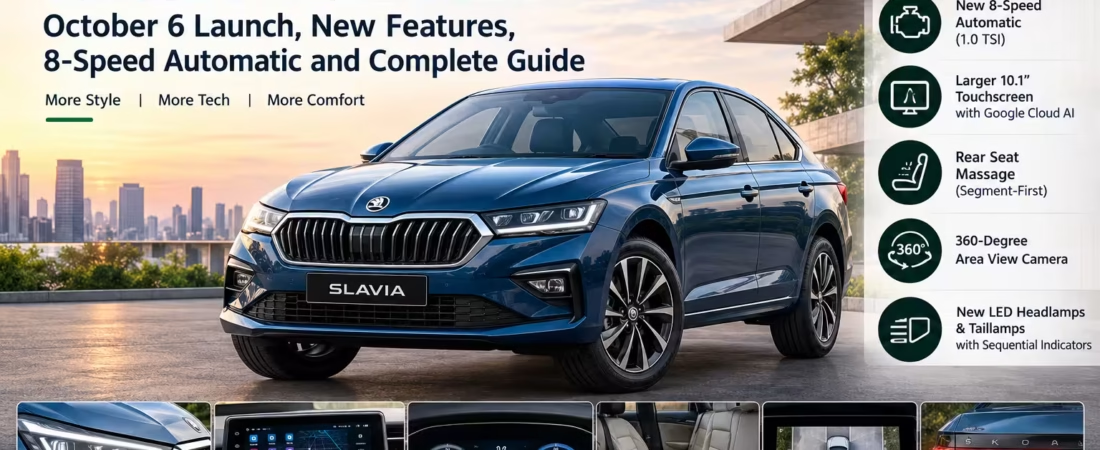
The Skoda Slavia facelift is arriving in India on 6 October 2026, bringing the first comprehensive update to Skoda’s popular mid-size sedan since its launch. Unlike a minor cosmetic refresh, the 2026 Slavia facelift combines redesigned exterior elements with meaningful cabin upgrades, a new automatic transmission for the 1.0 TSI engine, a 360-degree camera, rear-seat massage and upgraded connectivity.
For sedan buyers, the timing is significant. India’s passenger-car market has become heavily focused on SUVs, but the Slavia continues to target customers who want a proper three-box sedan with strong road manners, turbo-petrol performance, a spacious cabin and a safety-focused package.
Skoda has already unveiled the updated Slavia, so many of the important specifications are now confirmed. The company says the new model brings new LED headlamps and taillamps with sequential indicators, redesigned alloy wheels, refreshed interior elements, a segment-first eight-speed torque-converter automatic for the 1.0 TSI, a rear-seat massage function and a 360-degree Area View camera. The updated infotainment system also gets AI Companion powered by Google Cloud along with wireless Android Auto and Apple CarPlay.
The remaining major question for buyers is pricing. Skoda has scheduled the official price announcement for 6 October 2026, while pre-bookings are already open for ₹15,000. Production of the facelift has commenced at Skoda Auto Volkswagen India’s Chakan facility in Pune.
This detailed guide explains everything you need to know about the 2026 Skoda Slavia facelift, including its design changes, engines, new transmission, interior, technology, safety, expected positioning, variants, ownership considerations and competition.
Skoda Slavia Facelift 2026: Quick Overview
Here are the key highlights at a glance:
- India launch: 6 October 2026
- Body style: Mid-size sedan
- Platform: MQB-A0-IN
- Engines: 1.0 TSI and 1.5 TSI turbo-petrol
- 1.0 TSI power: 115hp
- 1.0 TSI torque: 178Nm
- 1.5 TSI power: 150hp
- 1.5 TSI torque: 250Nm
- 1.0 TSI transmissions: 6-speed manual and new 8-speed torque-converter automatic
- 1.5 TSI transmission: 7-speed DSG
- New convenience feature: Rear-seat massage
- New parking technology: 360-degree Area View camera
- Infotainment: Updated 10.1-inch system
- Driver display: New 10.25-inch digital display
- Safety: Six airbags and 5-star Global NCAP safety credentials carried forward
- New exterior features: LED lighting, sequential rear indicators, new alloy wheels and redesigned bumpers
- Pre-booking: ₹15,000
- Official price announcement: 6 October 2026
Skoda has confirmed the major mechanical and equipment updates, while the final variant-wise prices are scheduled to be announced at launch.
What Is the Skoda Slavia Facelift?
The Skoda Slavia facelift is the updated version of the current-generation Slavia sedan.
The Slavia was developed specifically for the Indian market under Skoda’s India 2.0 strategy. It uses the MQB-A0-IN platform, a version of the Volkswagen Group’s modular architecture adapted for India.
The facelift does not replace the Slavia with an entirely new generation.
Instead, Skoda has retained the car’s basic proportions and mechanical foundation while making changes in several areas where modern buyers expect improvement.
These include:
- Exterior styling
- Lighting
- Wheels
- Interior trim
- Infotainment
- Driver display
- Parking technology
- Rear-seat comfort
- Automatic transmission technology
- Smartphone connectivity
Skoda has described the updated Slavia as a new chapter in its sedan legacy, with an expanded powertrain choice and additional comfort and technology features.
This approach makes sense for the Slavia because the basic product already has a strong identity.
It is a sedan designed around driving dynamics, space, safety and turbocharged petrol engines.
The facelift attempts to modernise that formula without abandoning it.
Skoda Slavia Facelift Launch Date in India
The Skoda Slavia facelift will officially launch in India on 6 October 2026.
Skoda has already unveiled the updated model and opened pre-bookings. Production began at the company’s Chakan facility in Pune before the launch.
The launch date falls during India’s festive-season buying period, when manufacturers traditionally introduce important new products and buyers are more active in showrooms.
For Skoda, the facelift is particularly important because the Slavia remains one of the company’s key sedan products in India.
The company has not simply changed the exterior.
It has introduced a new automatic transmission, improved the cabin technology and added equipment that was previously unavailable or offered differently.
Skoda Slavia Facelift Price in India
The official price of the facelift is scheduled to be announced on 6 October 2026.
Therefore, buyers should be careful with websites or social-media posts presenting an unofficial final price before the launch.
Autocar India currently estimates the facelift could be positioned between approximately ₹10 lakh and ₹20 lakh, while its model page lists an expected price range of ₹10.25 lakh to ₹18.75 lakh. These are estimates rather than Skoda’s final announced prices.
The outgoing Slavia’s previous official price lists provide a useful reference, but they should not be used as the facelift’s final price.
The final amount will depend on:
- Variant
- Engine
- Transmission
- Optional equipment
- Special edition
- Insurance
- Registration
- Location-specific charges
The new 8-speed automatic and additional equipment could influence the price structure significantly.
Skoda Slavia Facelift Exterior Design
The 2026 Slavia facelift retains the familiar silhouette of the current model.
That is not surprising.
A facelift is intended to refresh a vehicle rather than completely redesign it.
However, Skoda has made enough changes to give the updated sedan a sharper appearance.
The major exterior changes include:
- New LED headlamps
- Revised daytime-running-light signatures
- Updated grille and air-dam treatment
- Redesigned LED tail-lamps
- Sequential rear turn indicators
- New alloy wheels
- Revised bumpers
- Updated rear trim
- New exterior colour options
Skoda’s official announcement confirms the new LED headlamps and redesigned LED taillamps with sequential indicators, along with new alloy wheel designs.
New LED Headlamps and DRLs
The front lighting has been redesigned.
The new LED headlamps are accompanied by revised daytime-running-light signatures, giving the Slavia a more contemporary face.
Lighting is increasingly important in modern vehicle design because it creates a recognisable identity even when the car is viewed from a distance.
The updated Slavia’s lighting arrangement makes the front end appear more sophisticated without dramatically changing the overall shape.
The facelift also continues Skoda’s emphasis on crisp, geometric design.
Revised Grille and Front Bumper
The front grille and bumper treatment have also been revised.
The changes are designed to make the sedan appear wider and more planted.
Rather than introducing an entirely new design language, Skoda has refined the existing appearance.
This is useful for current Slavia owners who may prefer the model’s established proportions but want the latest version to look noticeably newer.
The front-end changes are particularly visible when combined with the revised headlamps and alloy wheels.
New Rear Design and Sequential Indicators
The rear receives updated LED tail-lamps and sequential turn indicators.
Sequential indicators have become increasingly common in premium and upper-mid-range vehicles because they provide a more distinctive lighting signature.
The updated Slavia also receives new treatment between the tail-lamps, including prominent SKODA lettering.
This gives the rear a cleaner and more contemporary appearance.
The rear design changes are not purely decorative.
They also help visually distinguish the facelift from the pre-facelift model.
New Alloy Wheels
Skoda has introduced new alloy-wheel designs for the facelift.
The wheels are an important part of the Slavia’s overall visual character because the sedan has relatively long proportions.
A fresh wheel design can make a vehicle look newer without requiring major changes to the body panels.
The updated model’s wheels also contribute to its more modern appearance.
New Exterior Colours
The facelift is also expected to offer new exterior colour choices.
Autocar India reports that Arctic Silver and Cappuccino Beige are among the new colour options.
For buyers, colour selection is more than a cosmetic decision.
Lighter colours can emphasise the Slavia’s body lines, while darker shades can give it a more understated appearance.
The choice is ultimately subjective, but new colours help make the facelift feel more distinct from the outgoing car.
Skoda Slavia Facelift Interior
The Slavia’s basic dashboard architecture remains familiar, but Skoda has upgraded the technology and some comfort elements.
The most significant changes include:
- Larger infotainment screen
- Larger digital driver’s display
- Updated graphics
- 360-degree camera
- Rear-seat massage
- Updated interior accents
- New connectivity features
The touchscreen grows from the earlier 10-inch unit to 10.1 inches, while the driver’s display increases from 8 inches to 10.25 inches.
These changes are important because digital displays have become a major part of the modern car-buying decision.
10.1-Inch Infotainment System
The updated Slavia receives a 10.1-inch infotainment system.
The screen is not dramatically larger than the outgoing unit, but Skoda has also updated the underlying functions.
The new system includes:
- Wireless Android Auto
- Wireless Apple CarPlay
- Updated interface
- AI Companion powered by Google Cloud
- Connected features depending on specification
Skoda officially describes the infotainment system as next-generation and highlights its AI Companion functionality.
For everyday users, wireless smartphone connectivity is particularly useful.
It removes the need to connect a phone with a cable every time the driver enters the vehicle.
10.25-Inch Digital Driver Display
One of the more noticeable interior upgrades is the new 10.25-inch digital driver’s display.
The outgoing Slavia’s smaller display has been replaced by a larger digital unit with updated graphics and functions.
A larger driver display can make information easier to read.
Depending on the final software and variant, the screen can present information such as:
- Speed
- Engine information
- Driving data
- Navigation information
- Vehicle warnings
- Media information
The exact layout may vary by version.
AI Companion Powered by Google Cloud
One of the technology highlights of the updated Slavia is the AI Companion powered by Google Cloud.
This is an interesting addition because vehicle software is moving beyond conventional menu-based infotainment.
An AI-based assistant can make it easier for users to interact with the vehicle or access information through more natural language.
However, connected and AI features can depend on software, network connectivity and market-specific functionality.
Therefore, buyers should explore the actual system during a test drive rather than assuming every advertised digital feature works identically in every situation.
Wireless Android Auto and Apple CarPlay
Wireless smartphone integration is another practical upgrade.
For many drivers, Apple CarPlay and Android Auto are used every day for:
- Navigation
- Music
- Calls
- Messages
- Podcasts
- Voice assistance
Wireless connectivity makes these functions easier to access.
The benefit may seem small on paper, but it can make the everyday experience considerably more convenient.
360-Degree Camera
One of the most useful additions to the facelift is the 360-degree Area View camera.
Skoda officially lists this as one of the new convenience features.
A 360-degree camera uses multiple camera views to create a bird’s-eye representation of the vehicle and its surroundings.
This can help when:
- Parking between vehicles
- Entering narrow parking spaces
- Driving through tight apartment basements
- Avoiding low obstacles
- Positioning the car near a wall
- Manoeuvring in crowded areas
For city drivers, this may be one of the facelift’s most useful additions.
Rear Seat Massage: A Segment-First Feature
The rear-seat massage function is perhaps the most unusual addition to the Slavia facelift.
Skoda describes it as a segment-first feature, bringing a comfort function associated more commonly with expensive premium cars into this class of sedan.
This feature is particularly interesting for buyers who regularly travel in the rear seat.
Imagine a long highway trip.
Instead of simply having a comfortable bench seat, passengers can use the massage function to reduce fatigue during the journey.
Of course, a massage function does not transform the Slavia into a luxury limousine.
But it adds a distinctive comfort feature that separates the facelift from many conventional mid-size sedans.
Skoda Slavia Facelift Engine Options
The facelift continues with two turbo-petrol engines:
1.0 TSI
- 999cc
- Three-cylinder turbo-petrol
- 115hp
- 178Nm
1.5 TSI
- 1,498cc
- Four-cylinder turbo-petrol
- 150hp
- 250Nm
These figures are reported for the updated model by Autocar India and other automotive sources, while Skoda’s official announcement confirms continuation of the two-engine strategy.
The two engines target different types of buyers.
The 1.0 TSI is designed to offer a balance between performance, efficiency and affordability.
The 1.5 TSI is the enthusiast-oriented option, offering substantially more power and torque.
1.0 TSI Engine: The Practical Choice
The 1.0 TSI produces around 115hp and 178Nm.
For everyday city and highway driving, that provides a useful combination of responsiveness and efficiency.
The smaller engine is particularly relevant because the facelift introduces a major transmission change.
Previously, the automatic version of the 1.0 TSI used a six-speed automatic.
The facelift replaces this with a new eight-speed torque-converter automatic.
New 8-Speed Automatic for the 1.0 TSI
This is arguably the most important mechanical change in the facelift.
The 1.0 TSI now gets an eight-speed torque-converter automatic transmission.
Skoda calls it a segment-first eight-speed automatic for the 1.0 TSI.
The change matters because transmission behaviour has a major influence on how a car feels.
A torque-converter automatic can provide smooth low-speed operation and conventional gear changes.
That can be particularly useful in Indian traffic.
The eight-speed arrangement also provides more gear ratios than the previous six-speed automatic.
This gives the transmission more opportunities to keep the engine in an appropriate operating range.
Why the New 8-Speed Automatic Matters
Consider two driving situations.
City Traffic
At low speeds, a smooth automatic transmission can reduce driver fatigue.
There is no need to repeatedly operate a clutch.
Highway Driving
At higher speeds, additional ratios can allow the transmission to select an appropriate gear for acceleration or cruising.
The real-world benefit will depend on calibration, traffic and driving style.
But mechanically, the new eight-speed automatic is a significant update.
1.5 TSI Engine: The Performance Choice
The larger 1.5 TSI continues to produce around 150hp and 250Nm.
It is the engine for buyers who want stronger acceleration and a more performance-oriented character.
The 1.5 TSI is paired with a 7-speed DSG dual-clutch automatic in the updated Slavia.
This combination is particularly attractive to driving enthusiasts.
The DSG is designed for quick gear changes and works well with the 1.5 TSI’s stronger output.
However, the driving experience is different from the 1.0 TSI with its conventional torque-converter automatic.
1.0 TSI vs 1.5 TSI: Which Engine Should You Choose?
The answer depends on your priorities.
| Factor | 1.0 TSI | 1.5 TSI |
|---|---|---|
| Engine | 1.0L 3-cylinder turbo | 1.5L 4-cylinder turbo |
| Power | 115hp | 150hp |
| Torque | 178Nm | 250Nm |
| Automatic | 8-speed torque converter | 7-speed DSG |
| Character | Balanced | Performance-oriented |
| Typical buyer | Daily commuter | Enthusiast/highway user |
| Cost | Likely lower | Likely higher |
If most of your driving happens in the city and you want an automatic, the 1.0 TSI with the new eight-speed automatic is worth considering.
If you frequently drive on highways or simply enjoy stronger acceleration, the 1.5 TSI DSG is the more performance-focused option.
Does the Slavia Facelift Get a Hybrid?
The updated Slavia continues with its petrol powertrain lineup.
There is no confirmed hybrid version in the facelift announcement.
This is relevant because some competitors in India’s mid-size market offer strong-hybrid powertrains.
Skoda’s approach is different.
The company continues to focus on turbocharged petrol engines for the Slavia while improving transmission technology and equipment.
For buyers who specifically want a hybrid sedan, the Slavia facelift therefore does not currently provide that option.
Skoda Slavia Facelift Safety Features
Safety remains one of the Slavia’s major selling points.
Skoda says the facelift carries forward its 5-star Global NCAP safety credentials, with six airbags and a comprehensive suite of active and passive safety features.
The existing Slavia has received a 5-star Global NCAP rating for adult and child occupant protection, according to Skoda’s published information.
The facelift continues this safety-focused positioning.
Key equipment includes:
- Six airbags
- Electronic stability control
- ABS
- Electronic brake-force distribution
- Traction-related safety systems
- ISOFIX child-seat mounting points
- Front and rear parking sensors
- 360-degree camera
- Other active and passive safety technologies
Exact equipment can vary by variant.
Does the Slavia Facelift Get ADAS?
This is an important distinction.
The Slavia facelift receives a number of modern safety and parking technologies, but it does not introduce an ADAS suite according to current reporting. Autocar India’s production report specifically notes that an ADAS suite continues to be unavailable.
This means buyers should not confuse the 360-degree camera with ADAS.
A camera helps the driver see the vehicle’s surroundings.
ADAS systems such as adaptive cruise control, lane-centering assistance and autonomous emergency braking use sensors and software to assist with driving tasks.
The Slavia’s safety package is therefore substantial, but it does not compete on ADAS features in the same way as some newer rivals.
Skoda Slavia Facelift Dimensions and Practicality
The Slavia retains its existing overall proportions.
Autocar India’s current information lists approximately:
- Length: 4,541mm
- Width: 1,752mm
- Height: 1,507mm
- Wheelbase: 2,651mm
These dimensions give the Slavia a long, low-slung sedan profile.
The 2,651mm wheelbase also contributes to usable cabin space.
For rear passengers, the long wheelbase is particularly important.
Why Sedan Dimensions Still Matter in the SUV Era
SUVs dominate the Indian market, but a sedan has several inherent advantages.
The Slavia’s lower body and long wheelbase can provide:
- Stable highway behaviour
- A lower centre of gravity
- Large boot space
- Comfortable rear-seat proportions
- Strong aerodynamic efficiency compared with taller body styles
A sedan may not provide the same high seating position as an SUV, but it can deliver a different kind of driving experience.
For buyers who still prefer sedans, the Slavia remains one of the more prominent choices in the segment.
Skoda Slavia Facelift Ride and Handling
Driving dynamics have traditionally been an important part of the Slavia’s identity.
The MQB-A0-IN platform was developed for Indian conditions, while the suspension and steering are tuned to provide a balance between comfort and handling.
The facelift retains the same fundamental platform.
That means buyers should not expect a completely different driving character.
Instead, the improvements are focused on making the existing package more complete.
For enthusiasts, the 1.5 TSI DSG remains particularly attractive.
For everyday drivers, the new 1.0 TSI eight-speed automatic may become one of the facelift’s most relevant combinations.
Skoda Slavia Facelift vs Honda City
The Honda City remains one of the Slavia’s most important sedan competitors.
The two cars approach the segment differently.
The City is known for its naturally aspirated petrol and strong-hybrid options, depending on market and variant.
The Slavia focuses on turbocharged petrol engines.
The facelift gives the Slavia another advantage in equipment with its:
- 360-degree camera
- Rear-seat massage
- 8-speed automatic for the 1.0 TSI
- 10.25-inch digital driver display
- Updated infotainment
A buyer comparing these cars should focus on powertrain preference, rear-seat comfort, fuel economy, transmission behaviour and ownership support.
Skoda Slavia Facelift vs Hyundai Verna
The Hyundai Verna is another direct competitor.
The Verna offers a feature-rich cabin and turbo-petrol powertrain options.
The Slavia takes a somewhat different approach.
The facelift’s new features bring it closer to the Verna in terms of technology and convenience, while the Slavia continues to emphasise European-inspired driving characteristics.
A test drive is essential because the two cars feel different behind the wheel.
Skoda Slavia Facelift vs Volkswagen Virtus
The Volkswagen Virtus is perhaps the most closely related rival because both cars share the Volkswagen Group’s India 2.0 foundations.
They also use the same broad engine family.
The choice can therefore come down to:
- Styling
- Interior design
- Features
- Pricing
- Dealer support
- Personal preference
The Slavia facelift’s new eight-speed automatic for the 1.0 TSI gives it an important mechanical update.
Buyers should compare the exact variants and equipment of both cars after the updated Virtus lineup is considered.
Skoda Slavia Facelift vs SUVs
Although the Slavia is a sedan, many buyers will compare it with SUVs because the SUV has become the default family-car choice in India.
Relevant alternatives can include:
- Hyundai Creta
- Kia Seltos
- Volkswagen Taigun
- Skoda Kushaq
- Honda Elevate
- Toyota Urban Cruiser Hyryder
- Maruti Suzuki Grand Vitara
A sedan like the Slavia can make sense if you prioritise:
- Driving dynamics
- Lower seating position
- Highway stability
- Boot access
- Sedan styling
- Turbo-petrol performance
An SUV may be preferable if you want:
- Higher seating position
- Easier ingress and egress
- Greater visual road presence
- SUV-style practicality
The right choice depends on how the vehicle will actually be used.
Who Should Buy the Skoda Slavia Facelift?
The facelift could suit several types of buyers.
1. Sedan Enthusiasts
If you still prefer sedans over SUVs, the Slavia offers a modern turbo-petrol package with a strong equipment list.
2. Highway Drivers
The turbocharged engines and long-wheelbase sedan body make the Slavia well suited to highway use.
3. Automatic Buyers
The new eight-speed automatic on the 1.0 TSI expands the choice for buyers who want a conventional automatic transmission.
4. Feature-Conscious Buyers
The new 360-degree camera, digital display, wireless connectivity and rear-seat massage give the facelift a more comprehensive equipment package.
5. Performance-Oriented Buyers
The 1.5 TSI DSG continues to provide a higher-performance option.
Who May Prefer Another Car?
The Slavia is not ideal for every buyer.
You may prefer another model if:
- You specifically want a strong hybrid
- You want an SUV driving position
- You require ADAS features
- You prioritise maximum ground clearance
- You want an electric vehicle
- You need a very soft, comfort-first suspension
- You prefer a naturally aspirated engine
The most important part of the buying process is matching the car to your actual requirements.
Common Mistakes to Avoid When Buying the Slavia Facelift
Mistake 1: Choosing the Engine Based Only on Power
The 1.5 TSI is more powerful, but that does not automatically make it the right engine for every buyer.
A city commuter may prefer the 1.0 TSI automatic.
Mistake 2: Assuming 360-Degree Camera Means ADAS
It does not.
The camera improves visibility during parking and manoeuvring.
ADAS performs a different role.
Mistake 3: Ignoring the New Automatic Transmission
The 8-speed automatic is one of the facelift’s most significant changes.
Take it for a proper test drive.
Mistake 4: Looking Only at the Starting Price
The final on-road price can be significantly higher than the ex-showroom price.
Always request a complete quotation.
Mistake 5: Ignoring Rear-Seat Comfort
The facelift adds rear-seat massage, so passengers should actually test the rear cabin.
Mistake 6: Buying Without Comparing Variants
A feature may be available only on selected trims.
Compare the variant-wise equipment carefully.
How to Choose the Right Slavia Facelift Variant
Skoda is expected to offer the updated Slavia in six broad trims:
- Classic
- Classic Plus
- Signature
- Sportline
- Prestige
- Monte Carlo
Autocar India lists these trims for the updated model.
The final price and engine-transmission combinations should be checked against the official October 6 price list.
A useful strategy is to avoid automatically selecting the most expensive variant.
Instead, identify the equipment you genuinely need.
For example:
Budget-focused buyer
Look for the lowest variant that provides the desired safety equipment and engine.
Family buyer
Prioritise automatic transmission, parking camera, rear-seat comfort and infotainment.
Enthusiast
Consider the 1.5 TSI DSG.
Style-focused buyer
Consider Sportline or Monte Carlo if the design package suits your preferences.
Step-by-Step Guide Before Booking
Step 1: Confirm the Final Price
Wait for the official October 6 announcement.
Step 2: Compare Variant Equipment
Do not rely on the model name alone.
Step 3: Select the Engine
Decide between the 1.0 TSI and 1.5 TSI based on your usage.
Step 4: Test the Automatic
If you want an automatic, drive the 1.0 TSI 8AT and 1.5 TSI DSG separately.
Step 5: Test the Rear Seat
Try the new massage function and assess legroom.
Step 6: Test the Camera
Evaluate the 360-degree Area View system in an actual parking situation.
Step 7: Check Connectivity
Pair your phone and test Apple CarPlay or Android Auto.
Step 8: Ask About Warranty and Maintenance
Understand the full ownership package.
Step 9: Get an On-Road Quote
Ask for a written quotation including:
- Ex-showroom price
- Registration
- Insurance
- Accessories
- Extended warranty
- Maintenance package
- Any applicable discounts
Step 10: Compare With Alternatives
Only then make the final booking decision.
Practical Example: Which Slavia Facelift Makes Sense?
Imagine three different buyers.
Buyer A: Daily City Commuter
This buyer drives 30–40km every day through heavy traffic.
A 1.0 TSI with an automatic transmission could be a sensible configuration because smooth, easy driving is likely to matter more than maximum power.
Buyer B: Highway Enthusiast
This buyer frequently travels between cities and enjoys quick acceleration.
The 1.5 TSI DSG could be more appropriate because its 150hp and 250Nm output provide stronger performance.
Buyer C: Family Chauffeur Use
This buyer regularly carries parents or family members in the rear.
The rear-seat massage function, 360-degree camera and cabin comfort become particularly relevant.
These examples show why there is no universally correct variant.
The best specification depends on the driver’s priorities.
Maintenance and Ownership Considerations
Before buying any Skoda, buyers should consider the entire ownership experience rather than only the purchase price.
Important areas include:
- Scheduled servicing
- Warranty
- Extended warranty
- Maintenance packages
- Insurance
- Tyres
- Brake components
- Battery
- DSG-related maintenance considerations
- Dealer accessibility
The 1.0 TSI’s new eight-speed torque-converter automatic and the 1.5 TSI’s DSG are mechanically different.
If long-term ownership is a major priority, ask the dealer about the recommended service schedule and coverage for the exact transmission.
Do not assume that every automatic gearbox has identical maintenance requirements.
Should You Buy the 1.0 TSI 8AT or 1.5 TSI DSG?
This is likely to be one of the most important questions buyers ask.
The 1.0 TSI 8AT offers:
- 115hp
- 178Nm
- Eight-speed torque-converter automatic
- More conventional automatic behaviour
- Potentially lower purchase cost
The 1.5 TSI DSG offers:
- 150hp
- 250Nm
- Seven-speed dual-clutch automatic
- Stronger acceleration
- More performance-oriented character
For a buyer who wants relaxed daily driving, the 1.0 TSI 8AT deserves serious consideration.
For someone who wants performance, the 1.5 TSI DSG is the natural choice.
What Makes the 2026 Slavia Facelift Different?
The updated Slavia stands out because Skoda has changed several important aspects simultaneously.
Exterior
New LED lighting, sequential indicators, bumpers and alloy wheels.
Interior
New 10.25-inch digital driver display and refreshed cabin elements.
Infotainment
10.1-inch system with updated connectivity and AI Companion.
Convenience
360-degree Area View camera.
Comfort
Rear-seat massage.
Transmission
New eight-speed torque-converter automatic for the 1.0 TSI.
Performance
Continued 1.5 TSI with 150hp and 250Nm.
Safety
Six airbags and continuation of the model’s 5-star Global NCAP credentials.
Skoda’s official announcement confirms these core changes.
Is the Slavia Facelift Still Relevant in 2026?
Yes, particularly for buyers who still want a sedan.
The SUV market is much larger than it was a decade ago, but the Slavia occupies a useful niche.
It combines:
- Sedan styling
- Turbocharged petrol engines
- Large-cabin proportions
- Strong safety credentials
- Modern technology
- Automatic transmission choices
- Enthusiast-friendly performance
The facelift also makes the package more contemporary.
The new 8-speed automatic is especially important because automatic buyers now have another transmission choice within the 1.0 TSI range.
Future of Sedans in India
The Slavia facelift also raises a broader question: do sedans still have a place in India’s SUV-heavy market?
The answer is not simply yes or no.
SUVs have clear advantages, but sedans retain strengths of their own.
A sedan can offer:
- A lower centre of gravity
- Long wheelbase
- Good highway stability
- Traditional three-box styling
- Large luggage compartments
- A different driving feel
The Slavia’s continued development suggests Skoda still sees value in offering a modern sedan to Indian customers.
The facelift is not an attempt to turn the Slavia into an SUV.
Instead, it improves the sedan on its own terms.
Frequently Asked Questions
1. When will the Skoda Slavia facelift launch in India?
The Skoda Slavia facelift is scheduled to launch in India on 6 October 2026. Skoda has already unveiled the updated model and opened pre-bookings.
2. What is new in the Skoda Slavia facelift?
The major changes include redesigned LED lighting, new alloy wheels, refreshed exterior styling, a 10.25-inch digital driver’s display, updated infotainment, a 360-degree camera, rear-seat massage and a new eight-speed automatic for the 1.0 TSI engine.
3. Does the new Slavia get an 8-speed automatic?
Yes. The 1.0 TSI gets a new eight-speed torque-converter automatic, replacing the earlier six-speed automatic arrangement. Skoda describes it as a segment-first eight-speed automatic for the 1.0 TSI.
4. Does the Slavia facelift get a 360-degree camera?
Yes. The updated Slavia receives a 360-degree Area View camera system. It is designed to make parking and low-speed manoeuvring easier.
5. Does the Slavia facelift have rear-seat massage?
Yes. The updated model introduces a rear-seat massage function, which Skoda describes as a segment-first feature.
6. What engines are available in the Slavia facelift?
The updated Slavia continues with the 1.0-litre TSI and 1.5-litre TSI turbo-petrol engines. The 1.0 TSI produces approximately 115hp and 178Nm, while the 1.5 TSI produces approximately 150hp and 250Nm.
7. Does the Slavia facelift have ADAS?
No. Current reporting on the production version indicates that an ADAS suite is not available. The car does, however, offer other safety and convenience technologies, including six airbags and a 360-degree camera.
8. What will the Skoda Slavia facelift cost?
Skoda is scheduled to announce the official price on 6 October 2026. Current media estimates place it broadly around the ₹10–20 lakh range, but these are not official prices.
Final Takeaway: Is the Skoda Slavia Facelift Worth Waiting For?
The Skoda Slavia facelift 2026 is more than a styling exercise.
Skoda has retained the fundamental characteristics that define the sedan while adding several features that modern buyers increasingly expect.
The exterior receives redesigned LED lighting, new alloy wheels, revised bumpers and updated detailing.
Inside, the 10.25-inch digital driver display and updated 10.1-inch infotainment system make the cabin feel more contemporary.
The biggest mechanical change is the new eight-speed torque-converter automatic paired with the 1.0 TSI engine. This gives buyers an alternative to the performance-focused 1.5 TSI DSG and could make the smaller-engine automatic more appealing to urban drivers.
The facelift also brings genuinely useful convenience features.
The 360-degree Area View camera can make parking easier, while the rear-seat massage function gives the Slavia a distinctive comfort feature in its segment. Wireless Android Auto, wireless Apple CarPlay and the updated infotainment system further improve everyday usability.
Safety remains another strong part of the package, with six airbags and the model’s established 5-star Global NCAP credentials carried forward.
The biggest unanswered question is the final price.
That information is scheduled for 6 October 2026, when Skoda officially launches the facelift in India.
For buyers planning to purchase a sedan during the festive season, the updated Slavia deserves a proper test drive. Compare the 1.0 TSI 8AT with the 1.5 TSI DSG, examine the variant-wise equipment, test the rear-seat massage and 360-degree camera, and calculate the complete on-road ownership cost.
The Slavia facelift is not trying to become another SUV.
It is making a case for why a well-engineered sedan can still have a place in India’s rapidly changing automobile market.
CTA: If you’re planning to buy a new sedan this festive season, save this guide and check the official Skoda price list after the 6 October 2026 launch. Then compare the Slavia facelift with the Honda City, Hyundai Verna and Volkswagen Virtus before choosing the variant that best fits your budget and driving needs.
Unveiling the Mahindra XEV9S: A Comprehensive Review of Features and Specifications