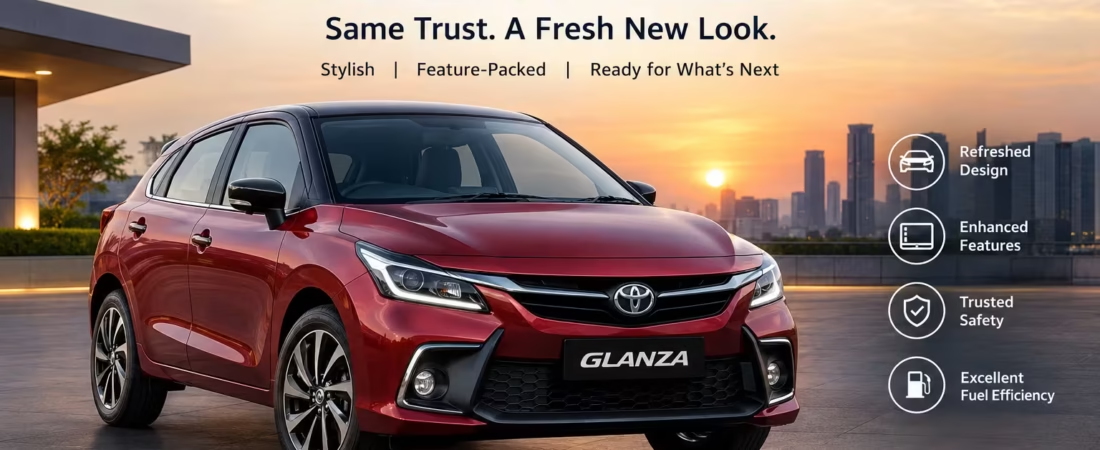
The Toyota Glanza facelift is set to bring a significant update to one of India’s familiar premium hatchbacks. Scheduled to debut on 14 October 2026, the refreshed Glanza is expected to combine subtle exterior styling changes with a new petrol engine, additional technology and upgraded safety equipment.
For buyers considering a premium hatchback in the ₹7–10 lakh range, the update is worth watching closely. The Glanza already competes in a crowded segment that includes the Maruti Suzuki Baleno, Hyundai i20, Tata Altroz and other compact hatchbacks. The facelift could strengthen Toyota’s proposition by adding features that were previously missing while retaining the Glanza’s compact dimensions and practical hatchback format.
Importantly, not every detail has been officially confirmed by Toyota yet. Current reports indicate that the facelift will borrow several mechanical and feature changes from the latest Maruti Suzuki Baleno, including a new 1.2-litre three-cylinder naturally aspirated petrol engine. The reported output is around 83 hp and 112 Nm, while a five-speed manual and AMT are expected.
So, what exactly can buyers expect from the 2026 Toyota Glanza facelift? Will the new engine improve efficiency and everyday drivability? Could ADAS make the Glanza one of the more technologically equipped hatchbacks in its class? And how much might Toyota charge for the updated model?
This detailed guide looks at the expected launch, design, engine, transmission, mileage, safety, technology, interior, expected price, variants, competitors, ownership considerations and the key reasons buyers may want to wait for the facelift.
Note: The article distinguishes between information reported ahead of the launch and specifications officially published by Toyota. Features, prices, variants and technical specifications marked as expected should be treated as provisional until Toyota makes the final announcement.
Toyota Glanza Facelift 2026: At a Glance
| Feature | Expected/Reported Details |
|---|---|
| Model | Toyota Glanza Facelift |
| Body style | Premium hatchback |
| India debut | 14 October 2026 |
| Engine | 1.2-litre naturally aspirated petrol |
| Engine configuration | 3-cylinder |
| Engine family | Z12E |
| Expected power | Around 83 hp |
| Expected torque | Around 112 Nm |
| Transmission | 5-speed manual / AMT expected |
| CNG | Expected, subject to Toyota confirmation |
| ADAS | Expected |
| Ventilated front seats | Expected |
| Wireless phone charger | Expected |
| TPMS | Expected |
| Expected price | Likely a modest premium over the outgoing model |
| Main rivals | Maruti Suzuki Baleno, Hyundai i20, Tata Altroz |
The October 14 launch date has been reported by multiple automotive publications, while Toyota’s official specifications and pricing for the facelift should be considered the final authority once released.
What Is the Toyota Glanza Facelift?
The Toyota Glanza facelift is a mid-cycle update to the company’s premium hatchback. It is not an entirely new generation. Instead, Toyota is expected to refresh the existing model with a revised front-end design, a new engine and additional features.
The current Glanza is closely related to the Maruti Suzuki Baleno through the Toyota-Maruti partnership. That relationship is expected to continue with the facelift, which explains why several of the upcoming Glanza’s changes are likely to mirror those introduced on the updated Baleno.
For buyers, this is significant because the facelift isn’t simply about a new grille or bumper. The mechanical update could change how the car feels to drive, while the expected ADAS and convenience upgrades could substantially improve its equipment list.
Toyota Glanza Facelift Launch Date in India
The Toyota Glanza facelift is expected to debut in India on 14 October 2026.
Reports indicate that Toyota’s launch is scheduled roughly a month after the updated Maruti Suzuki Baleno. The Glanza is expected to receive several of the same underlying changes, although Toyota may differentiate the model through its exterior design, feature packaging, variant strategy and pricing.
The launch date is particularly relevant for buyers currently considering the outgoing Glanza.
If you are not in a hurry to purchase a hatchback, waiting for the facelift can make sense because the updated model could introduce:
- A new petrol engine
- AMT availability
- More safety technology
- ADAS
- Ventilated front seats
- Wireless smartphone charging
- TPMS
- A revised front-end design
However, buyers should also consider that facelifted versions generally command a higher price than outgoing models.
Why the 2026 Glanza Facelift Matters
The premium hatchback segment has changed considerably. Buyers no longer compare cars only on engine power and fuel economy.
Features such as:
- Advanced driver assistance
- Connected technology
- Wireless smartphone connectivity
- Automatic climate control
- Rear cameras
- Multiple airbags
- Tyre-pressure monitoring
- Premium infotainment systems
- Ventilated seats
are increasingly part of the purchase conversation.
The Glanza already has a practical package, but the facelift could make its technology offering more competitive.
The biggest question, however, is whether Toyota’s new three-cylinder engine will deliver the refinement and drivability that existing Glanza owners expect from the outgoing four-cylinder engine.
Toyota Glanza Facelift Design: What Will Change?
The facelift is expected to be evolutionary rather than radical.
Reports suggest that the biggest visual changes will be concentrated around the front of the car. The new model is expected to receive a redesigned grille and front bumper while retaining much of the existing overall silhouette.
That approach makes sense for a facelift.
Toyota does not need to completely redesign the Glanza because its basic proportions already work well for an urban premium hatchback.
Front-End Changes
The front fascia is expected to receive:
- A revised grille
- A redesigned front bumper
- Updated styling elements
- Possible changes to trim detailing
- Toyota-specific visual treatment
The grille is particularly important because it is one of the easiest ways for Toyota to distinguish the Glanza from the Baleno.
Although the two cars share their underlying architecture, the Glanza has traditionally received its own front-end styling.
Side Profile
Major changes to the side profile are not expected.
The existing Glanza’s compact proportions make it suitable for:
- City driving
- Tight parking spaces
- Narrow roads
- Daily commuting
- Highway use
The wheelbase is expected to remain around 2,520 mm, consistent with the current model’s dimensions. Toyota’s existing Glanza measures approximately 3,990 mm long, 1,745 mm wide and 1,500 mm high.
Rear Design
The rear is also expected to remain relatively familiar.
The facelift appears to focus more heavily on the front fascia and technology rather than creating an entirely new rear design.
This could be a sensible decision because a mid-life facelift does not always need dramatic styling changes.
Toyota Glanza Facelift Interior and Cabin
Inside, the Glanza facelift is expected to retain the broad architecture of the current cabin.
That means buyers should not necessarily expect a completely redesigned dashboard.
Instead, Toyota is likely to focus on equipment upgrades.
The expected feature additions include:
- Ventilated front seats
- Wireless phone charger
- Updated safety technology
- TPMS
- ADAS
- Additional convenience features
These additions could make the cabin more attractive to buyers looking for a feature-rich premium hatchback.
Ventilated Seats Could Be a Major Convenience Upgrade
Ventilated front seats are particularly useful in India’s climate.
Instead of simply heating the seat, ventilation circulates air through perforated sections of the seat surface to reduce heat buildup.
For buyers who regularly park outdoors or drive during hot afternoons, this can be more useful than several cosmetic upgrades.
If Toyota offers this feature in a higher variant, it could become one of the Glanza facelift’s selling points.
Wireless Charging
A wireless smartphone charger is also expected.
The benefit is simple: compatible phones can be placed on the charging pad without connecting a cable.
However, buyers should remember that wireless charging performance depends on:
- Phone compatibility
- Charger output
- Phone temperature
- Case thickness
- Smartphone charging technology
It is a convenience feature rather than a reason alone to buy the car.
Toyota Glanza Facelift Engine: The Biggest Mechanical Change
The engine could be the most important change in the facelift.
The current Glanza uses a 1.2-litre four-cylinder petrol engine. Toyota’s existing brochure lists a 1,197cc four-cylinder petrol engine producing 66kW and 113Nm.
For the facelift, reports indicate that this engine will be replaced by a new 1.2-litre naturally aspirated three-cylinder Z12E petrol engine.
The reported output is approximately:
- 83 hp
- 112 Nm
- 1.2-litre displacement
- Naturally aspirated configuration
- Three cylinders
The engine is already associated with the updated Baleno, and Toyota is expected to use a similar powertrain strategy in the Glanza facelift.
Three-Cylinder vs Four-Cylinder: What Does It Mean for Buyers?
This is one of the most important questions surrounding the new Glanza.
A three-cylinder engine can offer advantages in terms of compactness, weight and efficiency potential. But cylinder count alone does not determine whether an engine is good or bad.
The real-world experience depends on:
- Engine tuning
- NVH insulation
- Gear ratios
- Vehicle weight
- Throttle calibration
- Engine mounting
- Low-speed torque delivery
The outgoing four-cylinder Glanza is known for its relatively smooth character. Therefore, refinement will be an important area for buyers to evaluate during the test drive.
What to Check During a Test Drive
If you are considering the facelift, do not judge the engine only by its specification sheet.
Test it at:
- Idle
- Low-speed traffic
- 20–40 km/h acceleration
- 60–80 km/h overtaking
- Highway cruising
- Full-load conditions
- Air conditioner switched on
Pay particular attention to vibration and engine sound during acceleration.
Toyota Glanza Facelift Transmission Options
The new petrol engine is expected to be paired with:
- 5-speed manual transmission
- AMT automatic transmission
The updated Baleno uses these transmission options with its new engine, and reports indicate Toyota is expected to follow the same approach.
Manual Transmission
The manual should remain the preferred choice for buyers who:
- Enjoy greater control
- Drive frequently on highways
- Want predictable gear selection
- Prefer a traditional driving experience
- Want to keep the purchase price lower
For city commuters, however, the AMT may be more convenient.
AMT Automatic
An automated manual transmission can reduce driver effort in traffic.
It is particularly useful in cities such as:
- Mumbai
- Pune
- Bengaluru
- Delhi-NCR
- Hyderabad
- Chennai
However, an AMT behaves differently from a conventional torque-converter automatic or CVT.
There can be noticeable pauses between gear changes, particularly when accelerating aggressively.
The best approach is to take an extended test drive in actual traffic before buying.
Toyota Glanza Facelift CNG: Will There Be a CNG Version?
A CNG version is also expected, although Toyota’s final launch confirmation and variant details should be awaited.
Reports suggest that the CNG model could use the same basic three-cylinder engine architecture and a manual transmission, with output expected to be around 70 hp.
A CNG Glanza could be particularly attractive for high-mileage users.
Potential buyers include:
- Taxi operators
- Daily commuters
- Sales professionals
- Intercity commuters
- Fleet users
- Families travelling long distances
But CNG buyers should consider boot-space requirements, refuelling infrastructure and the availability of CNG stations along their regular routes.
Toyota Glanza Facelift Mileage and Fuel Economy
Official mileage figures for the facelift should be confirmed after Toyota publishes the final specifications.
For reference, the current Glanza’s official brochure lists fuel-efficiency figures of 22.35 km/l for the manual petrol version and 22.94 km/l for the AMT petrol version, while the E-CNG version is listed at 30.61 km/kg.
It would be inappropriate to assume that the facelift will deliver exactly the same numbers.
The new three-cylinder engine may change efficiency characteristics, but actual fuel consumption will depend heavily on:
- Traffic
- Driving style
- Road conditions
- Passenger load
- Tyre pressure
- Air-conditioning use
- Vehicle maintenance
- Gear selection
How to Improve Real-World Mileage
Glanza owners can improve fuel economy by:
- Maintaining recommended tyre pressure
- Avoiding unnecessary hard acceleration
- Using the correct gear
- Reducing unnecessary idling
- Keeping the vehicle serviced
- Avoiding excessive luggage
- Maintaining a steady highway speed
Claimed mileage and real-world mileage should always be treated as different measurements.
Toyota Glanza Facelift Safety Features
Safety could be one of the biggest improvements in the new model.
The facelift is expected to receive additional safety technology, including Level 2 ADAS, along with other equipment such as TPMS.
If offered as reported, this would significantly change the Glanza’s technology profile.
What Is Level 2 ADAS?
ADAS stands for Advanced Driver Assistance Systems.
Level 2 systems can assist with certain driving tasks, such as:
- Steering assistance
- Adaptive cruise control
- Lane-related assistance
- Forward collision warning
- Automatic emergency braking
However, Level 2 does not mean autonomous driving.
The driver remains responsible for monitoring the road and controlling the vehicle.
This distinction is extremely important.
ADAS Should Be Treated as Driver Assistance
Drivers should not:
- Remove their hands from the steering wheel unnecessarily
- Read messages while driving
- Sleep while the system is active
- Treat adaptive cruise control as self-driving
- Assume the car will handle every emergency
ADAS is designed to support the driver, not replace the driver.
Tyre Pressure Monitoring System
TPMS is another potentially useful addition.
A tyre-pressure monitoring system can alert the driver when tyre pressure falls outside the expected range.
Correct tyre pressure affects:
- Handling
- Braking
- Tyre wear
- Ride quality
- Fuel consumption
For Indian driving conditions, where roads can include potholes and uneven surfaces, monitoring tyre pressure is particularly practical.
Will the Toyota Glanza Facelift Get a Sunroof?
Current reports suggest that a sunroof is not expected.
A digital driver’s display is also reportedly unlikely.
That may disappoint some buyers because sunroofs have become a popular showroom feature.
But a sunroof is not essential to the core purpose of a premium hatchback.
If Toyota prioritises ADAS, ventilated seats and other practical technology instead, the overall equipment package could still be competitive.
Toyota Glanza Facelift Expected Price in India
Pricing will be one of the most important launch announcements.
The current Glanza is listed by Toyota from ₹6.73 lakh, while reports indicate that the facelift is expected to receive a modest premium.
Pre-launch estimates from automotive portals vary. Autocar India currently lists an expected range around ₹7.53 lakh to ₹8.54 lakh for certain reported configurations, while other sources have published different estimates.
Because these are estimates, buyers should not treat them as final prices.
What Could Influence the Final Price?
Toyota could price the facelift according to:
- Engine costs
- ADAS hardware
- New features
- Variant structure
- CNG availability
- Manual vs AMT
- Competition
- Manufacturing costs
A relatively small increase could make the Glanza facelift attractive, but a large price jump could push buyers toward SUVs or larger hatchbacks.
Toyota Glanza Facelift Variants
The current Glanza is offered across multiple trims, including E, S, G and V configurations.
The facelift’s final variant structure has yet to be confirmed.
Potential buyers should not assume that every new feature will be available across all variants.
For example, manufacturers commonly reserve higher-cost equipment such as:
- ADAS
- Ventilated seats
- Wireless charging
- Premium audio
- Advanced lighting
for upper variants.
Therefore, comparing the on-road price of the exact variant is more useful than comparing the starting price.
Toyota Glanza Facelift vs Maruti Suzuki Baleno
The Baleno is the most obvious comparison because of the shared engineering relationship.
The two cars are expected to have substantial similarities under the skin.
Glanza Advantages Could Include
- Toyota badge
- Toyota dealer network
- Toyota-specific styling
- Potentially different warranty/ownership package
- Brand preference
- Familiar service ecosystem
Baleno Advantages Could Include
- Strong Maruti brand presence
- Extensive service network
- Established resale market
- Similar mechanical package
The decision may ultimately come down to pricing, variant equipment, warranty and the buyer’s local dealership experience.
Toyota Glanza Facelift vs Hyundai i20
The Hyundai i20 competes directly in the premium hatchback space.
The i20 traditionally appeals to buyers who prioritise:
- Styling
- Interior presentation
- Feature richness
- Premium cabin feel
The Glanza’s strongest argument is likely to be its balance of practicality, compact dimensions, efficiency potential and Toyota ownership appeal.
Buyers should compare the cars on actual variants rather than base prices.
Toyota Glanza Facelift vs Tata Altroz
The Tata Altroz is another major competitor.
It is known for its distinctive design, spacious cabin and broad powertrain positioning.
The Glanza can appeal to buyers who prefer:
- A lighter premium hatchback feel
- Toyota’s ownership ecosystem
- Compact dimensions
- Petrol/CNG flexibility
- A feature package that may now include ADAS
The Altroz remains an important alternative for buyers who place strong emphasis on design and cabin character.
Toyota Glanza Facelift vs Maruti Swift
The Swift is generally positioned as a more compact and youthful hatchback.
The Glanza is larger and positioned more directly toward premium-hatchback buyers.
Choose the Swift if:
- You want a smaller-feeling city car
- Easy manoeuvrability is a priority
- You prefer Swift’s styling
Consider the Glanza if:
- You want a larger premium hatchback
- Rear-seat space matters
- You want a more feature-oriented package
- You prefer Toyota branding
Who Should Buy the Toyota Glanza Facelift?
The facelift could make sense for several types of buyers.
1. Urban Families
The Glanza’s hatchback dimensions make it suitable for daily city use.
Its five-seat configuration, compact footprint and expected automatic option make it practical for family commuting.
2. First-Time Car Buyers
A premium hatchback can provide a good balance between affordability and equipment.
The Glanza could be attractive to buyers who want more features than an entry-level hatchback without moving into a larger SUV.
3. High-Mileage Users
If the CNG version is offered as expected, users covering large monthly distances may find it worth considering.
However, the economics should be calculated based on local fuel prices and annual kilometres.
4. Technology-Focused Buyers
The expected ADAS, TPMS and wireless charging could appeal to buyers who want modern equipment.
5. Existing Glanza Owners
Current owners may consider upgrading if they specifically want:
- Newer safety technology
- A newer engine
- Automatic transmission
- Ventilated seats
- Updated styling
Who Should Wait Before Buying?
Not every buyer needs to rush to book the facelift.
You may want to wait if:
- You want to see real-world mileage
- You want independent reviews
- You are concerned about three-cylinder refinement
- You want to compare AMT performance
- You want to check actual ADAS behaviour
- You are waiting for discounts on the outgoing Glanza
The outgoing model could become interesting if Toyota dealers offer stock-clearance discounts after the facelift arrives.
New Glanza vs Outgoing Glanza: Which Makes More Sense?
This could become one of the most interesting buying decisions.
Choose the New Facelift If You Want:
- Newer technology
- Expected ADAS
- New engine
- Updated design
- Latest model-year vehicle
- Potentially improved equipment
Consider the Outgoing Model If You Want:
- Proven four-cylinder engine
- Existing specification certainty
- Possible discounts
- Lower purchase price
- Familiar mechanical package
The right decision depends on whether the additional features justify the premium.
Common Mistakes to Avoid When Buying the Glanza Facelift
Mistake 1: Buying Only on the Starting Price
The base price can look attractive, but the features you actually want may be available only in a higher variant.
Always compare:
Variant price → Insurance → Registration → Accessories → On-road price
Mistake 2: Assuming ADAS Makes the Car Autonomous
It doesn’t.
ADAS is assistance technology, and the driver must remain attentive.
Mistake 3: Choosing AMT Without a Test Drive
AMTs behave differently from conventional automatic transmissions.
Always test the car in stop-and-go traffic.
Mistake 4: Comparing Claimed Mileage With Real-World Mileage
Certified figures are produced under controlled test conditions.
Your actual mileage will depend on your driving environment.
Mistake 5: Ignoring Service and Insurance Costs
A car’s purchase price is only one part of ownership.
Calculate:
- Insurance
- Service
- Tyres
- Fuel
- Extended warranty
- Accessories
- Financing cost
before making the decision.
How to Book or Buy the Toyota Glanza Facelift
Once Toyota officially opens bookings, buyers should follow a structured approach.
Step 1: Decide Your Powertrain
Choose between:
- Petrol manual
- Petrol AMT
- CNG, if officially introduced
Step 2: Select the Variant
Compare the equipment available in each trim.
Do not automatically select the top variant.
Step 3: Take a Test Drive
Evaluate:
- Seat comfort
- Engine refinement
- Visibility
- Steering
- Brake feel
- AMT behaviour
- Rear-seat comfort
- Boot usability
- ADAS calibration
Step 4: Get Multiple Quotes
Request an itemised quotation from more than one Toyota dealer where practical.
Compare:
- Ex-showroom price
- Registration
- Insurance
- Extended warranty
- Accessories
- Handling charges, where applicable
- Discounts
Step 5: Check Delivery Vehicle Details
Before accepting delivery, inspect:
- Exterior panels
- Paint
- Wheels
- Tyres
- Glass
- Interior
- Odometer
- VIN/chassis details
- Manufacturing date
- Accessories
Toyota Glanza Facelift: Practical Ownership Considerations
A car that looks impressive in a brochure still needs to work for your daily routine.
Before purchasing, consider where you will drive it.
Mostly City Driving
The Glanza’s compact size is an advantage.
An AMT could also make heavy traffic less tiring.
Frequent Highway Driving
Pay attention to:
- High-speed stability
- Overtaking response
- Seat comfort
- Engine noise
- Cruise-control availability
- ADAS behaviour
Frequent Long-Distance Travel
The CNG version could be attractive if CNG infrastructure is convenient along your routes.
Otherwise, petrol may provide greater flexibility.
Toyota Glanza Facelift: Expected Pros and Cons
Expected Pros
- Updated styling
- New petrol engine
- Expected AMT option
- Potential CNG availability
- Expected Level 2 ADAS
- Ventilated front seats
- Wireless charging
- TPMS
- Compact dimensions
- Practical five-seat layout
- Strong competition with established premium hatchbacks
Potential Cons
- Three-cylinder engine may not feel as smooth as the outgoing four-cylinder unit
- Major exterior redesign is unlikely
- Sunroof may remain unavailable
- Digital instrument display may not be offered
- Final price could rise
- Many features may be restricted to higher variants
- ADAS usefulness depends on real-world calibration
These points should be reassessed after the official launch and independent road tests.
Is the Toyota Glanza Facelift Worth Waiting For?
For many buyers, yes.
The reason is not simply the new styling.
The combination of a new engine and expected technology upgrades makes the facelift more meaningful than a cosmetic refresh.
However, the decision becomes more complicated if you can purchase the outgoing Glanza at a substantial discount.
A discounted outgoing model with the established four-cylinder engine could remain a sensible choice for buyers who prioritise value and proven refinement.
On the other hand, if you want the latest safety technology and equipment, waiting for the facelift makes more sense.
Expert Buying Checklist for the 2026 Toyota Glanza
Before signing the purchase agreement, ask the dealer these questions:
- What is the exact on-road price?
- Which variant gets ADAS?
- Which variant gets ventilated seats?
- Is wireless charging standard or optional?
- Is TPMS standard?
- Is AMT available across multiple variants?
- Is CNG available?
- What is the warranty coverage?
- What is the service interval?
- What is the insurance premium?
- Are accessories mandatory?
- What is the manufacturing month?
- What is the expected delivery date?
- Is there any introductory offer?
- Can I take an extended test drive?
Getting these answers in writing can prevent confusion later.
What Could Make the Glanza Facelift Successful?
The Glanza does not need to become a completely different car.
Its core strengths already include a compact footprint and premium-hatchback positioning.
The facelift’s success will depend on how well Toyota executes five things:
1. Engine Refinement
The new three-cylinder unit must feel refined enough for buyers accustomed to four-cylinder petrol engines.
2. Feature Packaging
ADAS and convenience features should be available at sensible price points.
3. Pricing
A small premium can be justified by new equipment. A large increase could weaken the value proposition.
4. Automatic Performance
The AMT needs to work well in real-world traffic.
5. Toyota Ownership Experience
Service quality, warranty support and dealer experience will remain important purchase factors.
The Bigger Picture: Premium Hatchbacks in India
The Indian car market has shifted toward SUVs, but premium hatchbacks continue to serve an important group of buyers.
Not everyone wants:
- A high driving position
- A large vehicle
- Higher running costs
- A bulky footprint
A premium hatchback can be easier to manoeuvre and park while still offering enough space for a small family.
The Glanza therefore occupies a useful position between smaller entry-level hatchbacks and compact SUVs.
The facelift may help Toyota keep that proposition relevant.
Frequently Asked Questions About Toyota Glanza Facelift
1. When will the Toyota Glanza facelift launch in India?
The Toyota Glanza facelift is expected to debut in India on 14 October 2026. The date has been reported by multiple automotive publications, while final launch details should come directly from Toyota.
2. What engine will the Toyota Glanza facelift use?
The facelift is expected to use a 1.2-litre naturally aspirated three-cylinder Z12E petrol engine producing around 83 hp and 112 Nm.
3. Will the Glanza facelift get an automatic transmission?
An AMT automatic transmission is expected, alongside a five-speed manual gearbox. The final variant-wise availability should be confirmed by Toyota.
4. Will Toyota Glanza facelift get ADAS?
Reports indicate that the facelift is expected to receive Level 2 ADAS. However, buyers should verify the exact ADAS functions and variant availability after Toyota publishes the official specification sheet.
5. Will the Glanza facelift get ventilated seats?
Ventilated front seats are among the expected feature additions for the facelift. Final availability may vary by variant.
6. Will Toyota Glanza facelift have a sunroof?
Current reports suggest that a sunroof is unlikely to be offered on the facelift.
7. Will there be a CNG version of the new Glanza?
A CNG version is expected based on reports about the updated powertrain strategy, but Toyota’s final CNG specifications and availability should be awaited.
8. What will be the Toyota Glanza facelift price?
The final price has not been confirmed in the reports available before launch. Current industry estimates suggest that the facelift could be priced at a modest premium over the outgoing model. The current Glanza starts at ₹6.73 lakh ex-showroom on Toyota India’s website.
Final Verdict: Should You Wait for the Toyota Glanza Facelift?
The Toyota Glanza facelift 2026 is shaping up to be a more substantial update than its exterior styling alone might suggest.
The expected redesigned front fascia will give the hatchback a refreshed appearance, but the bigger changes are underneath and inside the car.
The new 1.2-litre three-cylinder petrol engine could alter the driving character, while the expected AMT option should make the car more convenient for urban users. The addition of features such as Level 2 ADAS, ventilated seats, wireless charging and TPMS could also significantly improve the Glanza’s equipment package.
But buyers should keep expectations realistic.
The Glanza facelift is still expected to remain fundamentally a premium hatchback rather than becoming an SUV alternative. It is also not expected to receive every fashionable feature, with reports suggesting that a sunroof and digital driver display may remain absent.
The most important unknowns are therefore final price, variant-wise equipment, real-world engine refinement, AMT behaviour, fuel economy and the actual performance of the ADAS system.
If you are planning to buy a premium hatchback around the ₹7–10 lakh segment, the best strategy is to wait for the official launch, compare the exact variant prices and take a proper test drive before making the final decision.
Planning to buy the new Glanza? Keep an eye on the 14 October 2026 launch, compare the facelift with the Baleno, i20 and Altroz, and choose the variant based on the features you will actually use—not simply the longest equipment list.