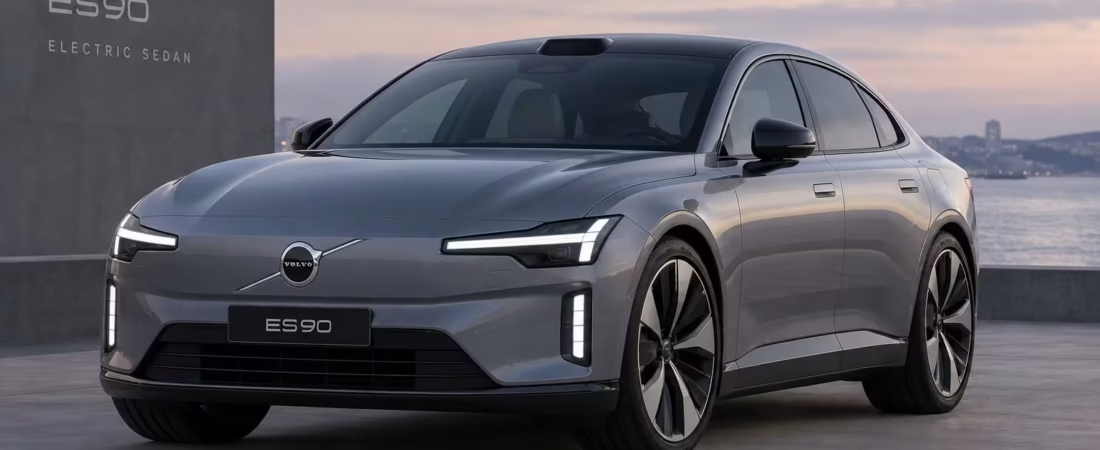
The Volvo ES90 is set to become one of the most important additions to Volvo’s electric-car portfolio, combining the traditional proportions of a luxury sedan with the technology, efficiency and packaging advantages of a modern EV. For Indian buyers, the ES90 is especially significant because Volvo is preparing to bring the model to India on 12 October 2026, marking the brand’s return to the premium luxury-sedan space after the S90 was discontinued in India in 2025.
Unlike an electric sedan designed simply as a replacement for a petrol or diesel car, the ES90 has been developed around Volvo’s latest electric architecture. Its headline technologies include an 800-volt electrical system, fast DC charging, advanced computing, a large battery and a software-focused vehicle architecture. Volvo says the ES90 can achieve up to around 700 km of WLTP range, depending on configuration and market, while official specifications in some European markets list the 106kWh twin-motor version at up to 696–702 km.
For buyers considering a luxury EV, however, the most interesting question is not simply how many kilometres the ES90 can travel. It is whether the car offers the right combination of comfort, range, charging speed, technology, safety, performance and everyday usability.
This guide takes a detailed look at the Volvo ES90, including its expected India positioning, battery technology, range, performance, charging capability, design, interior, safety technology, practicality, expected price and likely competition.
Note: The India launch is scheduled for 12 October 2026, but final India-specific specifications, variants, equipment and pricing should be confirmed at launch. Where relevant, this article distinguishes between Volvo’s published global specifications and India-market expectations.
Volvo ES90: What Is It?
The Volvo ES90 is a fully electric luxury sedan positioned near the top of Volvo’s passenger-car range. It sits within Volvo’s new generation of electric vehicles and shares its underlying SPA2 architecture with models such as the EX90.
The important distinction is that the ES90 is not simply an electrified version of an existing S90. Volvo has designed it as a dedicated next-generation electric model, with an 800V electrical architecture and a software-defined approach intended to allow the vehicle to gain improvements through over-the-air updates.
Volvo describes the ES90 as a car designed around a balance of comfort, technology, safety and efficiency. Its body combines sedan-like proportions with a relatively high roofline and practical rear packaging, giving it some characteristics traditionally associated with fastback-style luxury cars.
The result is an EV aimed at customers who want something more discreet and comfort-oriented than an overtly sporty electric performance sedan.
For India, the ES90 also has a strategic role. The model will bring Volvo back into a premium sedan category at a time when the luxury-car market is becoming increasingly electrified.
Volvo ES90 India Launch Date
The Volvo ES90 India launch date is 12 October 2026. Volvo has confirmed that the ES90 and the EX90 electric SUV will arrive in India on the same date.
This makes October 2026 particularly important for Volvo’s Indian portfolio.
The ES90 will effectively replace the space left by the discontinued S90, although it represents a fundamentally different approach because it is fully electric rather than powered by an internal-combustion engine.
For buyers who previously considered an S90 but now want an EV, the ES90 could therefore become Volvo’s most relevant luxury-sedan offering.
Expected India positioning
The ES90 is expected to occupy a premium position above Volvo’s smaller electric offerings.
Current Indian automotive-market estimates place the expected ES90 price around ₹1.00 crore to ₹1.20 crore ex-showroom, although this is not a confirmed Volvo India price.
The final price will depend on:
- Variant selected
- Battery and powertrain configuration
- Standard equipment
- Import and taxation structure
- Volvo India’s positioning strategy
- Optional equipment and packages
Therefore, buyers should treat ₹1.00–1.20 crore as an estimated range rather than an official price until Volvo announces the final India specification.
Volvo ES90 Design: A New Interpretation of the Luxury Sedan
The ES90’s exterior design is one of its strongest differentiators.
Volvo has retained the Scandinavian design philosophy that has become central to its modern identity. Instead of relying on excessive chrome, complicated body lines or aggressive styling, the ES90 uses clean surfaces, distinctive lighting and carefully controlled proportions.
The result is a sedan that looks modern without appearing overly dramatic.
Front Design
The front end incorporates Volvo’s contemporary lighting signature, with distinctive LED headlamps and a closed-off treatment appropriate for an electric vehicle.
Because the ES90 does not require a conventional engine cooling grille in the same way as an internal-combustion sedan, the front design can be cleaner and more aerodynamic.
The overall design communicates technology without relying on exaggerated styling.
Side Profile
The side profile is where the ES90’s aerodynamic priorities become particularly clear.
Volvo says the car has a drag coefficient of 0.25, making aerodynamic efficiency a central part of its engineering.
A lower drag coefficient helps reduce the energy required to move through the air, particularly at higher speeds.
That matters for an electric car because aerodynamic efficiency directly influences energy consumption and therefore driving range.
The long wheelbase and smooth roofline also contribute to the ES90’s premium sedan appearance.
Rear Design
At the rear, Volvo uses vertically oriented lighting elements and a clean tail design rather than a heavily sculpted boot.
The overall effect is understated.
That approach may appeal particularly to buyers who prefer luxury cars that look sophisticated rather than attention-seeking.
Volvo ES90 Dimensions and Practicality
The ES90 is a substantial luxury sedan.
Published European specifications list the car at approximately:
- Length: 5,000 mm
- Width: 1,942 mm
- Width including mirrors: approximately 2,120 mm
- Height: approximately 1,549 mm
- Wheelbase: 3,102 mm
These dimensions place the ES90 firmly in the executive-luxury segment.
The 3,102mm wheelbase is particularly relevant to rear-seat occupants.
A long wheelbase can provide generous legroom and contributes to the relaxed, lounge-like character expected from a premium sedan.
For Indian buyers, this could also make the ES90 relevant as a chauffeur-driven vehicle, particularly for customers who prioritise rear-seat comfort.
Volvo ES90 Interior: Scandinavian Minimalism Meets Technology
Inside, the ES90 follows Volvo’s minimalist design philosophy.
Instead of filling the dashboard with numerous physical controls, the cabin places significant emphasis on digital interfaces.
The centre of the dashboard is dominated by a large portrait-oriented touchscreen, while the driver receives a separate digital information display.
The overall design is intended to feel calm rather than visually overwhelming.
Large Central Touchscreen
The ES90 is expected to feature a 14.5-inch portrait-oriented touchscreen with Google-based software in the India-market specification reported ahead of launch.
This system is designed to provide access to:
- Navigation
- Media
- Vehicle functions
- Google services
- Charging information
- Connected features
- Driver information
The advantage of a connected digital system is that the interface can evolve through software updates rather than remaining fixed for the entire life of the vehicle.
Digital Driver Display
The ES90 also uses a slim digital driver’s display.
Rather than presenting every possible piece of information simultaneously, Volvo’s approach is to prioritise the information most relevant to driving.
This minimalist philosophy is consistent with the broader Scandinavian approach to interior design.
Head-Up Display
India-focused reports have also indicated a 13.2-inch head-up display for the expected specification.
A head-up display can reduce the need for the driver to look down at the instrument cluster or centre screen for information such as navigation guidance and driving data.
Panoramic Glass Roof
A panoramic glass roof is another major luxury feature associated with the ES90.
A large glass roof can make a spacious cabin feel even more open, particularly for rear passengers.
However, buyers in India’s hot climate should pay attention to the vehicle’s thermal-management and sun-protection features. A panoramic roof is attractive, but its effectiveness depends on insulation, shading and climate-control performance.
Volvo ES90 Battery and Electric Architecture
One of the most important technical aspects of the ES90 is its 800V electrical architecture.
Volvo says the ES90 is its first vehicle to use this technology, enabling faster charging and supporting improved electrical efficiency.
This is important because charging speed is becoming one of the defining factors separating newer premium EVs from earlier electric cars.
Why Does 800V Matter?
Most conventional EV systems use a lower-voltage architecture.
An 800V system allows the vehicle to achieve high charging power while managing current more efficiently.
In simple terms:
Higher voltage + appropriate charging infrastructure = potential for faster charging without requiring extremely high current.
The benefit becomes especially noticeable during long-distance journeys.
Instead of waiting for a large battery to recharge from a low state of charge, a compatible high-power DC charger can replenish a substantial amount of energy during a relatively short stop.
Volvo ES90 Battery Capacity
The ES90 is offered internationally with different battery and powertrain combinations.
Depending on configuration, published specifications include:
92kWh Single Motor
The Single Motor Extended Range version uses a 92kWh battery, rear-wheel drive and a 333hp motor in markets where this version is offered.
106kWh Twin Motor
The Twin Motor version uses a 106kWh battery and all-wheel drive.
Published specifications show:
- 106kWh battery
- 456hp
- 670Nm
- AWD
- 0–100 km/h in approximately 5.4 seconds
- Up to around 696km WLTP range in some markets
- 350kW DC charging capability
Twin Motor Performance
Some markets also offer a higher-performance version with:
- 500kW
- 680hp
- 870Nm
- 0–100 km/h in about 4.0 seconds
- 106kWh battery
Whether all of these configurations will be offered in India is not yet confirmed.
Volvo ES90 Range: How Far Can It Travel?
Range is likely to be one of the biggest reasons buyers consider the ES90.
Volvo’s global announcement originally stated a maximum WLTP driving range of around 700km.
Current published market specifications vary slightly depending on configuration, wheels and testing market. For example, official European specifications list approximately 696–702km for certain 106kWh Twin Motor configurations.
This means the headline figure should be understood as a laboratory-tested WLTP figure, not a guarantee of real-world highway range.
What Can Affect Real-World Range?
Several factors can change how far an EV travels on a charge.
1. Highway speed
Higher speeds increase aerodynamic resistance.
An ES90 travelling at moderate highway speeds can therefore use considerably less energy than the same car driven aggressively at very high speeds.
2. Air conditioning
India’s climate makes air conditioning an important consideration.
Running the climate-control system continuously can increase energy consumption.
3. Traffic
Stop-start traffic can have mixed effects.
Regenerative braking can recover some energy, but repeated acceleration still requires energy.
4. Passenger and luggage load
A heavily loaded vehicle generally consumes more energy.
5. Tyres and wheels
Larger wheels and performance-oriented tyres can influence efficiency.
6. Weather
Volvo itself notes that temperature, wind, road conditions and climate-control usage can affect EV range.
For this reason, buyers should never make a purchasing decision based solely on the maximum advertised range.
Volvo ES90 Charging: One of Its Biggest Strengths
The ES90’s 800V architecture becomes particularly interesting when discussing charging.
Volvo says the ES90 can add approximately 300km of WLTP range in 10 minutes when connected to an appropriate 350kW fast charger.
Published specifications also list approximately 22 minutes for a 10–80 percent DC charge under suitable conditions.
These figures are impressive, but there is an important qualification:
The charging station must be capable of delivering the required power, and actual charging performance varies with battery temperature, state of charge, charger capacity and other conditions.
A 350kW-capable car does not mean every charger will provide 350kW.
Home Charging for the Volvo ES90
For most EV owners, home charging will be more important than ultra-fast public charging.
A typical overnight charging routine can be sufficient for daily commuting.
For example, an owner could:
- Return home after work.
- Plug the car into a suitable home charger.
- Charge overnight.
- Start the next morning with a high state of charge.
This changes the traditional petrol-car refuelling routine.
Instead of visiting a fuel station every few days, an EV can effectively be “refuelled” while parked at home.
For an ES90 buyer, the availability of a reliable home charging point should therefore be considered before purchasing the vehicle.
Volvo ES90 Performance
Luxury does not mean slow.
The ES90’s electric powertrain provides immediate torque, allowing the sedan to deliver strong acceleration without needing conventional gear changes.
The 106kWh Twin Motor configuration published by Volvo develops approximately:
- 456hp
- 670Nm
- All-wheel drive
- 0–100 km/h in around 5.4 seconds
- 180km/h top speed
The Performance variant takes things considerably further, with:
- 680hp
- 870Nm
- 0–100 km/h in approximately 4.0 seconds
For an Indian luxury-car buyer, however, outright acceleration may not be the most important advantage.
The more useful benefit is effortless overtaking.
An electric motor can deliver strong torque immediately, meaning the car can accelerate smoothly without waiting for a gearbox to downshift.
Volvo ES90 Driving Experience: Comfort Over Drama
The ES90’s positioning suggests a different philosophy from performance-focused electric sedans.
Volvo’s emphasis is likely to be on:
- Quietness
- Smooth acceleration
- Long-distance comfort
- Stable highway behaviour
- Premium cabin refinement
- Safety
- Easy everyday driving
Electric cars are naturally quiet compared with combustion-engine vehicles, especially at low speeds.
This creates an opportunity for manufacturers to focus heavily on reducing road, tyre and wind noise.
For a luxury sedan, that refinement can be more valuable than extreme acceleration.
Volvo ES90 Safety Technology
Safety remains one of Volvo’s most recognisable brand characteristics.
The ES90 has been developed around Volvo’s latest safety and computing architecture.
Volvo says the model is built around its Safe Space Technology philosophy and incorporates the company’s extensive real-world safety research.
The vehicle also benefits from substantial computing power.
Volvo has stated that the ES90 is the first Volvo car powered by a dual NVIDIA DRIVE AGX Orin configuration, supporting advanced computing for safety and vehicle functions.
Advanced Driver Assistance
Depending on market and specification, the ES90 can incorporate advanced driver-assistance technologies.
These may include systems designed to:
- Monitor surrounding traffic
- Assist with lane positioning
- Warn the driver of potential collisions
- Support adaptive cruising
- Detect relevant objects and road users
- Provide additional steering or braking assistance
Such systems are designed as driver assistance, not as a replacement for an attentive driver.
Level 3 Driving Assistance: What Buyers Should Understand
Some India-market reports have referred to Level 3 driver-assistance capability for the ES90.
However, buyers should understand that autonomous-driving capability is highly dependent on:
- Local regulations
- Approved roads
- Software availability
- Hardware configuration
- Geographic operating restrictions
- Volvo’s market-specific activation
Therefore, the presence of hardware capable of supporting advanced driving assistance does not automatically mean every autonomous-driving feature will be active in every country.
Indian buyers should check the exact functionality offered at the time of delivery.
Volvo ES90 Technology and Software
The ES90 is not just an electric car with a large battery.
Software is a fundamental part of the vehicle.
Volvo’s Superset technology architecture is intended to create a common hardware and software foundation across its newer electric vehicles. Volvo says this approach allows improvements to safety and vehicle performance to be delivered through over-the-air updates.
This is increasingly important because modern vehicles are becoming software-intensive products.
Instead of requiring a workshop visit for every improvement, certain functions can potentially be updated remotely.
Google-Based Infotainment
The ES90’s infotainment system is built around Google’s automotive software ecosystem in markets where the system is offered.
This can provide access to familiar services such as:
- Google Maps
- Google Assistant-related functions
- App ecosystem
- Connected navigation
- EV route planning
Volvo’s Indian EV ecosystem also supports route planning and charging information through its connected services.
Volvo ES90 Audio and Cabin Comfort
Luxury is not only about screens and acceleration.
The ES90’s cabin is designed around a calm environment, with premium materials, comfortable seats and technology intended to reduce driver workload.
India-focused reports have indicated features such as:
- Four-zone climate control
- Powered front seats
- Panoramic roof
- Premium audio
- Advanced digital displays
The exact equipment list should be verified against the final Indian variant.
For a premium sedan, the rear cabin will also be important.
Many customers in this segment may use the ES90 for airport transfers, business travel or chauffeur-driven commuting. Rear-seat comfort and climate control should therefore be evaluated just as carefully as the front-seat technology.
Volvo ES90 Boot Space and Everyday Usability
Luxury electric sedans sometimes sacrifice conventional boot practicality because battery packaging and aerodynamic design influence body shape.
The ES90 nevertheless offers useful luggage space.
Published European specifications show approximately:
- Around 442 litres of boot capacity in one configuration
- Up to approximately 922 litres with the relevant seating configuration
- Up to approximately 1,445 litres with seats folded
- Around 27 litres of front storage in published specifications
The exact Indian specification may differ.
For most owners, the more relevant question is whether the boot can comfortably handle:
- Two or three large suitcases
- Airport luggage
- Shopping bags
- Business equipment
- Weekend travel baggage
The ES90 should be evaluated practically rather than based purely on the largest published number.
Volvo ES90 vs Traditional Luxury Sedans
The ES90 enters a market historically dominated by petrol, diesel and hybrid luxury sedans.
Its electric powertrain changes the ownership experience in several ways.
Electric advantages
An EV can offer:
- Instant torque
- Smooth acceleration
- Low mechanical noise
- Home charging
- Lower local tailpipe emissions
- Fewer conventional drivetrain components
- Regenerative braking
Traditional luxury-sedan advantages
Combustion-powered luxury cars still offer:
- Very rapid refuelling
- Familiar long-distance infrastructure
- Predictable refuelling times
- Broad fuel-station availability
The decision therefore depends heavily on how the vehicle will be used.
Someone with home charging and predictable daily driving may find the ES90 extremely convenient.
Someone who frequently undertakes long journeys through areas with limited high-speed charging infrastructure may need more planning.
Volvo ES90 vs BMW i5
The BMW i5 is one of the most obvious reference points for the ES90 because both occupy the premium electric executive-sedan space.
The BMW generally appeals to customers who prioritise:
- Driving dynamics
- Sportier handling
- Traditional BMW design cues
- Driver-focused controls
The ES90 takes a somewhat different route.
Its appeal is likely to centre around:
- Scandinavian design
- Safety
- Comfort
- Minimalism
- Electric efficiency
- Advanced software
- Understated luxury
The better choice will depend on whether the buyer values sporty driving or relaxed luxury more strongly.
Volvo ES90 vs Mercedes-Benz EQE and EQS
Mercedes-Benz has already established a strong presence in the premium electric-sedan category.
The ES90 competes from a Scandinavian perspective rather than trying to replicate German luxury-car design.
Mercedes tends to emphasise:
- High-end cabin ambience
- Extensive digital interfaces
- Traditional luxury-car prestige
- Long-distance comfort
Volvo’s approach is more restrained.
For buyers who prefer a discreet premium car with a minimalist cabin, the ES90 could be particularly appealing.
Volvo ES90 vs Audi A6 e-tron
The Audi A6 e-tron is another relevant comparison because it combines premium sedan design with a modern EV platform.
Audi’s strengths traditionally include:
- Interior quality
- Technology
- Refined road manners
- Strong brand recognition
Volvo differentiates the ES90 through its emphasis on safety, Scandinavian styling and a distinctly minimalist interior.
Indian buyers should compare actual equipment, range, charging performance and final on-road prices rather than choosing purely based on brand.
Expected Volvo ES90 Price in India
Current automotive-market estimates place the Volvo ES90 around ₹1.00 crore to ₹1.20 crore ex-showroom in India.
However, this remains an estimate until Volvo India announces official pricing.
The final on-road price will be higher after accounting for applicable taxes, insurance, registration and other charges.
Potential buyers should therefore distinguish between:
Expected ex-showroom price: approximately ₹1.00–1.20 crore
and
Final on-road price: dependent on the buyer’s state, registration, insurance and final Volvo pricing.
The price could also differ substantially depending on whether Volvo chooses a single high-specification variant or offers multiple configurations.
Should You Buy the Volvo ES90?
The ES90 could make sense for a particular type of luxury-car buyer.
The ES90 makes sense if you:
- Want a premium electric sedan
- Have access to home charging
- Prefer quiet and smooth driving
- Frequently travel on highways
- Value advanced safety systems
- Like minimalist Scandinavian design
- Want a high-tech luxury car without an overly flashy appearance
- Are comfortable planning longer EV journeys around charging infrastructure
You may want to reconsider if you:
- Frequently travel to remote areas without fast chargers
- Do not have convenient access to home or workplace charging
- Prefer the sound and character of a combustion engine
- Want a strongly driver-focused sports sedan
- Expect every advanced driver-assistance feature to operate everywhere
- Need the shortest possible refuelling stops regardless of infrastructure
How to Prepare for Buying the Volvo ES90 in India
If you are seriously considering the ES90, don’t evaluate it like a conventional petrol sedan.
Use an EV-specific checklist.
Step 1: Check your charging situation
Before booking the car, determine whether you can install a home charger.
Apartment residents should confirm:
- Parking ownership or allocation
- Electrical connection availability
- Permission from the housing society
- Cable routing
- Metering arrangements
- Installation requirements
This can have a greater effect on everyday convenience than the car’s advertised range.
Step 2: Calculate your daily driving
Write down your approximate weekly distance.
For example:
- Office commute: 35km per day
- Weekend travel: 100km
- Monthly highway trips: 500–700km
If your normal driving is well within the vehicle’s practical range, charging becomes much easier to manage.
Step 3: Check fast chargers around your regular routes
Look at:
- Home
- Office
- Airport
- Favourite highways
- Weekend destinations
- Nearby shopping centres
A strong local charging network makes EV ownership much easier.
Step 4: Test the rear seat
Do not focus only on the driver’s seat.
For a luxury sedan, check:
- Rear legroom
- Seat cushioning
- Headroom
- Door opening
- Rear climate controls
- Visibility
- Child-seat compatibility
- Luggage access
Step 5: Test the infotainment system
Spend time with the touchscreen.
Check whether:
- Navigation is easy to use
- Climate controls are intuitive
- Voice commands work reliably
- Phone connectivity is convenient
- Charging information is easy to understand
Step 6: Ask about warranty and service
Before signing the booking form, clarify:
- Vehicle warranty
- Battery warranty
- Roadside assistance
- Service intervals
- Charging equipment
- Software support
- Insurance
- Extended warranty options
These details can have a significant impact on long-term ownership costs.
Common Mistakes to Avoid When Buying a Luxury EV
Mistake 1: Comparing only the advertised range
A claimed 700km range does not mean you will always travel 700km.
Driving speed, weather, traffic, tyre pressure, passenger load and air conditioning all matter.
Volvo itself explains that driving style, speed, climate settings and weather can influence EV range.
Mistake 2: Assuming every fast charger delivers maximum power
A vehicle capable of 350kW charging cannot force a lower-powered charger to deliver 350kW.
Always check the actual charging station specification.
Mistake 3: Ignoring home charging
If you have to depend entirely on public chargers, everyday EV ownership can be less convenient.
Mistake 4: Buying based only on acceleration
A 0–100km/h number is impressive, but it does not tell you:
- How comfortable the car is
- How quiet it is
- How efficient it is
- How comfortable the rear seats are
- How good the software is
- How easy it is to charge
Mistake 5: Assuming global specifications automatically apply to India
Global Volvo specifications can vary by market.
Battery configurations, wheels, features, software functions and equipment packages may differ.
The India launch specification should therefore be treated as the final authority.
Expert Tips for Maximising Volvo ES90 Range
Owners can improve EV efficiency through relatively simple habits.
Maintain correct tyre pressure
Underinflated tyres increase rolling resistance.
Use smooth acceleration
Hard acceleration consumes considerably more energy.
Pre-condition while plugged in
Volvo recommends pre-conditioning the vehicle while connected to a charger to help manage cabin and battery temperature.
Plan highway charging stops
Do not wait until the battery is nearly empty before searching for a charger.
Use route planning
Connected navigation can help identify charging stops and account for factors such as terrain and traffic.
Charge strategically
For many daily users, charging to the level required for the next day’s driving can be more practical than treating every charging session as a full recharge.
Volvo ES90: Why the 800V Architecture Matters for India
India’s premium EV market is moving toward faster charging, and the ES90’s 800V architecture gives it a technological advantage on paper.
But the real-world benefit will depend on India’s charging infrastructure.
A high-voltage EV can charge very quickly when connected to a suitably powerful DC charger.
If the available charger provides significantly less power, the vehicle cannot take advantage of its full charging potential.
Therefore, the ES90’s fast-charging capability should be viewed as a combination of:
Vehicle technology + charger capability + battery condition + infrastructure availability.
That is a useful principle for any Indian EV buyer.
Volvo ES90 and the Future of Luxury Cars
The ES90 represents a broader change in how luxury cars are being developed.
Historically, luxury meant:
- Bigger engines
- More cylinders
- Leather
- Wood
- Large sedans
- Powerful performance
The definition is changing.
Modern electric luxury cars increasingly focus on:
- Software
- Battery technology
- Charging speed
- Connected services
- Advanced driver assistance
- Quietness
- Sustainable materials
- Digital experiences
- Energy efficiency
The ES90 sits directly within that transition.
Its importance therefore goes beyond one model.
It represents Volvo’s attempt to redefine what a flagship sedan can be in an increasingly electric market.
Is Volvo ES90 Suitable for Indian Roads?
The answer depends heavily on usage.
Indian roads present unique challenges, including:
- Congested urban traffic
- Uneven road surfaces
- Large speed breakers
- Variable road quality
- Extreme summer temperatures
- Monsoon conditions
- Dense highway traffic
A luxury sedan must therefore balance comfort with practicality.
The ES90’s relatively long body and low-slung sedan design may require more attention on poorly surfaced roads than an SUV.
Buyers should check ground clearance and wheel specifications for the exact India version before purchase.
For customers who spend most of their time in cities and on major highways, however, the sedan format can still be highly attractive.
Who Is the Volvo ES90 Really For?
The ES90 is not necessarily designed for everyone.
Its ideal customer is likely to be someone who wants a premium vehicle that feels modern without being excessively flashy.
That customer may value:
- Safety over outright aggression
- Comfort over track performance
- Minimalism over visual complexity
- Technology over mechanical drama
- Electric driving over combustion engines
- Premium quality without excessive showmanship
For such buyers, the ES90 could be a very compelling proposition.
Volvo ES90: Pros and Cons
Pros
- Fully electric luxury sedan
- 800V electrical architecture
- Strong fast-charging capability
- Large battery options
- Up to around 700km WLTP range depending on specification
- Powerful dual-motor AWD configuration
- Scandinavian design
- Advanced safety technology
- Google-based connected infotainment
- Over-the-air software-update capability
- Spacious executive-car proportions
- Quiet electric driving experience
Cons
- Premium pricing
- Final India specifications are still important to verify
- Public charging infrastructure remains a consideration
- Real-world range will be lower than laboratory maximums in many driving conditions
- Large dimensions may be challenging in tight urban environments
- Advanced features may vary by market
- Home charging is highly desirable for convenient ownership
Volvo ES90 Buying Checklist
Before booking the car, ask the Volvo retailer these questions:
- What is the exact India variant?
- Which battery capacity will India receive?
- Is the car single-motor or dual-motor?
- What is the certified India range?
- What is the maximum DC charging power?
- What charging equipment is included?
- Is home-charger installation included?
- What is the battery warranty?
- Which ADAS functions are active in India?
- Which software features can be updated over the air?
- What is the standard audio system?
- What are the wheel and tyre specifications?
- What is the boot capacity of the India version?
- What is the final ex-showroom price?
- What is the expected on-road price in your state?
- What is the service interval?
- What roadside assistance is included?
- Is a spare wheel provided?
- What is the expected delivery timeline?
- Can you take an extended test drive?
These questions can reveal far more about the ownership experience than a short showroom visit.
Volvo ES90 FAQs
1. What is the Volvo ES90?
The Volvo ES90 is a fully electric luxury sedan developed on Volvo’s latest electric architecture. It combines a long-range battery, 800V electrical system, advanced software and Volvo’s safety-focused technology.
2. When will the Volvo ES90 launch in India?
The Volvo ES90 is scheduled to launch in India on 12 October 2026, alongside the Volvo EX90 electric SUV.
3. What is the expected Volvo ES90 price in India?
Current estimates put the ES90 at approximately ₹1.00 crore to ₹1.20 crore ex-showroom, although Volvo’s official India price should be considered final once announced.
4. What is the Volvo ES90 range?
Volvo has stated a maximum range of around 700km under the WLTP cycle. Published specifications for the 106kWh Twin Motor version vary by market, with figures around 696–702km.
Actual Indian driving range will depend on speed, climate, traffic, tyres, terrain and driving style.
5. How large is the Volvo ES90 battery?
The ES90 is offered internationally with battery configurations including 92kWh and 106kWh, depending on powertrain.
The final battery configuration for India should be confirmed by Volvo.
6. How fast can the Volvo ES90 charge?
The ES90 supports DC charging at up to 350kW under suitable conditions. Volvo and published specifications indicate approximately 22 minutes for a 10–80 percent charge with an appropriate high-power charger.
Actual charging time will vary depending on charger output, battery temperature and state of charge.
7. Is the Volvo ES90 all-wheel drive?
The 106kWh Twin Motor version uses all-wheel drive. Internationally, Volvo also offers a 92kWh Single Motor Extended Range version with rear-wheel drive in selected markets.
India-specific configurations have yet to be confirmed.
8. What is the Volvo ES90’s acceleration?
The published 106kWh Twin Motor version produces approximately 456hp and 670Nm and can accelerate from 0–100km/h in about 5.4 seconds. A higher-performance version can produce 680hp and complete the same sprint in about 4.0 seconds.
Final Verdict: Is the Volvo ES90 Worth Watching?
The Volvo ES90 is shaping up to be one of the most interesting premium electric sedans coming to India in 2026.
Its appeal is not based on one specification. Instead, it brings together several technologies that matter in the next generation of luxury EVs: an 800V electrical system, fast charging, a large battery, advanced computing, connected software, strong performance and Volvo’s long-standing emphasis on safety.
The headline range of around 700km WLTP is particularly attractive, although buyers should remember that certified range and real-world range are not the same thing.
The ES90’s design also gives it a clear identity. It does not try to imitate a traditional German luxury sedan or look like a futuristic concept car. Instead, it takes Volvo’s Scandinavian design philosophy and adapts it to an electric flagship.
For Indian buyers, the 12 October 2026 launch is the date to watch.
The most important details to confirm at launch will be the India-specific battery, powertrain, equipment list, certified range, charging specification and final price.
If Volvo manages to combine the ES90’s international technology with competitive Indian pricing and a strong ownership package, the car could become a serious alternative to established premium electric sedans.
For buyers considering a luxury EV, the best next step is simple: compare the final ES90 specification with its closest rivals, calculate your actual charging needs, and take an extended test drive before making a decision.
If you’re planning to buy a premium electric sedan in 2026, keep the Volvo ES90 on your shortlist and revisit the final India specifications immediately after its October launch.
The Future of Electric Vehicles: A Deep Dive into Harrier.ev!